
NE RAILWAY BUREAU
NEW DELHI, AUG 26
Tamil Nadu is poised to gain a major capacity boost as Indian Railways advances its plan to four-lane the country’s high-density rail network, with the Howrah–Chennai and Chennai–Mumbai corridors forming a crucial part of the expansion. Railway Minister Ashwini Vaishnaw has outlined a sweeping capacity augmentation programme covering nearly 11,000 km of high-density routes that currently carry around 41% of the nation’s total rail traffic despite accounting for only 16% of the railway network.
More tracks ➡️ less congestion ➡️ more trains ➡️ faster journey pic.twitter.com/RjlLls4PEh
— Ashwini Vaishnaw (@AshwiniVaishnaw) August 26, 2026
The move is aimed at ensuring that some of the busiest passenger and freight corridors do not become bottlenecks as rail traffic continues to surge, while strengthening Chennai and Tamil Nadu’s connectivity with major economic centres across the country.
- Chennai gets a front-row seat in rail capacity expansion: Howrah–Chennai and Chennai–Mumbai are among seven high-density corridors targeted for four-laning.
- 11,000 km network carries 41% of rail traffic: The high-density routes account for a disproportionate share of passenger and freight movement despite covering only 16% of the railway network.
- Four lines to unclog India’s busiest rail arteries: The expansion is aimed at creating substantially greater capacity for future passenger and freight growth.
- Tamil Nadu’s industrial connectivity set for a boost: Stronger Chennai links with Mumbai, Howrah and Delhi could reinforce the State’s logistics and economic networks.
- Railways bets on capacity, cleaner mobility and lower costs: The expansion is also expected to deliver wider economic and environmental benefits by strengthening rail-based transportation.
Chennai at the heart of a high-capacity rail grid
The seven high-density routes identified for the four-laning programme connect some of the country’s biggest cities and regions. For Tamil Nadu, the Howrah–Chennai and Chennai–Mumbai corridors, along with the Delhi–Chennai connectivity, are particularly significant as they link Chennai with major industrial, commercial and population centres.
The proposed expansion will create four railway lines across these high-density routes, substantially increasing the capacity available for passenger and freight movement.
The seven corridors are:
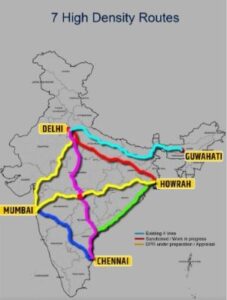
- Delhi–Howrah
- Howrah–Chennai
- Chennai–Mumbai
- Mumbai–Delhi
- Delhi–Chennai
- Mumbai–Howrah
- Delhi–Guwahati
With these routes already handling a disproportionate share of the country’s rail traffic, the capacity expansion is expected to provide Indian Railways with greater operational flexibility and room to accommodate future growth.
Four tracks to power passenger, freight growth
The four-laning initiative comes against the backdrop of rapidly rising demand for both passenger and freight transportation. Increasing line capacity on the busiest corridors can enable more trains to operate while easing pressure on existing infrastructure.
For Tamil Nadu, Chennai’s role as a major metropolitan, industrial and logistics hub makes enhanced rail connectivity particularly important. Faster and more reliable movement along the high-density network can strengthen links between the State and major manufacturing, consumption and trading centres in eastern, western and northern India.
The expansion is also part of a broader effort to create a railway system capable of supporting India’s long-term economic growth through increased capacity and more efficient movement of goods and people.
Rail expansion carries economic, environmental gains
Vaishnaw also highlighted the wider economic and environmental advantages of rail transportation.
Expanding rail capacity can help support the movement of larger volumes of freight and passengers while contributing to lower transportation costs. Greater reliance on rail can also promote cleaner mobility, particularly as the country seeks to build more sustainable transport infrastructure.
The high-density routes therefore represent more than a track-expansion exercise: they are emerging as strategic arteries for India’s passenger mobility, freight logistics and economic activity.
Tamil Nadu gains strategic connectivity edge
For Tamil Nadu, the inclusion of the Chennai-linked corridors in the high-density network gives the State a strategically important position in the next phase of railway capacity expansion.
Chennai’s rail links to Howrah, Mumbai and Delhi connect the State to three major geographical and economic axes. Strengthening these corridors could have a multiplier effect on industrial supply chains, freight movement and passenger connectivity.
The four-line network is consequently being positioned as a long-term capacity solution—one designed not merely to meet today’s demand but to keep pace with the country’s expanding economy and mobility requirements.
Steaming ahead towards a four-line railway network
The plan reflects the larger transformation underway across Indian Railways, with capacity creation becoming central to meeting the country’s growing mobility needs.
As the seven high-density corridors account for nearly half of total railway traffic while occupying only a fraction of the overall network, their expansion could significantly alter the capacity equation.
For Tamil Nadu, the message is particularly significant: Chennai is not merely on the railway map—it is being placed at the centre of a higher-capacity national rail grid connecting India’s principal economic corridors.