R ARIVANANTHAM
CHENNAI, AUG 19
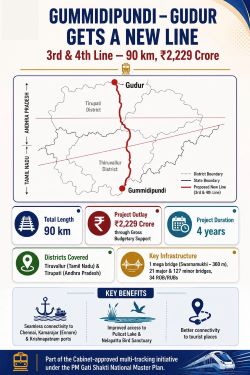
Tamil Nadu’s rail infrastructure is set for a significant capacity injection, with the Centre approving a ₹9,450-crore multitracking package that will add third and fourth lines on the crucial 90-km Gummidipundi–Gudur corridor, strengthening the State’s rail connectivity with Andhra Pradesh and creating greater headroom for passenger and freight movement.
The Cabinet Committee on Economic Affairs approved four major railway projects worth around ₹9,450 crore and the upgradation of NH-22 in Bihar to four-lane standards.
Union Minister Ashwini Vaishnaw said the highway will boost connectivity and development between the Nepal… pic.twitter.com/ReepEKcPY3
— PB-SHABD (@PBSHABD) August 19, 2026
The project, one of four approved by the Cabinet Committee on Economic Affairs, will particularly benefit the northern Tamil Nadu–southern Andhra Pradesh rail corridor, where additional capacity is expected to ease congestion, improve operational efficiency and enhance the reliability of train services.
- Gummidipundi–Gudur corridor to get third and fourth lines, easing congestion and strengthening Tamil Nadu–Andhra connectivity
- ₹9,450-crore Cabinet-approved rail package to add about 410 km to the national network across four States
- Project to unlock faster movement of passengers and freight, while improving reliability on a critical industrial corridor
- Expanded connectivity to strengthen access to Pulicat Lake, Nelapattu Bird Sanctuary and other tourism destinations
- PM Gati Shakti-backed projects expected to facilitate 76 MTPA additional freight traffic while cutting logistics costs and emissions
The four projects together will add approximately 410 km to the Indian Railways network across West Bengal, Odisha, Tamil Nadu and Andhra Pradesh, with an estimated total cost of ₹9,450 crore and completion targeted by 2030-31.
The Gummidipundi–Gudur project alone involves construction of third and fourth lines over 90 km, providing a substantial capacity augmentation on a strategically important route connecting the Chennai region with Andhra Pradesh.
Two more lines, more room for Tamil Nadu’s growth
For Tamil Nadu, the additional lines are significant not merely as an infrastructure expansion but as a potential mobility and logistics multiplier.
By separating and increasing capacity for passenger and freight operations, the project is expected to reduce bottlenecks and enable smoother train movement. Greater line capacity can also provide Railways with more flexibility to introduce or reschedule services without the constraints imposed by an already heavily utilised corridor.
The improved rail infrastructure could prove particularly valuable for industries and businesses dependent on reliable movement of raw materials and finished goods between Tamil Nadu and neighbouring Andhra Pradesh.
The Cabinet said the increased line capacity would “significantly enhance mobility, resulting in improved operational efficiency and service reliability for Indian Railways.”
The projects are expected to streamline operations and alleviate congestion while providing seamless connectivity for the movement of people, goods and services.
Gati Shakti blueprint for seamless connectivity
The four projects have been planned under the PM Gati Shakti National Master Plan, with an emphasis on integrated planning, multimodal connectivity and logistics efficiency.
The Government said stakeholder consultations and coordinated infrastructure planning would help create seamless connectivity between different modes of transport.
The projects will cover eight districts and improve connectivity for approximately 6,448 villages with a combined population of around 60 lakh.
For Tamil Nadu, the Gummidipundi–Gudur expansion adds another layer to the State’s growing logistics infrastructure, particularly as Chennai and its northern industrial belt continue to play a major role in manufacturing, automobile, port-linked trade and regional commerce.
Tourism gets a rail-connectivity lift
The capacity augmentation is also expected to strengthen access to a range of tourism and pilgrimage destinations along the wider corridors covered by the projects.
In the Tamil Nadu–Andhra region, improved rail connectivity will benefit access to destinations, including Pulicat Lake, Nelapattu Bird Sanctuary and the Lord Veeraraghava Perumal Temple, while the wider package will strengthen connectivity to several prominent tourism destinations in Odisha and West Bengal.
The Government said the improved rail network would help support the movement of tourists while simultaneously strengthening economic activity around destinations that depend on reliable public transport connectivity.
76 million tonnes of additional freight potential
The economic significance of the projects extends well beyond passenger mobility.
The routes are important for transportation of commodities including coal, iron ore, cement, iron and steel, containers, automobiles and foodgrains.
The capacity augmentation is expected to generate additional freight traffic of around 76 million tonnes per annum (MTPA).
For Tamil Nadu, the additional capacity on the Gummidipundi–Gudur route could strengthen the movement of industrial and commercial cargo along the Chennai–Andhra Pradesh axis, potentially helping industries reduce dependence on road transport for long-haul movement.
The Railways’ greater freight capacity also fits into the Government’s broader effort to shift more goods movement towards rail, which is generally more energy-efficient than road transport.
₹9,450 crore investment with an environmental dividend
The Centre has projected a substantial environmental and logistics dividend from the four projects.
As rail is an energy-efficient and comparatively environment-friendly mode of transportation, the capacity enhancement is expected to help reduce logistics costs, lower dependence on oil imports and contribute towards climate goals.
The projects are estimated to help reduce oil consumption by approximately 13 crore litres and cut carbon dioxide emissions by around 65 crore kg.
The Government equates the reduction in emissions to the environmental benefit of planting approximately 2.60 crore trees.
The Cabinet said the projects are aligned with Prime Minister Narendra Modi’s vision of a “New India”, with comprehensive regional development expected to enhance employment and self-employment opportunities and make people of the region “Atmanirbhar.”
For Tamil Nadu, the immediate takeaway is clear: the 90-km Gummidipundi–Gudur third-and-fourth-line project is more than an additional railway track—it is a capacity upgrade aimed at giving the northern gateway of the State greater room to move people, goods and economic activity.