

NE NEWS SERVICE
WASHINGTON, AUG 19
What if the financial assistance that helps an Indian student survive college in America today becomes a question mark when the family seeks a green card tomorrow? That is the uncomfortable question parents and students chasing the American Dream now need to confront—not with panic, but with preparation.
A significant change in US immigration policy is set to take effect on September 18, potentially subjecting thousands of Indians seeking permanent residence to a broader examination of their financial circumstances and certain public benefits.
- From scholarships to food and housing aid, a new US immigration test is forcing Indian families to rethink the cost of the American Dream
- USCIS to widen public-charge scrutiny from September 18 as financial self-sufficiency moves sharply up the immigration checklist
- Green-card hopefuls could face questions on age, health, family status, assets, finances, education and skills
- But receiving a covered benefit is not an automatic rejection: USCIS says every case will be judged on the totality of circumstances
- With 66,800 India-born immigrants securing green cards in FY2024, the policy shift carries particular significance for Indian families
- India already advises students to verify institutions, understand foreign laws and job prospects and stay connected with Indian missions
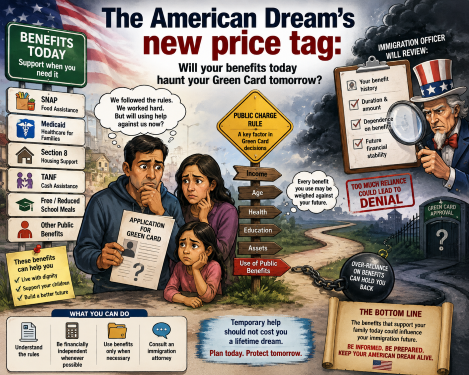
The US Citizenship and Immigration Services (USCIS) has issued new guidance after the Department of Homeland Security rescinded the 2022 Biden-era public-charge regulations. Under the new framework, immigration officers may consider a wider range of means-tested public benefits when determining whether an applicant is likely to become a “public charge.”
For Indian students and their parents, however, the headline should not be read as “use of any government assistance means no green card”. That would be misleading.
The real message is more nuanced—and potentially more important: financial dependence, the nature of benefits received and the applicant’s overall ability to support themselves can become part of a much wider immigration assessment.
September 18: the date parents must circle
The new rules will apply to Form I-485 applications for adjustment of status that are postmarked or electronically submitted on or after September 18.
Applications submitted between December 23, 2022 and September 17, 2026 will continue to be adjudicated under the 2022 regulations and associated guidance.
The change primarily concerns people seeking lawful permanent residence who are subject to the public-charge ground of inadmissibility. It does not apply to people who are already US citizens or existing green-card holders.
Family-sponsored immigrants—including many spouses, children and parents of US citizens and certain relatives of lawful permanent residents—can fall within the assessment. Several employment-based immigrant categories are also covered.
At the same time, Congress has exempted a range of humanitarian and special categories, including refugees, asylees, certain TPS applicants, qualifying victims of trafficking and certain criminal activity, and specified VAWA self-petitioners, among others.
What exactly will USCIS look at?
This is where the new regime becomes particularly relevant for families planning a long-term US journey.
USCIS officers are required to consider five statutory factors:
Age; health; family status; assets, resources and financial status; and education and skills.
The officer may also examine the sponsor’s Form I-864 Affidavit of Support, under which the sponsor commits financial resources to support the intending immigrant.
In other words, the immigration conversation is no longer simply about “Do you have an admission?” or “Do you have a job?”
For those covered by the public-charge rules, the larger question becomes:
Can this person reasonably support themselves without becoming primarily dependent on specified government assistance?
That distinction is crucial for Indian families investing enormous amounts in US education with the expectation that an American degree will eventually translate into employment, H-1B status and, ultimately, permanent residence.
Food, housing and assistance: read the fine print
Under the new framework, benefits that may be considered include certain means-tested public benefits, with the scope expanding for benefits received on or after September 18.
Housing assistance and food assistance are among the categories that can come under scrutiny.
But parents should resist the temptation to interpret this as a blanket ban on receiving public help.
USCIS specifically lists benefits and services that it will not consider under the new rule. These include school lunch programmes, attendance at public school, certain community or non-profit assistance such as soup kitchens, crisis counselling and short-term shelter, certain transportation services and other benefits not specifically enumerated in the rule.
That means families must examine the exact nature of a benefit, who receives it, when it was received and whether it falls within the categories covered by the regulation.
One benefit does NOT automatically mean one rejection
Perhaps the most important reassurance in the new guidance is that receipt of a covered benefit does not automatically result in denial.
USCIS says officers must consider all relevant evidence and make an individual determination based on the “totality of the circumstances.”
No single factor—except the absence of a sufficient affidavit of support when one is required—can by itself establish that an applicant is likely to become a public charge.
That makes financial planning all the more important.
A student or prospective immigrant should therefore maintain clear records of scholarships, fellowships, assistantships, employment income, bank funds, family support, tax records and other legitimate financial resources, while seeking professional immigration advice before making decisions that could affect a future adjustment-of-status application.
The ₹-crore American education gamble needs a new risk checklist
For Indian parents, the development should trigger a much broader conversation before writing the next tuition cheque.
The American Dream has traditionally been sold as a pathway:
Indian school → US university → US job → H-1B → Green Card → permanent settlement.
But that pathway has never been automatic—and the immigration environment is becoming more complex.
Parents should therefore ask questions beyond university rankings and starting salaries:
- Is the institution accredited and recognised?
- What is the realistic total cost—not merely tuition?
- What are the post-study employment prospects in the chosen field?
- What happens if the student does not secure a job immediately?
- What immigration category is realistically available after graduation?
- Could the family’s future green-card strategy be affected by dependence on particular public benefits?
- What documentation should be preserved from day one?
These are no longer peripheral questions. They are part of the financial and immigration due diligence behind an American education.
India’s own warning: research before you fly
Interestingly, the Government of India has already been advising prospective students to approach overseas education as a matter requiring careful due diligence.
The Ministry of External Affairs advises Indian students going abroad to check that the foreign university or college is accredited and recognised, understand the relevant laws, living conditions and subsequent employment prospects, obtain the appropriate visa and register with the Indian mission/consulate where applicable.
Its specific advisory for Indian students heading to the US also urges them to conduct thorough research before applying to relatively unknown institutions, consult friends, relatives and Indian student associations already in America and read contractual obligations carefully before making payments.
The MEA has also recorded that Indian Missions have issued student guidelines and advisories aimed at safeguarding Indian students and helping them understand the realities of studying abroad.
The message from New Delhi is therefore increasingly clear: an overseas education decision must be based on verified information, not brochures, agents or social-media promises.
66,800 Indian green cards: why this matters here
The stakes for India are enormous.
According to US Department of Homeland Security data cited in the original report, around 66,800 India-born immigrants obtained US green cards in fiscal 2024, representing about 4.9% of the 1.36 million people granted lawful permanent residence that year.
Around 61% of the Indian recipients obtained permanent residence through adjustment of status while already living in the United States.
That last figure is particularly significant for the Indian student community because adjustment of status can become the bridge between temporary US residence and permanent settlement.
And it is precisely at that bridge that the new public-charge scrutiny can become relevant for applicants who fall within its scope.
The American Dream is still alive—but it needs a balance sheet
There is no reason for Indian parents to abandon the US as an education or career destination solely because of this rule.
There is, however, every reason to stop treating the American Dream as a guaranteed investment.
A US degree can still open extraordinary academic and professional opportunities. But the journey now demands something equally important alongside ambition: immigration literacy.
The new public-charge framework should therefore be viewed as a wake-up call for students, parents, education consultants and financial planners alike.
Before the suitcase is packed, the tuition is paid and the flight is booked, families need to know not only “Which university can my child get into?”
They also need to ask: “Can my child afford the entire American journey—and what happens if the journey to the Green Card takes a different turn?”
That may be the most important question behind the American Dream in 2026.