
R ARIVANANTHAM
CHENNAI, JAN 5
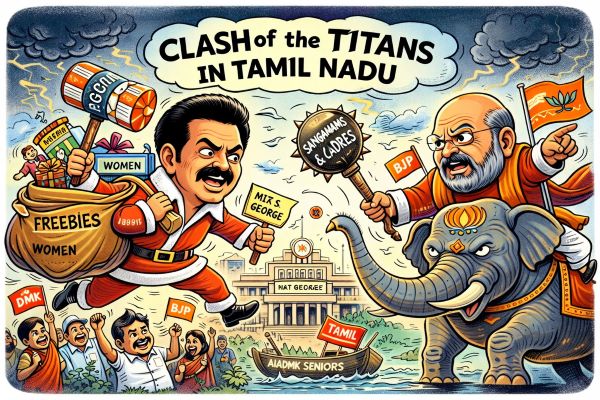
Tamil Nadu’s political chessboard is witnessing an early and intense endgame, with Chief Minister M K Stalin and Union Home Minister Amit Shah emerging as the principal architects of two sharply divergent strategies aimed at capturing Fort St George in the forthcoming Assembly elections.
- As Stalin Turns Santa for All, Amit Shah Bets Big on Cadres, Culture and Centre’s Outreach
- Tamil Identity, Federal Politics and the Battle for Fort St George
- From Sangamams to Succession Wars, 2026 Polls Begin Early
On one side stands Stalin, playing the role of a benevolent provider, rolling out a calibrated mix of welfare expansion, women-centric schemes and inclusive governance—earning him the sobriquet of a political Santa who leaves no constituency untouched. On the other is Shah, riding high on an energised cadre base, deploying cultural diplomacy, organisational muscle and symbolic gestures from the Centre to prise open Tamil Nadu’s long-resistant political fortress.
Stalin’s Welfare Shield and the Politics of Delivery
Stalin’s approach is rooted firmly in governance optics and outcome-based politics. The ruling dispensation has sharpened its focus on women, youth and marginalised groups, ensuring that cash transfers, free travel, education support, healthcare initiatives and urban infrastructure projects are not merely announced but visibly delivered.
Also Read;
Stalin’s grand Pongal playbook: Women, welfare and work power DMK’s majority push
By widening the welfare umbrella while maintaining a steady reformist pitch in industry, health and education, Stalin has sought to consolidate a broad social coalition. The messaging is unmistakable: stability, dignity and continuity versus disruption and uncertainty.
Political observers note that the ruling front’s confidence stems from its ability to frame the election as a referendum on governance rather than ideology.
Shah’s Cultural Offensive and the Sangamam Strategy
Amit Shah’s Tamil Nadu playbook, however, operates on a different frequency. Recognising that ideological confrontation alone yields limited dividends, the BJP has recalibrated its approach through cultural outreach and symbolic inclusivity.
The Kashi Tamil Sangamam 4.0 and the inaugural Saurashtra Tamil Sangamam 1.0 are not mere cultural festivals but strategic overtures aimed at reconnecting Tamil identity with a broader civilisational narrative. By foregrounding historical linkages, language pride and shared heritage, the BJP is attempting to soften resistance and reframe its image in the southern state.
The Centre’s endorsement of a Tamil leader as Vice President is being read as another calculated signal—an assertion that Tamil Nadu’s aspirations can find space at the national high table.
Cadres, Confidence and Shah’s Ground Game
Unlike earlier electoral cycles, the BJP’s cadre morale in Tamil Nadu is visibly high. Organisational expansion, booth-level consolidation and alliance recalibration have injected fresh momentum into the party’s state unit.
Shah’s strength lies in turning political marginality into long-term persistence. The party may still trail in numbers, but its confidence in steadily widening its footprint—urban pockets, aspirational youth and sections of the middle class—has altered the tone of the contest.
The EPS Factor and a Fractured Opposition Space
Complicating the landscape is the evolving role of Edappadi K Palaniswami. With senior leaders exiting what critics describe as a sinking ship, EPS finds himself both strengthened and constrained—commanding authority within his camp but facing questions over alliance arithmetic and voter transferability.
His choices—whether to align, confront or remain strategically ambiguous—could tilt the balance in closely contested regions, particularly where anti-incumbency sentiment intersects with alliance fatigue.
Fort St George: The Ultimate Prize
At its core, the battle is about Fort St George—symbolic of power, prestige and permanence. Stalin is betting that welfare, governance and Tamil pride anchored in federal autonomy will hold firm. Shah is wagering that sustained engagement, cultural bridges and cadre resilience can finally breach the Dravidian stronghold.
As the campaign gathers momentum, Tamil Nadu is set for a high-decibel contest where generosity meets organisation, delivery clashes with symbolism, and two towering strategists test the limits of their political imagination.
The clash of titans has begun—long before the first vote is cast.