- 80-tank annual capacity: New facility at Vehicle Factory, Jabalpur will overhaul T-72 and T-90 tanks for the Indian Army
- Closing the readiness gap: Army needs 230 tanks overhauled annually, against the existing capacity of 150 at Heavy Vehicles Factory, Avadi
- From repair to modernisation: Project will equip India’s armoured fleet for a battlefield increasingly shaped by drones, AI, precision weapons and electronic warfare
- MSMEs get a battlefield role: Local sourcing of mechanical, electrical, electronic and hydraulic systems to deepen resilient domestic supply chains
- Jabalpur emerges as defence hub: Project expected to generate employment while strengthening Madhya Pradesh’s defence and aerospace manufacturing ambitions
NE DEFENCE BUREAU
JABALPUR, AUG 27
India is preparing its armoured forces not merely for the next battle, but for the next generation of warfare. A ₹472-crore tank overhaul project at Vehicle Factory, Jabalpur, is set to add 80 tanks a year to the Army’s maintenance pipeline, strengthening operational readiness while creating a domestic ecosystem of manufacturers, MSMEs, skilled workers and technology providers around India’s T-72 and T-90 fleets.
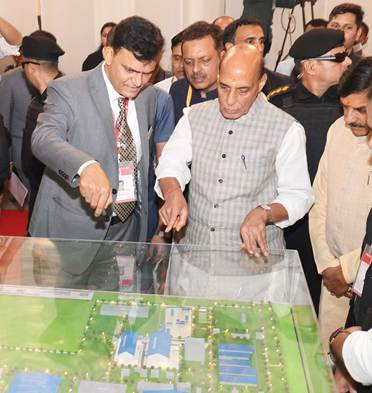
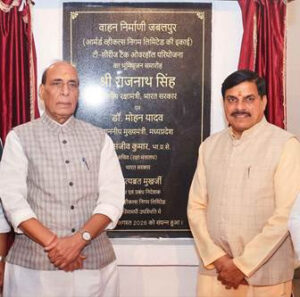
Defence Minister Rajnath Singh and Madhya Pradesh Chief Minister Dr Mohan Yadav on Thursday performed the Bhoomi Pujan for the T-Series Tanks Overhaul Project at Vehicle Factory, Jabalpur, a unit of Mini Ratna Defence Public Sector Undertaking Armoured Vehicles Nigam Limited (AVNL).
The project envisages dedicated facilities for overhauling T-72 and T-90 tanks at an estimated cost of ₹472 crore, marking another significant step in India’s drive towards self-reliance in defence production, maintenance and modernisation.
80 more tanks a year — and a major readiness boost
The new facilities are designed to overhaul 80 tanks annually, ensuring faster availability of refurbished and modernised tanks to the Indian Army.
The capacity addition addresses a critical requirement: the Army needs around 230 tanks to be overhauled every year, while Heavy Vehicles Factory, Avadi, currently has the capacity to overhaul 150 tanks annually.
The Jabalpur facility will therefore help bridge the existing capacity gap and reduce dependence on external sources for critical maintenance requirements.
The project also builds upon AVNL’s long experience in maintaining and overhauling T-72 and T-90 variant tanks. Heavy Vehicles Factory, Avadi, has supplied around 4,400 tanks to the Indian Army over the past four decades, underlining the strategic importance of India’s indigenous armoured-vehicle manufacturing and maintenance ecosystem.
Rajnath Singh said the project reflects India’s growing technological and industrial capabilities and expressed confidence that it would contribute to the country’s emergence as a leading global defence manufacturing and export hub.
The tank is evolving — not disappearing
The project comes at a time when the character of warfare is changing rapidly.
Drones, precision-guided weapons, missiles, satellites, artificial intelligence and cyber warfare are redefining the battlefield. Yet, Defence Minister stressed, the changing nature of warfare does not diminish the relevance of tanks; instead, it demands that armoured platforms evolve and operate as part of a larger integrated combat architecture.
“Modern warfare demands combined capabilities rather than dependence on a single platform. Tanks, infantry, artillery, drones, air power, surveillance, and precision weapons together form an integrated combat system, a concept demonstrated by the Indian Army through its ‘Integrated Battle Group’. There is a need to equip our tanks with superior sensors and capabilities aligned with modern battlefield requirements. Our focus is to provide the soldiers with drones, missiles, artillery, electronic warfare capabilities, energy weapons & modernised tanks, and ensuring seamless coordination among them. This overhaul facility will advance this vision,” Rajnath Singh said.
His message was clear: the future of the tank lies not simply in armour and firepower, but in its ability to connect with sensors, drones, electronic warfare systems, precision weapons and other battlefield assets.
From overhaul facility to industrial multiplier
The Jabalpur project is also expected to have an impact well beyond the factory gates.
Overhauling T-Series tanks will generate demand for a wide range of mechanical, electrical, electronic and hydraulic components, assemblies and subsystems, opening new opportunities for domestic manufacturers and MSMEs.
The resulting procurement ecosystem can strengthen local supply chains, encourage ancillary manufacturing and create a broader industrial base capable of supporting India’s armoured forces during both peacetime maintenance and prolonged military contingencies.
Rajnath Singh said the project would be a boon for soldiers while generating employment opportunities for people in Jabalpur and surrounding areas, including farmers, workers, youth and small entrepreneurs.
That makes the project more than a defence infrastructure investment: it has the potential to become an employment, technology and industrial-development engine for the region.
Resilient supply chains are now a strategic weapon
Defence Minister linked the project to a larger strategic lesson emerging from contemporary conflicts: military strength increasingly depends on the ability of a nation to sustain production, repairs, upgrades and supplies over long periods.
“Nations with advanced technologies, resilient supply chains, robust industrial capacity, and dynamic innovation capabilities will be better equipped to withstand prolonged conflicts,” he said.
Against this backdrop, the Government is seeking to ensure that India’s armed forces are not dependent on foreign supply chains for critical requirements.
“Our aim is to manufacture defence equipment domestically, undertake repair and maintenance within the country, upgrade existing systems with modern technologies, and develop next-generation capabilities indigenously,” Rajnath Singh said.
The emphasis on indigenous maintenance is particularly significant for large armoured fleets, where availability and turnaround time can directly influence operational preparedness.
Atmanirbhar Bharat gathers industrial momentum
Rajnath Singh said sustained efforts under Atmanirbhar Bharat have transformed India’s defence sector and changed the global perception of the country as a defence manufacturer.
Defence production rose to around ₹1.80 lakh crore in FY2025-26, compared with ₹46,000 crore in 2014, while defence exports reached an all-time high of approximately ₹39,000 crore, from less than ₹1,000 crore earlier.
He described these developments as evidence of India’s emergence as a global manufacturing hub, reliable technology partner and trusted defence partner.
The Jabalpur project fits into this larger transformation by focusing on an often-overlooked pillar of military self-reliance: the ability to maintain, repair, upgrade and modernise platforms already in service.

Madhya Pradesh targets a bigger defence-industrial footprint
Rajnath Singh also highlighted Madhya Pradesh’s efforts to attract investment in industry and defence manufacturing.
He pointed to the 3,073 hectares of land in the Gwalior-Chambal region earmarked for defence manufacturing prospects and proposed investments exceeding ₹16,960 crore, describing the initiatives as part of the state’s ambition to emerge as a major defence and aerospace manufacturing hub.
“Global Investors Summit 2025, the transparent and seamless approval system via ‘Invest MP 3.0’, and industry-friendly policies are establishing the state as an attractive hub for investment. The prospects for defence manufacturing on 3,073 hectares of land in the Gwalior-Chambal region and proposed investments exceeding Rs 16,960 crore reflect the state’s vision. This effort is laying a strong foundation to make Madhya Pradesh India’s next major Defence & Aerospace Manufacturing Hub,” he said.
Chief Minister Dr Mohan Yadav welcomed the investment in Jabalpur, saying it would strengthen the state’s defence ecosystem and encourage greater participation by MSMEs.
He also credited the leadership of Prime Minister Narendra Modi for India’s growing stature globally and said the country was prepared to meet emerging challenges.
With the Bhoomi Pujan, Jabalpur is poised to add a new strategic capability to India’s defence manufacturing landscape — turning tank overhaul from a maintenance function into a force multiplier for operational readiness, indigenous technology, resilient supply chains and regional employment.