- Reliance Foundation and C-DAC join forces to train one million ‘Cyber Sakhis’ across India
- Backed by MeitY’s ISEA programme, initiative blends policy, tech expertise and grassroots reach
- Focus on last-mile digital safety as rural women rapidly adopt online services and transactions
- Phased rollout begins in Madhya Pradesh and Odisha, scaling nationally by 2029
NE WOMEN EMPOWERMENT BUREAU
NEW DELHI, APR 14
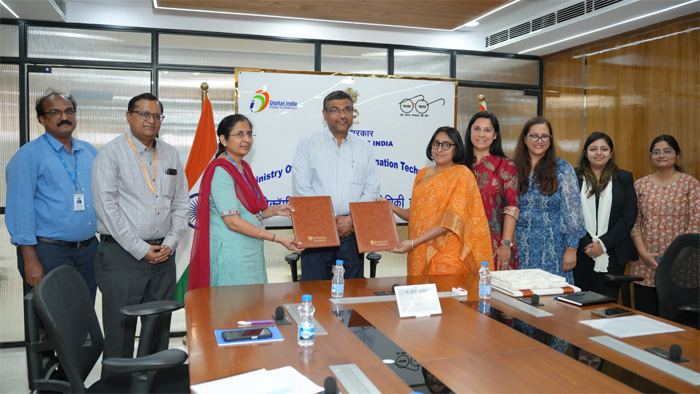
In a decisive push to make India’s digital revolution safer and more inclusive for women, Reliance Foundation and Centre for Development of Advanced Computing, under the Ministry of Electronics and Information Technology, have launched e-SafeHER—an ambitious cyber security awareness training programme aimed at empowering one million women across rural India.
Anchored in MeitY’s Information Security Education and Awareness (ISEA) programme, the initiative seeks to build a gender-responsive, community-led model of digital safety—equipping women not just to access the internet, but to navigate it securely and confidently.
At a time when rural women are increasingly engaging with digital platforms for financial transactions, livelihoods, and essential services, e-SafeHER aims to strengthen last-mile cyber awareness through structured training and peer-led community interventions. The programme will create a robust network of ‘Cyber Sakhis’—local champions of digital safety—who will drive awareness within their communities.
Speaking on the launch, S Krishnan, Secretary, MeitY, said, “In an era where the Government of India is pushing for capacity, collaboration and resilience to ensure that we reach across the length and breadth of the country towards a Cyber Secure Bharat, e-SafeHER is an exciting opportunity where we will bring together the curriculum and knowledge of the MeitY’s Information Security Education and Awareness (ISEA) programme. Through C-DAC working together with Reliance Foundation, this initiative will enable women from the remotest rural regions to be safe, seen and empowered. We look forward to a model initiative that can be replicated and scaled up with like-minded partners across the country.”
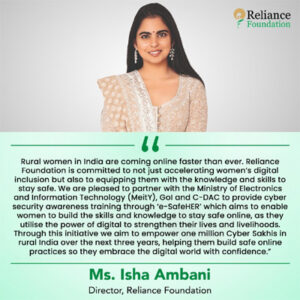
Highlighting the foundation’s commitment to inclusive growth, Isha Ambani, Director, Reliance Foundation, said, “Rural women in India are coming online faster than ever. Reliance Foundation is committed to not just accelerating women’s digital inclusion but also to equipping them with the knowledge and skills to stay safe. We are pleased to partner with the Ministry of Electronics and Information Technology (MeitY), GoI and C-DAC to provide cyber security awareness training through ‘e-SafeHER’ which aims to enable women to build the skills and knowledge to stay safe online, as they utilise the power of digital to strengthen their lives and livelihoods. Through this initiative we aim to empower one million Cyber Sakhis in rural India over the next three years, helping them build safe online practices so they embrace the digital world with confidence.”
Under the collaboration, C-DAC will spearhead the development, localisation, and continuous upgrading of cybersecurity training content—including multilingual modules—while Reliance Foundation will drive on-ground implementation through its extensive grassroots network, particularly via women’s Self-Help Groups (SHGs).
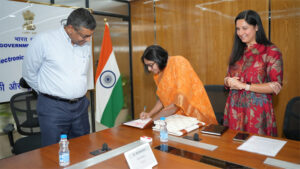
The rollout will begin with targeted training in Madhya Pradesh and Odisha, before expanding nationwide through a phased, multi-stakeholder approach. Designed for scalability and sustainability, the programme integrates cybersecurity awareness into existing digital literacy and women empowerment initiatives, avoiding the need for parallel infrastructure.
With its blend of audio-visual modules, localised content, and community-based learning, e-SafeHER aims to deliver measurable behavioural outcomes—from improved awareness of cyber risks to increased confidence in digital transactions and the adoption of safe online practices.
By converging MeitY’s national cybersecurity vision, C-DAC’s technological expertise, and Reliance Foundation’s community outreach, the initiative is poised to create a powerful safety net—ensuring that India’s women are not only digitally included, but digitally secure.