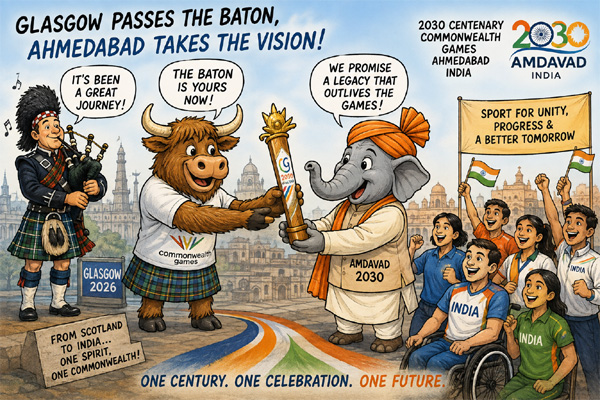
- Commonwealth Games flag and host baton move to Ahmedabad as India prepares to stage the 2030 centenary edition
- Historic handover at Glasgow closing ceremony puts Gujarat at the centre of India’s global sporting ambitions
- PM Modi: “We look forward to welcoming the world!” as India seeks to turn sporting momentum into a lasting legacy
- Bhupendra Patel eyes Ahmedabad as “Sporting Capital of India”; Harsh Sanghavi says 2030 will mark a century of sporting excellence and shared values
- Mandaviya calls Ahmedabad 2030 a celebration of India’s growth story and sport as a vehicle for national development
- Gujarat’s sports administration, AMC and sporting bodies now face the bigger test—building infrastructure, talent and an urban legacy that outlives the Games
NE SPORTS BUREAU
GANDHINAGAR/GLASGOW, AUG 2
The baton is changing hands tonight—but for Ahmedabad, the real race begins the moment the applause fades. As Glasgow closes the 2026 Commonwealth Games, the Commonwealth Games flag and host baton will formally move to Ahmedabad, opening the countdown to the 2030 Centenary Commonwealth Games and placing Gujarat before the world as India’s next major sporting stage.
The handover at the closing ceremony inside Glasgow’s OVO Hydro is more than sporting protocol. It marks India’s return as Commonwealth Games host after 20 years and gives Ahmedabad the responsibility of staging the 100th anniversary edition of a sporting movement that began in Hamilton, Canada, in 1930.
It is also a test of whether a mega sporting event can become something larger than a fortnight of competition—a catalyst for athletes, infrastructure, urban mobility, tourism, investment and a deeper sporting culture.
Modi: ‘We look forward to welcoming the world’
Prime Minister Narendra Modi, after Ahmedabad secured the hosting rights, called it a collective achievement of India’s sporting ecosystem.
“Delighted that India has won the bid to host the Centenary Commonwealth Games 2030!” Modi said, congratulating the people of India and the sporting ecosystem.
He underlined that “our collective commitment and spirit of sportsmanship” had placed India “firmly on the global sporting map”.
“With the ethos of Vasudhaiva Kutumbakam, we are eager to be celebrating these historic games with great enthusiasm,” Modi said, adding: “We look forward to welcoming the world!”
That welcome will now have to be translated into venues that work, transport that moves efficiently, athletes who are supported and a city that remains better equipped after the Games leave.
Patel’s sporting capital vision
For Gujarat Chief Minister Bhupendra Patel, the award of the Games has been positioned as a transformational opportunity for Ahmedabad.
When Ahmedabad was recommended as host city, Patel described it as “a proud moment for Gujarat and India” and a “historic milestone” towards the vision of making Ahmedabad the “Sporting Capital of India”. He also credited Modi’s leadership and commitment to India’s global sporting ambitions.
Patel has subsequently made the urban legacy of the Games a central part of the State’s preparation, telling The Indian Express that improving air quality and public transport, alongside international-standard sports facilities, would be among Gujarat’s priorities.
His larger message is significant: the infrastructure created for 2030 must improve everyday urban life long after the Games are over.
Sanghavi: A century of sporting excellence
Gujarat Deputy Chief Minister and Sports Minister Harsh Sanghavi, who is leading the State’s preparations in Glasgow, has repeatedly stressed the broader significance of the centenary edition.
Presenting India’s formal proposal earlier, Sanghavi said: “The 2030 Commonwealth Games hold significance for both India and the Commonwealth as it will mark a century of sporting excellence, unity, and shared values within the Commonwealth, making the centenary edition a landmark celebration.”
Sanghavi has also described the hosting opportunity as a major moment for Gujarat and credited Modi’s leadership for India’s changing sporting landscape.
At Glasgow, the Deputy Chief Minister has been assessing how the host city manages venues, transport, spectator services and event operations, while the Amdavad Experience Centre has provided an international platform to showcase Gujarat’s identity.
The exercise is as much about learning as it is about showcasing.
Mandaviya: Sport as a vehicle for national development
Union Minister for Youth Affairs and Sports Dr Mansukh Mandaviya has framed the Games in terms extending beyond medals and ceremonies.
“The Commonwealth Games 2030 in Amdavad will be a celebration of India’s growth story and its commitment to sport as a vehicle for national development,” Mandaviya said.
Earlier, after Ahmedabad was recommended as host, Mandaviya called it “a huge moment for Indian sports” and a “proud milestone for our nation”, saying the decision reflected India’s growing stature in global sport.
PIB has also highlighted the importance of timely planning, inter-agency coordination and athlete-centric preparation, with the Union Sports Ministry, Gujarat Government, Indian Olympic Association and Sports Authority of India working together on the preparations.
The sports administration’s bigger test
Gujarat’s Principal Secretary, Sports, Youth & Cultural Activities Department, Ashwini Kumar, has offered perhaps the clearest explanation of why Ahmedabad emerged as the host.
“Somebody has to take the lead. Ahmedabad already had the world’s biggest cricket stadium. There is an ecosystem,” Kumar said, pointing to the city’s experience in hosting major cricket matches, the IPL, international events and large-scale public gatherings.
“The vision that has been given by our political leaders is to make the city the sports capital of the country,” he said.
The administration’s challenge now is to convert that ecosystem into a multi-sport ecosystem—one capable of supporting athletes in disciplines that do not routinely command the commercial spotlight.
Gujarat has already been building facilities and preparing a wider sporting network, while the Sports Authority of Gujarat, Gujarat Sports Infrastructure Development Board, Indian Olympic Association and other partners are part of the delivery architecture.
The 2030 Games will therefore be judged not simply by the opening ceremony or medal table, but by whether the facilities become productive sporting assets for the next generation.
AMC’s city-legacy test
For the Ahmedabad Municipal Corporation, the Games are inseparable from the transformation of the city itself.
AMC Commissioner Banchhanidhi Pani has said: “Ahmedabad’s preparation for the Commonwealth Games 2030 is anchored in long-term urban transformation.”
“Our focus extends beyond sporting excellence to integrated infrastructure, sustainable mobility, civic modernisation and global partnerships,” Pani said.
He added that the city was being positioned “not just as a host city, but as a globally competitive urban centre prepared to deliver enduring economic and social legacy.”
That is arguably the most important promise surrounding Ahmedabad 2030.
A Games that produces stadiums but leaves traffic, air quality, public transport and everyday urban infrastructure untouched would deliver only a sporting spectacle.
A Games that leaves behind better mobility, greener public spaces, accessible sports facilities, stronger local businesses and a deeper culture of participation could change Ahmedabad permanently.
Glasgow hands over more than a flag
The Glasgow closing ceremony will feature a specially curated Indian handover segment designed to offer the world its first taste of Amdavad 2030.
The programme will comprise three broad acts—celebrating the 150th anniversary of Vande Mataram, a classical Indian-Scottish musical jugalbandi featuring sitarist Rishabh Rikhiram Sharma and Scottish piper Ross Ainsley, and a cultural journey across India with Gujarat at its heart.
Glasgow 2026 Chief Marketing and Ceremonies Officer Louisa Mahon summed up the significance of the transition: “This handover is not a formality. This event will express the spirit of two nations on the same stage.”
Ceremony Director Chanda Singh said the programme was designed to present an India that is “confident while remaining rooted in its traditions.”
The message will be watched by a global audience—and Ahmedabad will get its first opportunity to answer the question that matters most: what kind of centenary Games does India intend to deliver?
The baton is passed. Now comes the legacy.
The 2030 Commonwealth Games are already being viewed as part of India’s wider sporting ambitions, including its aspiration to host the 2036 Olympic Games.
But the Olympic conversation should not overshadow the immediate task.
The next four years must be about athlete development, grassroots participation, high-performance training, coaching, sports science, accessible infrastructure, sustainable mobility and efficient Games management.
The Commonwealth Games flag may change hands in Glasgow tonight.
But the real baton is being passed to a generation of Indian athletes and administrators who must ensure that Ahmedabad 2030 is remembered not merely for what India hosted, but for what Indian sport became because it hosted it.