NE BUSINESS BUREAU
MUMBAI, AUG 27
The next big logistics revolution may not be on the highway — it could be riding the coastline. At Paradip, AM/NS India is strengthening that maritime proposition with a 30-year concession that seeks to create a seamless industrial corridor from its pellet plant to the port and onward by sea to Hazira.
Paradip Port Authority (PPA) has formally granted Award of Concession to AMNS Paradip Logistics Private Limited (APLPL), a special purpose vehicle of AM/NS India, for the mechanisation of CQ-III berth for captive handling of dry-bulk cargo with a capacity of 10 million tonnes per annum (MTPA).
- Paradip gets a major logistics boost: Paradip Port Authority grants AM/NS India’s SPV a 30-year concession to mechanise CQ-III berth for captive dry-bulk cargo handling
- 10 MTPA cargo pipeline: Fully mechanised conveyor connectivity will move iron-ore pellets directly from AM/NS India’s pellet plant complex to the berth
- From road to sea, with sustainability in focus: Coastal movement of pellets from Paradip to Hazira strengthens a more fuel-efficient and environment-conscious supply chain
- Port infrastructure meets industrial ambition: The concession is set to enhance operational efficiency, supply-chain resilience and Paradip’s emergence as a global maritime gateway
The concession, awarded for 30 years, is more than a port-infrastructure agreement. It represents an important step in AM/NS India’s strategy to integrate manufacturing, port handling and coastal shipping into a single logistics chain, while supporting the Government of India’s push for more fuel-efficient, economical and environmentally sustainable coastal transportation.
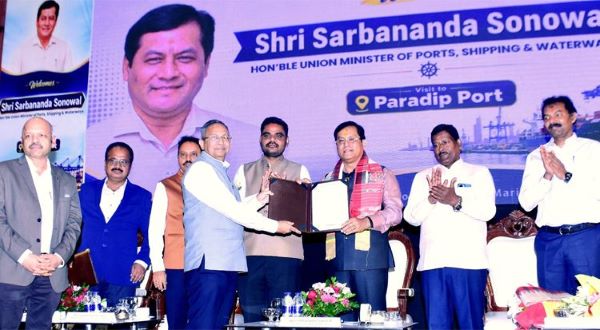
The Award of Concession was presented by Sarbananda Sonowal, Union Minister for Ports, Shipping and Waterways, to Deepak Arora, Chief – Corporate Affairs, AM/NS India, at a special function at Biju Convention, Paradeep, Odisha, on August 21.
A berth that could become the supply chain’s powerhouse
At the heart of the project is the mechanisation of CQ-III berth for captive dry-bulk cargo operations.
The arrangement will enable APLPL to handle iron-ore pellet shipments through a fully mechanised conveyor system directly linking AM/NS India’s pellet plant complex with the Paradip berth.
That direct connection could significantly streamline material movement by reducing intermediate handling and creating a more predictable flow between production and dispatch.
For a large industrial operation, such integration can mean more than speed. It can strengthen supply-chain reliability, operational efficiency and logistics resilience, particularly when cargo can move directly from the plant into a dedicated maritime transportation network.
Pellets take the green route to Hazira
The strategic significance becomes even clearer once the cargo leaves Paradip.
AM/NS India already uses coastal shipping to transport iron-ore pellets from Paradip to Hazira, making the sea route an established component of its logistics network.
The captive berth is expected to reinforce this model by creating a more integrated and mechanised movement system at the origin point.
Coastal shipping is increasingly being promoted as an alternative to more carbon-intensive land-based freight movement because moving large volumes by sea can offer greater fuel efficiency and potentially lower emissions per tonne-kilometre.
For AM/NS India, the Paradip–Hazira corridor therefore represents a combination of industrial logistics and sustainability strategy — moving bulk material at scale while strengthening the maritime component of its supply chain.
The project aligns with the Government’s broader policy objective of increasing the role of coastal shipping in India’s freight ecosystem.
30 years, 10 MTPA — a long-term industrial bet
The 30-year concession gives the project a long-term horizon.
For AM/NS India, the captive use of CQ-III is expected to support its growth plans while providing a dedicated link in its supply-chain pipeline. For Paradip, increased mechanisation and captive cargo handling could contribute to the port’s broader evolution into a modern maritime and industrial hub.
The project also underscores a shift in the way major manufacturing companies view ports.
A port is no longer simply the place where cargo arrives or leaves.
It can become an extension of the factory floor — integrated with production facilities, automated material handling, dedicated berths and coastal shipping networks.
That model can reduce friction between manufacturing and transportation while creating greater predictability in the movement of critical raw materials and finished industrial products.
Paradip’s maritime ambition gets an industrial push
The concession is being positioned as a significant milestone in AM/NS India’s effort to strengthen its logistics capabilities and modernise port operations.
It also reinforces the company’s stated focus on operational excellence, innovation and environmental sustainability.
For Paradip, the project adds another industrial dimension to the port’s growth story. Mechanised bulk handling, integrated conveyor connectivity and captive cargo movement can strengthen the port’s ability to serve large-scale industrial supply chains.
The larger opportunity is to create an ecosystem in which port infrastructure, manufacturing capacity and coastal shipping reinforce one another.
That could help Paradip deepen its role not merely as a cargo-handling facility but as an important gateway supporting India’s expanding industrial and maritime economy.
The Award of Concession ceremony was attended by Sampad Chandra Swain, Minister of State (Independent Charge), Department of Industries, Skill Development and Technical Education, Government of Odisha; Bibhu Prasad Tarai, MP, Jagatsinghpur; P. L. Haranadh, Chairman, Paradip Port Authority; T. Venu Gopal, Deputy Chairman, Paradip Port Authority; U.S.R. Raju, Head – Odisha Operations, AM/NS India; and senior PPA officials and corporate leaders from Paradeep.