R ARIVANANTHAM
CHENNAI, AUG 27
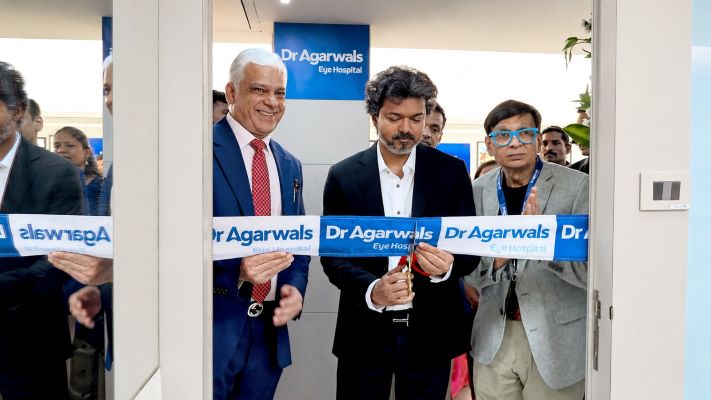
Can a hole barely a few millimetres wide change the way a damaged eye sees the world — and perhaps spare a patient from a corneal transplant? Chennai has placed that intriguing possibility at the centre of global ophthalmic innovation with the inauguration of the world’s first dedicated Pinhole Pupilloplasty (PPP) Centre at Dr Agarwals Eye Hospital, TTK Road, Alwarpet.
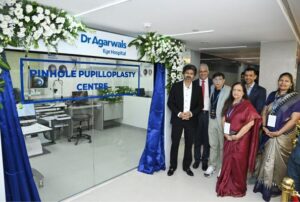
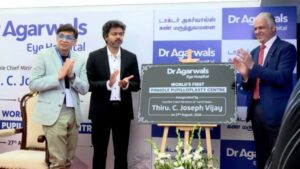
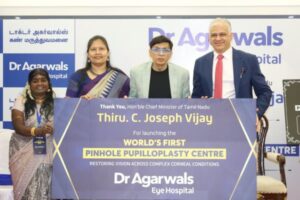
Tamil Nadu Chief Minister C. Joseph Vijay inaugurated the centre on Thursday in the presence of Prof Amar Agarwal and Dr Manoj Khatri, marking a significant milestone for an Indian-developed surgical technique that has already provided vision to more than 5,000 patients, according to the hospital.
- A global ophthalmic first: Chennai gets the world’s first dedicated Pinhole Pupilloplasty Centre, turning an Indian-developed microsurgical innovation into a structured clinical and training programme
- Vision without a donor cornea: The technique can help selected patients with corneal scars, irregular corneas and higher-order aberrations by creating a precisely sized pinhole pupil rather than replacing the cornea
- 5,000 patients, one pioneering idea: Developed by Prof Amar Agarwal, Pinhole Pupilloplasty has already been used to provide vision to more than 5,000 patients
- Science meets a global shortage: With millions awaiting corneal transplants worldwide, a tissue-sparing approach could offer an important alternative for carefully selected patients
- From Chennai to the world: The new centre will combine diagnostics, surgery, follow-up, research and ophthalmic training, aiming to take the innovation to a wider international community
The timing is particularly significant. The centre has been launched during the 41st National Eye Donation Fortnight, putting the spotlight on an unusual but potentially powerful question in modern eye care: when a damaged cornea cannot deliver clear vision, must the cornea always be replaced?
Pinhole Pupilloplasty offers another possibility for appropriately selected patients — change the eye’s optical pathway rather than replace its precious donor tissue.
The technique, developed by Prof Amar Agarwal and his collaborators, has also moved beyond an experimental concept into peer-reviewed ophthalmic research. A 2019 study described how the pinhole effect filters stray and distorted peripheral light while allowing more focused central and paracentral rays to reach the retina.
The science behind the ‘pinhole’
The idea is deceptively simple.
In selected eyes affected by corneal scars, irregular corneas or higher-order optical aberrations, light entering through the irregular portions of the cornea can become scattered and distorted, degrading the quality of vision.
Pinhole Pupilloplasty creates a small, precisely centred pupil, effectively restricting the amount of distorted light entering the eye.
Recent reporting on the Chennai centre said surgeons narrow the pupil to roughly 1-1.5 mm, compared with an ordinary pupil that can be around 5 mm. The smaller aperture acts somewhat like a pinhole camera, blocking more scattered peripheral rays and allowing relatively focused rays through to the retina.
The principle has been investigated scientifically for years. Research published in the Journal of Cataract & Refractive Surgery found that the technique can reduce the effect of higher-order corneal aberrations and improve visual acuity and image quality in appropriately selected patients.
A 2026 study involving patients with scarred corneas further evaluated PPP for higher-order aberrations and reported satisfactory visual outcomes, suggesting that the technique can be considered in selected eyes with central or paracentral corneal scars where some clear cornea remains.
A small aperture against a gigantic global problem
The significance of the Chennai centre becomes even clearer when viewed against the global shortage of donor corneas.
A major international survey has estimated that around 12.7 million people worldwide are awaiting corneal transplantation, while only one donor cornea is available for every 70 people in need. Around 185,000 corneal transplants are performed annually across 116 countries, highlighting the enormous gap between demand and available tissue.
For patients who are suitable candidates for PPP, the technique does not require donor corneal tissue.
That does not mean PPP replaces corneal transplantation for every patient. Rather, its significance lies in creating another option for a carefully selected group whose visual problems arise from optical distortion, scars or irregularity while sufficient functional corneal tissue remains.
This distinction is crucial — and it is precisely why the new centre is being designed as more than a surgical unit.
From surgery to a complete vision pathway
Prof Amar Agarwal, Chairman of Dr Agarwals Eye Hospital, said the dedicated centre would help take the innovation into a more structured phase.
“We are immensely thankful to the Chief Minister, C. Joseph Vijay, for inaugurating the PPP Centre. The inauguration of a dedicated Pinhole Pupilloplasty Centre is an important milestone because it will enhance the access and wide adaptation of this path-breaking surgical innovation, thus providing vision to many.”
He added: “The PPP Centre enables us to create a highly structured pathway, from detailed corneal diagnostics and optical assessment to surgery and long-term outcome monitoring. It will also become a platform for teaching ophthalmologists how to identify the right patient for the right procedure.”
That emphasis on “the right patient for the right procedure” is central to the technology’s future.
PPP is not a universal substitute for a transplant. Its value lies in precision — identifying patients whose visual disability can potentially be reduced by altering the eye’s optical aperture rather than replacing the cornea.
The Alwarpet centre will therefore bring together advanced diagnostics, patient selection, microsurgery, postoperative assessment, long-term follow-up, research and ophthalmic training under one programme.
From Chennai innovation to global ophthalmic classroom
The centre also seeks to address another challenge: knowledge.
The hospital says more than 50 ophthalmologists undergo training in the technique every year through workshops and academic programmes. The new centre is expected to give that training a permanent institutional platform.
Dr Manoj Khatri, Director, Vitreo-Retinal Services, Dr Agarwals Eye Hospital, said: “Innovation becomes truly meaningful when it moves from a scientific idea to a solution that changes a patient’s everyday life. We firmly believe that the Chief Minister’s presence here at the inauguration will further this cause, and take a remarkable innovation to benefit millions of patients worldwide.”
The educational dimension could prove as important as the surgical one. The more widely ophthalmologists understand the indications, limitations, optical principles and patient-selection criteria of PPP, the better positioned they will be to determine who may benefit from it.
Recent scientific work also shows that PPP remains an active area of research. A 2026 paper examined outcomes in patients with higher-order aberrations caused by scarred corneas, while another recent publication examined different grades of pinhole pupilloplasty.
A new chapter in tissue-preserving eye care
The inauguration also comes against the backdrop of Dr Agarwals Eye Hospital’s broader community eye-health initiatives in Tamil Nadu.
Earlier, in connection with the Chief Minister’s birthday, the hospital conducted a one-day eye-screening initiative covering more than 16,000 schoolchildren across Tamil Nadu, according to the hospital.
Together, these initiatives reflect two ends of the eye-care spectrum — early detection among children and advanced microsurgical innovation for complex visual disorders.
The new Pinhole Pupilloplasty Centre now adds a third dimension: building a specialised ecosystem around a technique born from Indian ophthalmic innovation.
For Chennai, it is a landmark clinical facility.
For ophthalmology, it is a reminder that some of the most transformative ideas do not necessarily require bigger implants, larger machines or more invasive procedures.
Sometimes, the breakthrough can begin by making the window smaller — and making the vision clearer.