- ITEC programme equips global professionals with geoinformatics and disaster-risk reduction tools to tackle climate and security challenges
- Delegates from Asia, Africa, the Middle East and South America converge in Gujarat for advanced capacity-building under India’s flagship international cooperation initiative
- Field visits, cutting-edge research and technology-driven training to strengthen global resilience, emergency preparedness and risk-informed governance
- RRU reinforces India’s role as a global knowledge partner in disaster management, national security and South-South cooperation
NE EDUCATION BUREAU
GANDHINAGAR, JULY 8
Can satellites, digital maps and geospatial intelligence save lives before disaster strikes? Rashtriya Raksha University (RRU) believes they can—and is bringing together experts from across four continents to demonstrate how technology is redefining disaster preparedness and national security.
In a significant step towards strengthening global resilience and international capacity-building, the Centre of Disaster Risk Reduction (CDRR) under the School of Internal Security and SMART Policing (SISSP) at Rashtriya Raksha University has launched a two-week International Training Programme on “Geoinformatics, Disaster Risk Reduction and National Security” under the prestigious Indian Technical and Economic Cooperation (ITEC) initiative of the Ministry of External Affairs, Government of India.
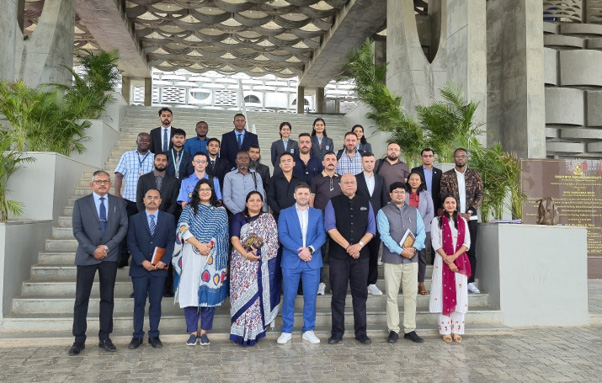
The programme, being conducted from July 6 to 17, has brought together an accomplished group of international delegates from 14 countries spanning Asia, Africa, the Middle East and South America. Participants represent Bangladesh, Bhutan, Cambodia, Ecuador, Ghana, Iraq, Lebanon, Liberia, Maldives, Mauritius, Mongolia, Sri Lanka, Syria and Tanzania, reflecting India’s expanding global leadership in disaster resilience, security cooperation and knowledge sharing.
Chairing the inaugural session, Prof. (Dr.) Kalpesh H. Wandra, Pro Vice-Chancellor of RRU, underlined the growing importance of technology-driven disaster management.
“It’s high time to take leverage from technologies like geoinformatics for disaster risk reduction,” he said.
The inaugural ceremony was attended by Lt. (Dr.) Ruchika Singla, Director, SISSP, Ravish Shah, Director, International Cooperation and Relations Branch (ICRB), while Dr. Subhajit Bandopadhyay, Programme Coordinator, proposed the vote of thanks.
Designed with a multidisciplinary perspective, the programme explores how geospatial technologies, disaster science, climate resilience and national security intersect in addressing increasingly complex global challenges. Participants will gain hands-on knowledge in applying geo-informatics for disaster preparedness and emergency response, understanding the linkages between climate risks and national security, developing risk-informed governance frameworks and adopting innovative technology-driven approaches to build resilient societies.
A major highlight of the programme is its experiential learning component. Delegates will undertake field visits to Gujarat’s premier disaster management institutions, including the Gujarat Institute of Disaster Management (GIDM), the Institute of Seismological Research (ISR) and the State Emergency Operation Centre (SEOC). They will also visit specialised laboratories and research facilities at Rashtriya Raksha University to witness India’s advances in disaster resilience, emergency preparedness and security technologies.
Unlike conventional disaster management courses, the programme treats disasters not merely as humanitarian emergencies but as strategic issues linked to governance, climate resilience and national security, offering participants a holistic understanding of emerging global risks.
The initiative also reflects India’s continued commitment to South-South Cooperation and the philosophy of “Vasudhaiva Kutumbakam – One Earth, One Family, One Future,” promoting international collaboration, knowledge exchange and best practices to address shared global challenges.
Through such international initiatives, Rashtriya Raksha University continues to strengthen its position as a leading institution in security studies, disaster risk reduction and geospatial research while contributing to the larger goal of creating safer, smarter and more resilient communities across the world.