

- Defence Minister underlines secure sea lanes, freedom of navigation and stronger maritime cooperation across the Indian Ocean
- Sri Lanka assures India its territory will never be used against New Delhi’s security interests
- MoUs cover L70 air-defence gun upgrades, National Cadet Corps exchanges and National Defence College cooperation
- Three Bailey Bridges built by Indian Defence Forces reinforce India’s first-responder and humanitarian role
- Delhi offers deeper cooperation in maritime domain awareness, counter-narcotics, anti-piracy and disaster response
- President Dissanayake and Prime Minister Amarasuriya reaffirm shared development, security and people-first partnership
NE DEFENCE BUREAU
COLOMBO, SEPT 9
India and Sri Lanka are moving from a relationship built on geography and history to one increasingly shaped by shared maritime security, strategic trust and collective resilience. Defence Minister Rajnath Singh’s high-level engagements in Colombo on Wednesday brought that transformation sharply into focus, with India and Sri Lanka combining defence cooperation, maritime security, capacity building and humanitarian assistance in a partnership designed to protect both people and the waters that connect them.
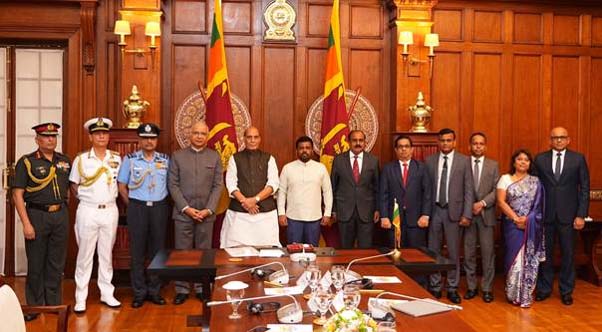
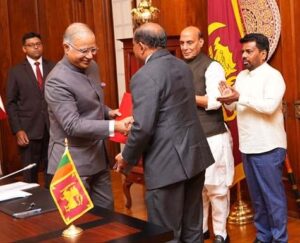
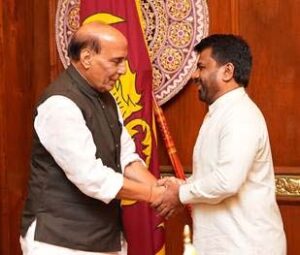
Singh called on Sri Lankan President Anura Kumara Dissanayake and Prime Minister Harini Amarasuriya, held extensive discussions with the Sri Lankan defence establishment and witnessed the exchange of two important MoUs. The agreements cover upgradation of six L70 air-defence guns for the Sri Lankan Air Force and cooperation between the National Cadet Corps (NCC) and the National Defence Colleges (NDCs) of India and Sri Lanka.
The visit also saw the virtual inauguration of three Bailey Bridges constructed by the Indian Defence Forces, underlining India’s role as a first responder and dependable partner in Sri Lanka’s times of crisis.
Maritime security moves to centre stage
Addressing senior Sri Lankan defence leadership, including Deputy Defence Minister Aruna Jayasekara and the commanders of the Army, Navy and Air Force, Singh placed the Indian Ocean firmly at the heart of the bilateral security relationship.
“Secure sea lanes, freedom of navigation, respect for international law and unhindered maritime trade are pivotal for collective security & prosperity of the Indian Ocean Region (IOR).”
He called for enhanced India-Sri Lanka cooperation to create a secure maritime environment and tackle emerging challenges before they threaten development and economic interests.
Singh emphasised that national security and economic growth cannot be viewed in isolation, particularly in a region where geography, maritime trade and strategic security are closely intertwined.
“India and Sri Lanka, as close maritime partners, are well positioned to jointly safeguard peace, security & stability across IOR.”
He said the two countries need to sharpen skills, share experience and develop joint protocols to confront emerging threats.
“We need to devise & implement joint protocols, sharpen the skills and share experiences to deal with emerging threats arising from the rapidly evolving global and regional dynamics.”
He linked this deeper maritime partnership to Prime Minister Narendra Modi’s MAHASAGAR — Mutual and Holistic Advancement for Security and Growth Across Regions vision.
Colombo gives India a strategic assurance
Singh’s meeting with President Dissanayake reinforced the political foundation of the security partnership.
The two sides reaffirmed their commitment to work together for development and the welfare of their people while jointly ensuring peace, security and prosperity in the region.
Dissanayake reiterated a particularly significant assurance:
“Sri Lanka would never allow its territory to be used for any activities inimical to India’s security interests.”
He also thanked India for relief assistance under Operation Sagar Bandhu following Cyclone Ditwah and for the comprehensive rehabilitation package extended by New Delhi.
Singh stressed that India’s assistance should not be viewed as charity.
“As a closest friend and neighbour of Sri Lanka, India considered it not a favour, but a responsibility to provide assistance as the first responder and would continue to do so in the future as well.”
L70 upgrade adds teeth to Sri Lanka’s air defence
The MoU covering the upgradation of six L70 guns for the Sri Lankan Air Force is backed by a Government of India grant.
The L70 air-defence guns had earlier been provided to Sri Lanka by India. Their upgradation is expected to strengthen the air-defence architecture protecting critical assets in the island nation.
The second set of agreements broadens the partnership beyond hardware.
Academic cooperation between the National Defence College of India and Sri Lanka will promote knowledge sharing and strengthen institutional and professional links between the two defence establishments.
The NCC cooperation agreement, meanwhile, will formalise the youth exchange programme, providing Sri Lankan and Indian cadets opportunities to interact, learn and participate in activities that deepen people-to-people bonds.
From Bailey Bridges to disaster diplomacy
The three Bailey Bridges virtually inaugurated by the two leaders add a powerful humanitarian dimension to the defence partnership.
India’s defence forces have increasingly demonstrated their ability to move rapidly from security operations to humanitarian assistance and disaster relief, and Sri Lanka has been a prominent beneficiary of this first-responder capability.
Singh’s message was clear: defence cooperation is not restricted to weapons, exercises or military preparedness—it can also mean restoring roads, reconnecting communities and rebuilding lives after disasters.
This approach was reinforced during discussions on the future of bilateral maritime cooperation.
A shared maritime shield against emerging threats
India and Sri Lanka have already expanded cooperation in search-and-rescue operations, counter-narcotics, anti-piracy and combating human trafficking.
Singh highlighted the growing relevance of the Colombo Security Conclave, whose areas of cooperation include maritime safety, counter-terrorism, cyber security and organised crime.
He cited the Maritime Rescue Coordination Centre, established through India-Sri Lanka collaboration, as an example of how the two countries can translate strategic partnership into operational capability.
Looking ahead, Singh proposed that India and Sri Lanka explore a mutually beneficial and integrated Maritime Domain Awareness system, enabling real-time sharing of maritime information among relevant agencies, navies and coast guards.
Such cooperation could help address illegal fishing, suspicious vessels, narcotics trafficking, smuggling, terrorism and other maritime threats.
Importantly, he also stressed that maritime cooperation must address the concerns of fishermen and expand into aquaculture, marine biotechnology, ocean science, environmental protection, maritime tourism and humanitarian assistance and disaster relief.
He suggested exploring a joint Maritime HADR system for coordinated and rapid responses to natural and man-made disasters.
“The tectonic shifts and rapid transformation underway present both challenges and opportunities. The two countries must leverage their longstanding maritime partnership to turn these opportunities into shared growth.”
Development and security sail together
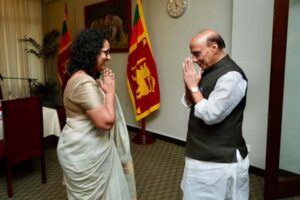
In his meeting with Prime Minister Harini Amarasuriya, development cooperation featured prominently, alongside education, information technology, infrastructure, innovation and research.
Singh emphasised that India and Sri Lanka, as sister democracies with shared heritage, should pursue a common developmental vision for regional peace, prosperity and people’s welfare.
He also highlighted capacity building as a major pillar of cooperation and described Amarasuriya as a symbol of women’s empowerment and Nari Shakti, encouraging greater participation of Sri Lankan women in ICCR scholarships and other Indian Government initiatives.
For India, the broader strategic message emerging from the visit is unmistakable: the security of the Indian Ocean and the prosperity of the region are inseparable.
Singh summed up India’s approach by describing the country as a true “Vishwa Mitra” and reiterating its commitment to playing a constructive and dependable role in its shared neighbourhood.
“Sri Lanka is a friendly neighbour, longstanding friend and reliable partner for India. Both nations are central to any strategic discourse on maritime security in the region.”
As India and Sri Lanka deepen their cooperation across defence, maritime security, disaster response, capacity building and development, the relationship is increasingly evolving into a partnership where shared waters are becoming shared responsibility—and shared security is becoming the foundation for shared prosperity.