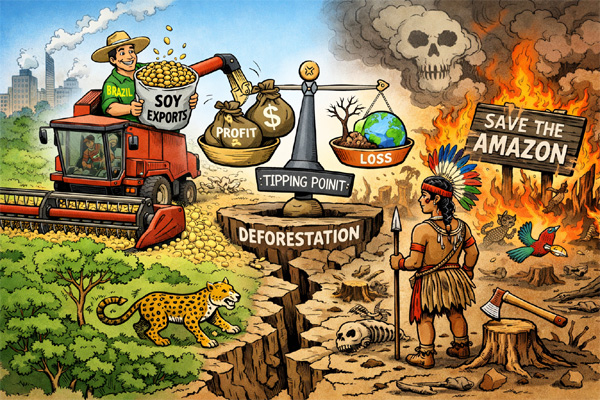
- Suspending the Amazon Soy Moratorium has reopened the fault line between profit and preservation
- Two decades of export-led success now collide with ecological limits and rising economic risks
- As fires surge and deforestation accelerates, Brazil edges closer to the Amazon tipping point
- Why sustainable agriculture—not endless expansion—may be Brazil’s last real advantage
DEEPAK PAREEK

The recently concluded United Nations Climate Change Conference (COP30) in Belém, deep in the Amazon basin, may have delivered limited progress on global climate commitments, but it succeeded in refocusing international attention on Brazil—its environmental promises and its actions on the ground. That spotlight had already intensified following the suspension of the Amazon Soy Moratorium (ASM), a landmark sectoral agreement that once stood as a global benchmark for zero-deforestation supply chains.
First implemented in 2006, the ASM committed major commodity traders to avoid sourcing soybeans from land deforested after 2008. The results were striking. Soy-linked deforestation fell from nearly 30% in the pre-moratorium years to just 1% by 2013, demonstrating that agricultural expansion and environmental protection could coexist.
Over nearly two decades, the moratorium helped prevent approximately 18,000 square kilometres of Amazon deforestation—an area comparable to the size of Portugal—while allowing Brazilian soy production to grow rapidly on already cleared land. During this period, Brazil’s soybean exports quadrupled, rising from 705 million bushels in 2004 to 3,744 million bushels in 2023. Yet beneath this success lies an uncomfortable reality: the economic model powering Brazil’s soy boom is approaching diminishing returns—environmentally and economically.
A Structural Flaw in the Soy Story
At the core of the dilemma is a structural inefficiency often overlooked in climate and trade debates. Soybean is a land-intensive oilseed with relatively low oil yield per hectare compared to other edible oil crops. Sustaining output growth therefore depends less on productivity gains and more on continuous horizontal expansion, inevitably increasing pressure on land and ecosystems.
Even when soy expands onto previously cleared land, the sheer scale required to maintain export momentum locks Brazil into a development pathway marked by escalating ecological damage and rising long-term economic costs.
Impact Beyond the Forest Edge
The consequences of large-scale soybean expansion extend far beyond deforestation alone. Monocropping dominates soy landscapes, increasing reliance on chemical inputs while heightening vulnerability to pests, diseases and climate volatility. These factors steadily erode long-term sustainability and weaken resilience at the farm level.
The Amazon Soy Moratorium was not merely effective—it became the global gold standard for zero-deforestation commitments and inspired similar agreements across sectors. Most importantly, it proved that safeguarding ecosystems need not come at the cost of food security or economic growth. Today, with the moratorium weakened, Brazil risks surrendering that hard-earned advantage.
Deforestation linked to soy is once again accelerating the Amazon’s decline. In 2024 alone, the region lost 954,126 hectares of primary forest, as fire hotspots spread southward into Mato Grosso’s expanding soy frontier. More than 70% of major Amazon fires now burn on recently cleared land, often escaping into surrounding forests. That same year, fires directly affected 2.8 million hectares of primary forest—the highest figure on record.
Although official data show an 11% decline in annual deforestation for the year ending July 2025, marking an 11-year low, the trend remains fragile. A sharp 92% spike in May 2025 and a 27% rise during the first half of the year indicate that new clearing—much of it soy-driven—continues to fuel both deforestation and the fires that follow.
The Amazon Tipping Point
The loss of the Brazilian Amazon is not only an ecological crisis but a profound economic threat. As the world’s largest rainforest, it generates ecosystem services worth hundreds of billions of dollars annually through rainfall regulation, carbon storage and biodiversity protection.
Scientific modelling warns of an Amazon tipping point: 20–25% deforestation combined with 4°C of global warming could trigger an irreversible shift toward degraded savanna ecosystems. By 2022, 13.2% of the original Amazon biome had already been lost, with the eastern Amazon—where 31% of forest loss has occurred—especially vulnerable due to its role in initiating crucial moisture cycles.
Looking ahead, research suggests that by 2050, between 10% and 47% of Amazonian forests could face compounded stress from rising temperatures, extreme droughts, deforestation and fires. Crossing this threshold would impose enormous externalised costs on Brazilian agriculture itself, disrupting rainfall patterns and reducing crop productivity.
Ironically, soybean cultivation would be among the first casualties. Highly sensitive to rainfall timing and prolonged dry spells, soy yields decline sharply under climate stress, threatening to turn today’s expansion-driven gains into tomorrow’s losses.
Who Pays the Real Price
Global demand dynamics intensify these pressures. China remains the largest destination for Brazilian soy exports and the most exposed market to deforestation linked to its imports, followed by Brazil’s domestic market and the European Union. This creates a classic principal-agent problem: importing nations benefit from low-cost commodities while exporting nations—and the global climate—bear the environmental costs.
The human dimension further exposes economic inefficiency. Indigenous communities consistently record 83% lower deforestation rates while protecting lands rich in biodiversity and carbon stocks. Yet across the Amazon, these communities face political marginalisation, violence, land grabbing and cultural erosion. Research in the Brazilian Legal Amazon shows that indigenous territories receive up to 36% fewer socio-economic benefits than other land-use categories, despite delivering far greater environmental returns.
As COP30 draws to a close, policymakers confront a defining question: do short-term agricultural gains justify mounting long-term economic and ecological losses? A rational economic model would internalise these costs and recognise that Brazil’s true comparative advantage may not lie in endlessly expanding soy acreage, but in leading the world toward a sustainable agricultural future—one that preserves the natural capital upon which all prosperity ultimately depends.
The author of this article is a distinguished agriculture economist and technology strategist with over 27 years of global experience across 34 countries, working at the intersection of agriculture, technology, policy and economics.