- Forest Department creates dedicated natural enclosure at Ambardi to protect people without compromising lion conservation
- Move comes as Gir’s iconic lions expand beyond traditional forest boundaries, intensifying the challenge of human-wildlife coexistence
- PCCF Dr Jaipal Singh: “Lions involved in human attacks will be kept in a suitable environment”
- Strategic intervention ahead of World Lion Day seeks to turn conflict management into conservation
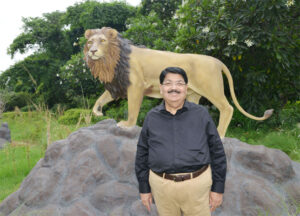
- Lion conservationist Parimal Nathwani has repeatedly stressed the need to manage the expanding Gir landscape and protect lions beyond sanctuary boundaries
NE ENVIRONMENT BUREAU
AHMEDABAD, AUG 9
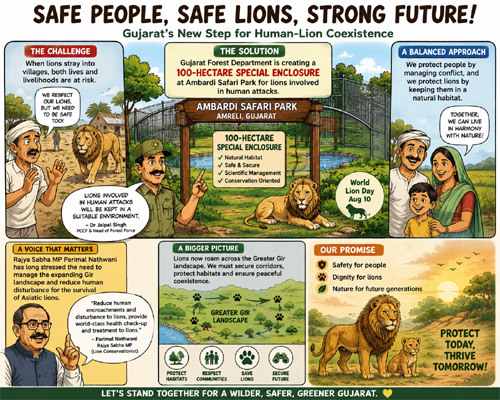
Gujarat is drawing a bold new line in the delicate coexistence between its people and its most celebrated wild icon—with the Forest Department preparing a sprawling 100-hectare natural enclosure at Ambardi Safari Park to house Asiatic lions involved in attacks on humans, seeking to protect lives while ensuring that the lions remain in a habitat that resembles the wild.
The move, coming on the eve of World Lion Day on August 10, signals a significant shift towards a more targeted approach to human-lion conflict: rather than treating conflict-prone animals simply as a threat to be removed, Gujarat plans to give them a dedicated natural space within the Gir landscape where they can be securely managed.
The proposed enclosure will be created within Ambardi Safari Park near Dhari in Amreli district, a reserved forest area forming part of the Gir Protected Area. Lions identified as being involved in attacks on humans will be relocated from conflict zones and housed in the designated enclosure.
‘Suitable environment’ for lions that cross the human safety line
Dr Jaipal Singh, Principal Chief Conservator of Forests and Head of Forest Force, confirmed the initiative.
“Lions involved in human attacks will be kept in a suitable environment by fencing a designated area at Ambardi Safari Park. Necessary instructions have been issued for this work, and the required work has been initiated.”
The proposed 100-hectare enclosure will constitute a separate designated zone within the much larger Ambardi Safari Park, which itself covers around 365 hectares.
The official Gujarat Gir Lion website describes Ambardi as a wildlife interpretation zone established in 2017 to strengthen Asiatic lion conservation and create greater public awareness. Located on the banks of the Shetrunji river, the park has a savannah-like landscape and shelters Asiatic lions alongside leopards, chinkara, nilgai, spotted deer and other wildlife.
A conservation challenge born from a conservation success
The proposed enclosure comes against the backdrop of one of India’s great wildlife conservation successes—the remarkable recovery and geographical spread of the Asiatic lion.
As lion numbers and their distribution have expanded across the wider Gir landscape, encounters between lions and people have increasingly become a complex management challenge. The conservation question is no longer confined to protecting lions inside a sanctuary; it increasingly involves managing lions, people, livestock, roads, farms and expanding habitats across the broader Greater Gir landscape.
Rajya Sabha MP Parimal Nathwani, a long-standing advocate for Gir lions, has repeatedly highlighted this wider conservation challenge.
In an earlier intervention, Nathwani pointed out that a significant share of the lion population was living outside the protected sanctuary and urged authorities to focus on these populations as well. He had also called for reducing human encroachment and disturbance in lion habitats.
More recently, Nathwani has continued to raise issues concerning the health and protection of Asiatic lions. In May 2026, he urged the Centre and Gujarat Government to strengthen healthcare interventions following reports of suspected babesiosis among lions in Gir and Greater Gir.
His long-standing advocacy underscores a crucial point: protecting the lion increasingly means protecting the landscape around the lion.
From conflict zones to a controlled natural habitat
The Forest Department’s strategy is based on scientific wildlife management and safe relocation.
Wild animals entering villages, agricultural fields or residential areas are generally captured safely and moved to suitable forest habitats. Relocation can also become necessary when animals require medical treatment, when population management is required or when a particular animal needs to be moved to a more appropriate habitat.
Lions and leopards straying into human settlements or agricultural areas may similarly be captured and relocated to safer forest or sanctuary zones.
But the proposed Ambardi enclosure represents a more specific intervention: animals identified as having attacked humans will have a dedicated area where they can be managed separately from areas of intense human interaction.
The approach seeks to avoid a stark choice between human safety and wildlife conservation.
Gir’s lion story enters a new chapter
The evolution of Ambardi itself mirrors Gujarat’s changing approach to lion conservation.
Spread over around 365 hectares, the park was established in 2017 as a wildlife tourism and interpretation destination and as an extension of the eastern Gir landscape. Its natural terrain and rich biodiversity have made it an increasingly important destination for wildlife enthusiasts.
The park’s popularity is also growing. Recent government figures reported that Ambardi recorded more than 2.07 lakh visitors during 2024 and 2025, with tourist footfall rising by 18.6 per cent over the period.
The new enclosure, therefore, will sit within a landscape where conservation, tourism, local livelihoods and human-wildlife coexistence increasingly intersect.
Beyond Gir’s boundaries, the conservation map is expanding
The challenge is not restricted to Ambardi.
Gujarat has identified 21 important lion corridors under the management plan for the Gir Protected Area, highlighting the need to secure movement routes as the lions disperse through the wider landscape. The information was provided by the Union Government in Parliament in response to a question raised by Parimal Nathwani.
Nathwani has also consistently supported the development of additional lion habitats. When a lion was sighted in Barda Wildlife Sanctuary in 2023 after a gap of 143 years, he described the natural dispersal as encouraging and said Barda could become a second home for Asiatic lions.
This wider approach is increasingly important as the Asiatic lion’s success in Gir creates a new conservation imperative: how to give a growing population enough safe space while ensuring that surrounding communities remain secure.
A delicate balance: protect the lion, protect the people
The Ambardi initiative is ultimately about managing that delicate balance.
The Asiatic lion is one of Gujarat’s greatest natural treasures and India’s only wild population of the species. Prime Minister Narendra Modi, on World Lion Day, has highlighted the significant increase in the lion population in Gir and invited wildlife lovers to experience the conservation efforts in Gujarat.
But conservation success brings responsibility.
A lion that repeatedly enters human habitation or becomes involved in attacks cannot simply be allowed to continue posing a danger. At the same time, its conservation value makes indiscriminate removal an undesirable answer.
The proposed 100-hectare Ambardi enclosure attempts to occupy that difficult middle ground—secure enough to protect people, natural enough to respect the animal, and strategic enough to strengthen Gujarat’s long-term lion management.
On the eve of World Lion Day, Gujarat’s message is therefore particularly significant:
The roar of the Asiatic lion must continue—but so must the safety of the communities that share its landscape.
Read also