
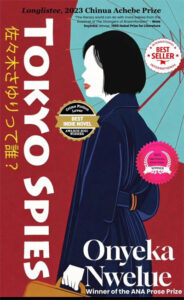
- In his ambitious new historical novel, the Nigerian writer, filmmaker and cultural traveller enters Meiji-era Japan and Qing-era China to examine cowardice, exile, desire and the possibility of redemption
- The book also brings together the central preoccupations of a career shaped by restless movement across countries, cultures and artistic forms
NAWAID ANJUM

Onyeka Nwelue has always been drawn to people who cross borders, shed identities and attempt to begin again. His characters are migrants, wanderers, artists, hustlers and outsiders, people who arrive in unfamiliar cities carrying ambitions far larger than their means and secrets heavier than their luggage. In his new novel, Tokyo Spies, that familiar restlessness takes him into an entirely new landscape: Japan and China in the closing years of the nineteenth century.
Set in 1887, the novel follows Zenjiro Ito, a young Japanese student devoted to calligraphy. His life changes when he learns that his family has fallen gravely ill. The news presents him with a simple but terrible choice: return home and face what awaits him, or run. Zenjiro chooses escape. He leaves Japan for Tianjin, disguising his fear as artistic ambition and allowing others to believe that his journey is part of his education.
That first act of cowardice becomes the foundation of everything that follows. Zenjiro does not merely leave his family; he begins constructing another version of himself. In China, he becomes involved with two women. Lin Ruo offers affection, emotional steadiness and the promise of a home. Mei is more restrained, demanding and intellectually alert. Each relationship allows Zenjiro to imagine a different future, but both are built upon what he has concealed.
Despite its title, Tokyo Spies is not a conventional espionage novel. There are no governments exchanging coded messages, no secret services pursuing one another through dark streets. The spying here is more intimate. Zenjiro watches himself performing the role of an artist, lover and exile. He studies the reactions of others and adjusts his personality accordingly. His greatest deception is the one he practises upon himself: the belief that changing countries has freed him from the moral consequences of leaving home.
This is where the novel becomes more than a story of travel or forbidden love. Nwelue is interested in the lies people create in order to continue living with themselves. Zenjiro does not initially appear monstrous. His failure is painfully ordinary. He is frightened, ashamed and unwilling to witness suffering. But a single act of avoidance gradually demands an entire architecture of deceit. Every new intimacy requires another omission; every declaration of love depends on the suppression of an earlier obligation.
When that structure collapses, Zenjiro loses his relationships, his security, his sense of artistic purpose and eventually his place in society. Reduced to living on the streets, he turns again to calligraphy. But the art he creates after his fall is different from the polished work through which he once sought approval. He begins developing a form that draws upon both Chinese and Japanese traditions, no longer pursuing technical perfection alone but attempting to place something honest on the page.
Calligraphy is not decorative background in Tokyo Spies. It is the novel’s moral language. A brushstroke records the movement that produced it: confidence, hesitation, force, weakness, control. Once placed on the page, it cannot be recalled without leaving evidence. In this sense, calligraphy becomes the opposite of Zenjiro’s carefully edited life. He can revise the story he tells others, but the brush exposes the condition of the hand holding it.
Nwelue is currently studying calligraphy in Osaka, and that closeness to the form appears to have shaped the novel’s central metaphor. He treats calligraphy as bodily work rather than an exotic symbol of East Asia. The discipline requires repetition, patience and surrender to the consequences of each movement. For Zenjiro, it becomes a way of discovering that art cannot erase guilt. At best, it may force the artist to stop looking away.
The book’s historical setting adds another layer to its emotional drama. Zenjiro moves between Meiji-era Japan, a society undergoing enormous political and cultural transformation, and Tianjin under the Qing dynasty, an important point of contact between China and the outside world. Yet Nwelue keeps the large movements of history largely beneath the surface. The novel is less interested in turning its protagonist into a representative of a nation than in showing how private weakness unfolds within a changing world.
That decision reflects a larger tendency in Nwelue’s writing. He often places individual lives inside complicated histories without allowing historical explanation to absolve personal conduct. His people may be shaped by migration, poverty, race, violence or social exclusion, but they are still required to make choices. Circumstance explains them; it does not automatically forgive them.
Nwelue’s own literary life began with an act of geographical movement. Born in Imo State, Nigeria, in 1988, he travelled to India while still very young and began developing the material that became his debut novel, The Abyssinian Boy. Published in 2009, the book brought Nigerian and Indian families into the same story, examining cultural difference, mixed inheritance and the uneasy ways in which communities look at one another.
India would remain important to his imagination and career. He has travelled and worked extensively in the country and served as a visiting assistant professor of African literature at Manipur University in Imphal. His engagement with India has never been limited to the familiar metropolitan circuit of Delhi, Mumbai and literary festivals. He has shown a sustained curiosity about linguistic regions, borderlands and places that rarely occupy the centre of international conversations about Indian culture.
This willingness to work across cultural settings became one of the defining features of his fiction. In The Strangers of Braamfontein, Nwelue entered the violent world of migrant communities in Johannesburg. The novel confronted corruption, trafficking, modern slavery, gang warfare and the particular vulnerability of people attempting to survive outside their countries of birth. Its most memorable quality was not simply its violence but its sympathy for those trapped within systems designed to consume them.
The migrant in Nwelue’s work is rarely a glamorous global citizen. Travel does not automatically produce freedom. A new country can offer reinvention, but it can also expose a person to new forms of loneliness, exploitation and moral compromise. That understanding links the crowded streets of Johannesburg in The Strangers of Braamfontein to Zenjiro’s more inward exile in Tokyo Spies. Both books examine people who travel in the hope of escaping one life and discover that the self they carried with them remains stubbornly present.
Nwelue has also resisted confinement within a single medium. Alongside his novels, poetry and nonfiction, he has worked as a filmmaker, publisher, musician, bookseller and cultural organiser. His nonfiction book Hip-Hop Is Only for Children examined the music industry and received the Creative Non-Fiction Book of the Year honour at the 2015 Nigerian Writers’ Awards. His interests in music also entered his poetry, including The Lagos Cuban Jazz Club.
His filmmaking has grown directly out of his literary concerns. The documentary The House of Nwapa explored the life and legacy of the pioneering Nigerian novelist Flora Nwapa and was nominated at the 2017 Africa Movie Academy Awards. Nwelue later adapted his novella Island of Happiness into the Igbo-language film Agwaetiti Obiụtọ. The film was nominated in two categories at the 2018 Africa Movie Academy Awards and won a directing prize at the Newark International Film Festival.
The use of Igbo in Agwaetiti Obiụtọ is significant. Nwelue’s work may travel internationally, but he has repeatedly returned to the question of who gets to speak, publish and be heard in African languages. His filmmaking, publishing and cultural projects suggest that he sees storytelling not only as the production of books but as the creation of structures through which neglected histories and voices can circulate.
This combination of novelist and cultural organiser explains the scale of his output. He appears less interested in building a neat, carefully protected literary identity than in moving wherever a story or idea takes him. A novel may lead to a film; an encounter with music may become nonfiction or poetry; a journey may produce a character who remains with him for years. The result is a career that is uneven by design but unusually wide in reach.
Tokyo Spies may be his most striking act of imaginative travel yet. For a Nigerian writer to create a historical novel around a Japanese calligrapher in nineteenth-century China is to accept a considerable artistic challenge. It demands research, attentiveness and the humility to recognise that another culture cannot be reduced to atmosphere. Nwelue’s answer is to build the novel around a moral experience that crosses geography: the human urge to flee responsibility and rename that flight as freedom.
The novel is expected to open a six-part project set in Japan, with later books extending its engagement with history, art, exile and cultural exchange. That ambition feels characteristic of Nwelue. He seldom enters a world tentatively. He builds across forms, countries and stories, following connections that may not appear obvious until they begin to form a larger pattern.
Yet Tokyo Spies is most effective when it becomes quiet. Its real force lies not in the sweep of its setting but in the image of a man sitting before a blank page, unable to escape the knowledge of what he has done. Zenjiro’s journey across the sea cannot save him. Neither can romantic love, artistic talent or suffering by itself. His only possible beginning lies in looking directly at the truth he once abandoned.
For a writer whose career has been built upon movement, Tokyo Spies offers a compelling reversal. It asks whether constant movement is always an expression of courage, or whether it can sometimes be the most elaborate form of hiding. Zenjiro travels far to become another man. His real journey begins only when he can no longer run.
Nawaid Anjum is a New Delhi-based senior journalist and literary writer with more than three decades of experience, known for his incisive engagement with literature, culture and contemporary ideas.