
- Individual business borrowing grows at 18% CAGR in Gujarat, outpacing the 13% expansion in micro-business credit over three years
- Nearly 24.8 lakh individual entrepreneurs have never borrowed in their enterprise capacity, although 72% have CIBIL scores above 730
- Manufacturing accounts for 36% of Gujarat’s micro-business outstanding balances, with textile credit growing at 18% CAGR
- Nationally, individual business borrowers account for ₹19.1 lakh crore of the ₹29.6-lakh-crore micro-business entrepreneur credit market
NE ECONOMIC BUREAU
AHMEDABAD, OCTOBER 28
If millions of entrepreneurs already have established credit histories, why do so many continue to borrow for business in their individual capacity rather than access finance as enterprises? Gujarat’s micro-business credit market presents a telling paradox: outstanding balances have reached approximately ₹2.41 lakh crore, yet a substantial pool of entrepreneurs remains to be connected with enterprise-level financing.
Outstanding balances held by individual entrepreneurs in Gujarat grew at a compounded annual growth rate (CAGR) of 18% over the three years to June 2026, compared with 13% for micro businesses. The faster growth in individual borrowing underlines its expanding role in financing entrepreneurial activity, while raising questions about how more eligible businesses can access credit suited to their growth and operational needs.
The findings are contained in Micro Business Entrepreneurs in India: Growth, Transformation & Emerging Opportunities, a joint study by TransUnion CIBIL and the National Small Industries Corporation Limited (NSIC). The report points to an opportunity to broaden structured business financing for entrepreneurs who have already established individual credit profiles.
The credit gap: Good scores, but no enterprise borrowing
Approximately 24.8 lakh individual entrepreneurs in Gujarat had never borrowed in their enterprise capacity as of March 2026. Significantly, 72% of this group had CIBIL Credit Scores above 730, suggesting that many already have established individual credit profiles.
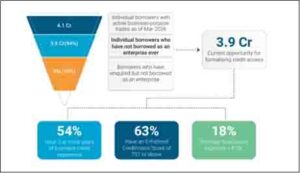
The national picture is similarly striking. About 3.9 crore individual business borrowers across India had never borrowed in an enterprise capacity as of March 2026. Of these, 54% had at least two years of business-credit experience, while 63% had CIBIL scores above 730.
These figures point to a potential opportunity for lenders to assess eligible entrepreneurs for enterprise-level financing, subject to applicable credit policies, underwriting standards and regulatory requirements. Greater access to working-capital facilities, cash credit and overdrafts could help businesses meet evolving financial needs and potentially reduce dependence on personal assets as collateral.
Gujarat’s manufacturing engine drives credit demand
Gujarat’s micro-business credit profile reflects its established industrial base and varied financing needs. Manufacturing accounts for 36% of outstanding balances among micro businesses, while credit to the textile industry grew at an 18% CAGR over the past three years.
Loans Against Property (LAP) remains the largest financing product, accounting for 38% of overall micro-business entrepreneur balances. Cash credit, overdrafts and commercial vehicle finance also support business activity. Private sector banks account for nearly 45% of individual business-borrower balances, while non-bank finance companies continue to play an important role in commercial vehicle financing.
Bhavesh Jain, Managing Director and CEO of TransUnion CIBIL, said Gujarat’s diverse entrepreneurial ecosystem requires financing that reflects businesses’ different stages of growth.
“Gujarat’s entrepreneurial ecosystem has a strong manufacturing and trading base, with businesses at different stages of growth requiring different forms of financing. A textile manufacturer investing in capacity, a trader managing inventory and an entrepreneur looking to expand operations have distinct credit requirements. As these businesses grow, lenders have an opportunity to look more closely at their operating cycles, existing credit histories and future financing needs. Helping entrepreneurs build credit relationships in their enterprise capacity can improve their access to suitable financial products and support the next stage of business expansion.”
Stronger credit profiles offer a window of opportunity
Gujarat’s existing borrower base offers further grounds to examine the potential for deeper enterprise-credit access. As of June 2026, borrowers in the above-prime segment accounted for 62% of outstanding individual business-borrower balances in the state, the highest share among the major states analysed in the study.
Portfolio performance has also improved. Delinquency of 90 days or more declined by approximately 45 basis points over three years to 1.2%. Established credit histories and improving repayment performance could help lenders identify eligible entrepreneurs for suitable enterprise-level products, although individual credit scores alone do not guarantee approval.
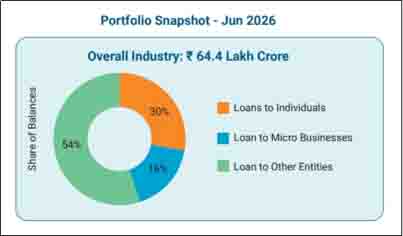
Nationally, micro-business entrepreneurs accounted for ₹29.6 lakh crore in outstanding commercial credit as of June 2026, representing nearly half of the overall commercial credit portfolio. Of this, ₹19.1 lakh crore was held by individuals borrowing for business purposes and ₹10.5 lakh crore by micro businesses.
Individual business-borrower balances grew at a 21% CAGR over three years, compared with 12% for micro businesses. The trend reinforces the growing significance of individual borrowing in business finance and the potential to connect more entrepreneurs with credit in their enterprise capacity.
Collateral still dominates business financing
Secured lending remains central to India’s micro-business credit market. Loans Against Property accounted for ₹10.9 lakh crore in outstanding balances as of June 2026, followed by cash credit and overdraft facilities at ₹5.6 lakh crore and commercial vehicle loans at ₹5 lakh crore.
The dominance of secured products highlights the continuing role of collateral in business finance, while pointing to the scope for wider adoption of cash-flow-based assessment and working-capital-oriented lending where appropriate.
Portfolio quality has improved alongside credit expansion. Overall delinquency declined from approximately 3% in June 2023 to 1.9% in June 2026, indicating stronger repayment performance across the reported portfolio.
From individual borrowing to enterprise growth
The next phase of micro-business credit growth may depend not only on expanding the volume of lending but also on ensuring that suitable businesses can access the right form of finance as they grow.
Wider use of cash-flow-based underwriting, credit-guarantee mechanisms and digital financial information could help lenders assess viable businesses beyond traditional collateral-based approaches. Better alignment between financing products and the operating cycles of manufacturers, traders and other entrepreneurs could also help meet needs ranging from inventory purchases to capacity expansion.
For Gujarat, the central question is how to convert a strong base of individual business borrowers into broader, sustainable access to enterprise-level credit. The figures suggest a substantial opportunity—but turning it into actual lending will depend on sound risk assessment, appropriate products and lenders’ ability to recognise the distinct needs of micro-businesses.