NE RAILWAY BUREAU
NEW DELHI, SEPT 15
Gujarat’s freight economy is getting a fresh rail push, with five Gati Shakti Cargo Terminals (GCTs) set to strengthen the movement of goods from regional production centres to ports and national markets, while a new salt-transport initiative seeks to make one of the State’s most important commodities easier and more efficient to move by rail.
Strengthening freight network.
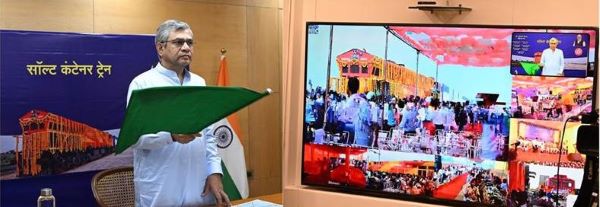
✅ Flagged off Salt Container Train from Shivlakha pic.twitter.com/st8LxKBd3D— Ashwini Vaishnaw (@AshwiniVaishnaw) September 15, 2026
Railway Minister Ashwini Vaishnaw on Tuesday virtually dedicated four Gati Shakti Cargo Terminals to the nation and laid the foundation stone for a fifth in Gujarat, strengthening the State’s freight-handling capacity and connectivity between economic centres, ports and markets across India.
- Four GCTs dedicated, foundation laid for fifth as Gujarat strengthens rail links between production hubs, ports and national markets
- Ashwini Vaishnaw flags off salt-loaded freight train from Shivlakha to Mithapur, signalling smarter cargo logistics
- Lightweight stainless-steel containers promise easier salt loading, unloading and transportation
- 150 Gati Shakti Cargo Terminals now commissioned nationwide as rail freight network expands
- ₹5,600-crore railway projects underway in Kachchh to boost industrial, defence and passenger connectivity
- DFC expansion, Mumbai-Ahmedabad bullet train and indigenous high-speed coach add momentum to Gujarat’s rail transformation
Vaishnaw also flagged off a salt-loaded freight train from Shivlakha GCT to Mithapur, marking an important step towards expanding rail-based transportation of salt from Gujarat to its destinations.
माननीय रेल मंत्री श्री @AshwiniVaishnaw जी ने आज गुजरात में स्थित पांच गति शक्ति कार्गो टर्मिनल का शिलान्यास, उद्धाटन एवं राष्ट्र को समर्पण किया।#RailInfra4Gujarat#FreightFriendlyRailways pic.twitter.com/KmdpEpqi67
— Ministry of Railways (@RailMinIndia) September 15, 2026
The four terminals dedicated to the nation are Shivlakha and Bhimasar in Kachchh, Devaliya in Morbi and Chandisar in Banaskantha. The foundation stone was laid for the Linch GCT in Mahesana.
From local production to national markets
The new terminals are expected to expand freight-handling capacity, ease congestion and bottlenecks at port locations and strengthen rail connectivity between Gujarat’s ports and the northern hinterland.
More importantly, they are designed to connect regional economic centres directly with wider national markets, potentially giving industries, traders and businesses a more efficient logistics channel.
The expansion comes as India seeks to reduce logistics costs and shift a larger share of freight to rail, particularly for bulk commodities and industrial cargo.
A new track for Gujarat’s salt economy
Salt transportation received special attention with the flagging off of the Shivlakha-Mithapur freight service.
Vaishnaw pointed out that salt is an essential commodity consumed by every household, including poor and middle-class families, while Gujarat—particularly Kachchh—is one of India’s major salt-producing regions.
However, transporting salt by conventional railway wagons has involved logistical challenges.
Vaishnaw explained that a significant part of the wagon’s carrying capacity is occupied by the wagon itself, while salt can absorb moisture during transportation, making the cargo wet and creating difficulties during loading and unloading.
Stainless steel solution to a salty logistics challenge
The new lightweight stainless-steel salt container has been designed to address these problems.
The containers allow loading from the top and unloading from the side, making the handling of salt smoother and more efficient.
Vaishnaw said the new containers would make it easier to transport salt to different parts of the country while improving the loading and unloading process.
The innovation could therefore represent more than a change in packaging—it could become a logistics efficiency intervention for a commodity produced at massive scale in Gujarat.
150 GCTs mark a nationwide freight shift
Vaishnaw said 150 Gati Shakti Cargo Terminals have now been commissioned across the country, providing industries with additional freight-handling facilities and improving cargo connectivity.
The GCT model is aimed at bringing freight infrastructure closer to production and consumption centres, thereby creating smoother links between industry, railways, ports and markets.
For Gujarat, with its large industrial base, ports and strategic location, the expansion has particular significance.
₹5,600-crore Kachchh rail push
Gujarat’s freight story is also being reinforced by a major railway infrastructure push in Kachchh.
Vaishnaw said railway projects worth around ₹5,600 crore are currently underway in the region, including capacity augmentation and doubling works on important sections connecting Samakhiali, Bhachau, Gandhidham, Adipur and Bhuj.
He highlighted the Bhuj-Naliya gauge conversion project, which has strengthened rail connectivity in the region.
The Naliya-Jakhau Port new broad-gauge line has also been sanctioned and is expected to further improve connectivity.
Four-line corridors and stronger port connectivity
Rail connectivity in the Kandla-Gandhidham industrial region is also being strengthened through capacity augmentation.
Vaishnaw said the Samakhiali-Bhachau section has already been made four-line, while the Gandhidham-Adipur section has also been made four-line.
Adipur-Bhuj single-line section is being doubled
The Bhuj-Naliya section has recently been converted from metre gauge to broad gauge, while the railway network from Naliya towards Jakhau Port, Vayor, Luna, Hajipur and Desalpar is also being developed further.
Freight, defence and industry on one rail network
The expanding railway network is expected to deliver benefits well beyond freight.
Vaishnaw said the infrastructure would particularly support the requirements of the defence sector and industry, while improving connectivity for residents living across Kachchh’s challenging terrain.
Together, these initiatives are aimed at strengthening both freight and passenger infrastructure, improving access to rail services and cargo facilities and creating greater opportunities for industries, businesses and local communities.
Dedicated Freight Corridors add another layer
Railway Minister also highlighted the role of Dedicated Freight Corridors (DFCs) in transforming goods movement.
The recently commissioned infrastructure is expected to enable faster and more efficient transportation of freight, while work on expanding east-west freight connectivity is also being pursued.
For Gujarat’s manufacturing and port economy, the combination of GCTs, DFCs and expanded regional rail capacity could significantly improve the efficiency of the broader logistics chain.
Bullet train and indigenous high-speed rail
Gujarat’s railway transformation is not confined to freight.
On the Mumbai-Ahmedabad High-Speed Rail project, Vaishnaw said construction on the Vapi-Surat section is targeted for completion by December 2026, followed by testing and associated works.
He also said the first coach of India’s indigenous high-speed train has been prepared and is undergoing various tests.
The train is being developed as part of India’s efforts towards Atmanirbhar Bharat and greater indigenisation of high-speed rail technology.
A broader rail transformation for Gujarat
The event was attended by Gujarat Minister of State Trikambhai Chhanga, MPs Vinodbhai Chavda, Haribhai Patel, Rajubhai Shukla and Chandubhai Shihora, along with senior officials and other dignitaries.
With new cargo terminals, upgraded industrial corridors, port connectivity, DFC integration and high-speed rail moving simultaneously, Gujarat’s railway story is increasingly shifting from simply connecting destinations to connecting production, logistics and markets.
The next test will be how efficiently this expanding network can translate into lower logistics costs, faster cargo turnaround, stronger industrial competitiveness and greater economic opportunities for Gujarat and the country.