R ARIVANANTHAM
AHMEDABAD, JAN 12
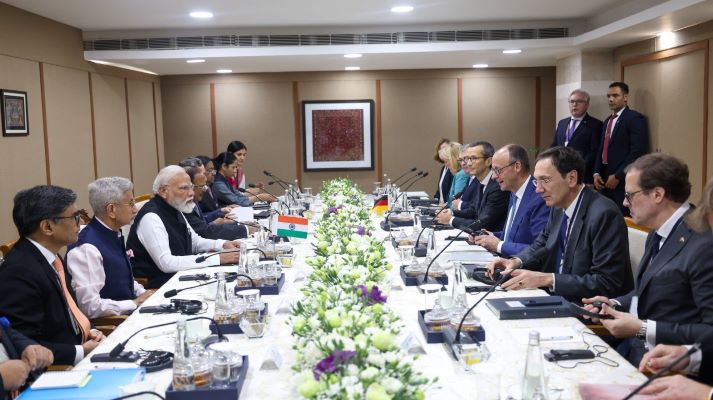
India and Germany on Monday elevated their Strategic Partnership to a new level as Prime Minister Narendra Modi and German Chancellor Friedrich Merz held wide-ranging talks in Ahmedabad, setting an ambitious roadmap for cooperation in defence, economy, climate action, technology, education and global governance.
Sharing my remarks during the India-Germany Business Forum.@bundeskanzler@_FriedrichMerz https://t.co/IiPIf5MlzK
— Narendra Modi (@narendramodi) January 12, 2026
We agreed to take our relationship to a qualitatively higher level, with deeper cooperation in defence, space and other critical and emerging technologies. Our discussions also covered joint efforts on climate action, trusted and resilient supply chains, skilling, education,…
— Narendra Modi (@narendramodi) January 12, 2026
The visit — Chancellor Merz’s first official visit to India and Asia — comes at a landmark moment in bilateral ties, with 25 years of India–Germany Strategic Partnership completed in 2025 and 75 years of diplomatic relations being commemorated in 2026. The Chancellor was accompanied by a high-level delegation, including 23 leading German CEOs and industry leaders, underlining Germany’s growing strategic and economic focus on India.
- PM Modi, Chancellor Merz chart future-ready roadmap across defence, trade, climate and innovation
- Historic visit marks 25 years of Strategic Partnership and 75 years of diplomatic relations
- Bilateral trade crosses USD 50 billion as CEOs, investors and innovators converge
- Green hydrogen, semiconductors, mobility and skilling emerge as new growth engines
- Shared stand on Indo-Pacific, terrorism, UN reforms and global peace
Welcoming Chancellor Merz in Gujarat, Prime Minister Modi hosted him at Sabarmati Ashram, where the two leaders paid tribute to Mahatma Gandhi, and later participated in the International Kite Festival, symbolising people-to-people warmth alongside strategic engagement.
Addressing the joint press interaction, Prime Minister Modi said: “As Chancellor, this is his first visit not only to India, but to Asia. It is a strong testament to the importance he places on relations with India.”
Highlighting the depth of economic ties, the Prime Minister noted: “Our bilateral trade has now reached its highest level ever and crossed the USD 50 billion mark.”
Chancellor Friedrich Merz, thanking Prime Minister Modi for the warm welcome and hospitality, described India as a key strategic partner for Germany in the Indo-Pacific, and reaffirmed Germany’s commitment to expanding cooperation across economic, technological and security domains.
Defence, Security and Counter-Terrorism
Both leaders reaffirmed their commitment to deepening defence and security cooperation, welcoming progress in military-to-military engagement, joint exercises, port calls and defence industrial collaboration. A Joint Declaration of Intent on Defence Industrial Cooperation was signed, focusing on co-development, co-production and technology partnerships.
The leaders strongly condemned terrorism in all its forms, including cross-border terrorism, and reiterated their resolve to strengthen cooperation against terrorist networks, financing and safe havens. They jointly condemned recent terror attacks in Jammu and Kashmir and Delhi, calling for sustained international action.
Trade, Investment and Industry
India and Germany welcomed the record growth in bilateral trade, which crossed USD 50 billion in 2024, accounting for over a quarter of India’s trade with the European Union. Prime Minister Modi invited German companies to expand their footprint in India, citing its business-friendly environment, skilled workforce and scale opportunities, while Chancellor Merz encouraged Indian investments in Germany.
The leaders reiterated strong support for the India–EU Free Trade Agreement, calling it a catalyst for future growth. A Joint Declaration of Intent on Economic Cooperation through the India–Germany CEO Forum was also signed.
Technology, Innovation and Science
The talks placed strong emphasis on critical and emerging technologies, including semiconductors, AI, digitalisation, telecommunications, critical minerals and bioeconomy. A new Semiconductor Ecosystem Partnership and collaboration on critical minerals aim to build resilient supply chains and advanced manufacturing ecosystems.
Both sides welcomed progress under the Indo-German Science and Technology Centre (IGSTC) and the establishment of Indo-German Centres of Excellence in digital convergence, battery technology, green mobility and affordable healthcare.
Green Partnership and Climate Action
The leaders reviewed the progress of the Green and Sustainable Development Partnership (GSDP), under which Germany has committed €10 billion till 2030, with nearly half already allocated to renewable energy, urban mobility, climate resilience and green hydrogen projects.
They welcomed major breakthroughs in green hydrogen and green ammonia, including one of the largest offtake agreements between Indian and German companies, calling it a game-changer for future energy security.
Indo-Pacific, Global Issues and Multilateral Reform
India and Germany reaffirmed their shared commitment to a free, open and rules-based Indo-Pacific, announcing a new bilateral consultation mechanism. Both leaders supported the India–Middle East–Europe Economic Corridor (IMEC) as a transformational connectivity initiative.
They reiterated the urgent need for UN Security Council reforms, supported peaceful resolutions to conflicts in Ukraine and Gaza, and underlined the necessity of accelerated global action on climate change.
Education, Mobility and People-to-People Ties
The leaders welcomed expanding student, researcher and skilled professional mobility, and the announcement of visa-free transit for Indian passport holders through Germany. A Comprehensive Roadmap on Higher Education was unveiled, with Prime Minister Modi inviting leading German universities to establish campuses in India under the New Education Policy.
Summing up the visit, Prime Minister Modi said: “I am confident that today’s discussions will give new energy and clear direction to the India–Germany partnership.”
Both leaders agreed that the next India–Germany Inter-Governmental Consultations will be held in Germany later this year, reaffirming their shared commitment to taking the Strategic Partnership to greater heights.