NE DEFENCE BUREAU
SEOUL, MAY 20
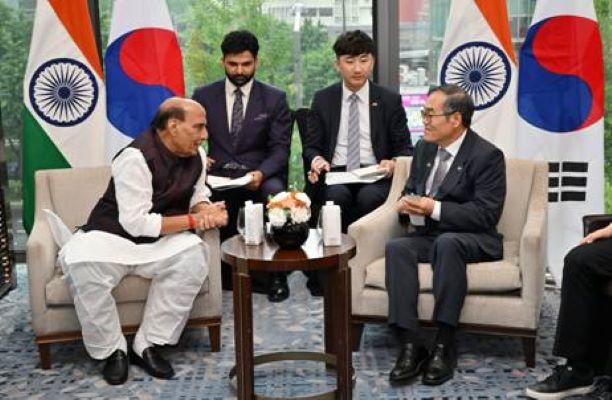
In a major strategic and defence diplomacy breakthrough, India and the Republic of Korea (RoK) have moved to significantly deepen their military and defence-industrial partnership following comprehensive bilateral talks between Raksha Mantri Rajnath Singh and Republic of Korea’s Minister of National Defence Ahn Gyu-back in Seoul.
Held an excellent meeting with my South Korean counterpart, Ahn Gyu Back in Seoul. We discussed ways to further deepen India–Republic of Korea defence, defence industry and strategic cooperation, with a shared commitment towards regional peace, stability and technological… pic.twitter.com/FTqsy3fU3d
— Rajnath Singh (@rajnathsingh) May 20, 2026
The high-profile meeting on Tuesday reviewed the full spectrum of bilateral defence cooperation and set the stage for a new era of collaboration in defence production, maritime security, logistics, emerging technologies and Indo-Pacific security.
- Raksha Mantri Rajnath Singh holds high-level defence talks in Seoul with Republic of Korea leadership
- India and South Korea sign key MoUs in defence cyber cooperation, military training and UN peacekeeping
- New roadmap discussed for joint defence innovation, co-development, co-production and defence exports under KIND-X ecosystem
- Rajnath Singh urges Korean industry to partner India in advanced technologies including AI, cyber, semiconductors and autonomous systems
- Defence Minister asserts India’s growing strategic confidence, citing Operation Sindoor and India’s expanding defence manufacturing strength
Cyber, Training and Peacekeeping Pacts Signed
Marking a decisive expansion of bilateral ties, India and South Korea signed multiple Memoranda of Understanding aimed at making the strategic partnership more comprehensive and multidimensional.
The agreements include cooperation in:
- Defence Cyber domain
- Training collaboration between India’s National Defence College and Korea National Defence University
- United Nations Peacekeeping operations
Both sides reaffirmed their commitment to a free, open, inclusive and rule-based Indo-Pacific, reflecting growing convergence between India’s Act East Policy and South Korea’s regional strategic vision.
Rajnath Pushes Joint Defence Manufacturing Push
Raksha Mantri also held separate discussions with Lee Yong-chul, Minister of Defense Acquisition Program Administration of RoK, where both leaders agreed to unlock fresh opportunities in joint development, joint production and joint defence exports.
A key focus was the proposed India-Korea Defence Innovation Accelerator Ecosystem (KIND-X), envisioned as a powerful platform to connect and strengthen innovation ecosystems in both countries.
Later, Shri Rajnath Singh chaired the India–RoK Defence Industry Business RoundTable, bringing together senior officials and leading defence manufacturers from both nations.
The interaction explored new pathways in defence manufacturing, supply chains, co-production and technology partnerships.
“India and RoK Uniquely Positioned”
Addressing business leaders and defence industry stakeholders, Rajnath Singh made a strong pitch for deeper industrial collaboration.
He said:
“Trusted partnerships between technologically capable nations acquire immense strategic importance. India and RoK are uniquely positioned to work together in this changing global landscape.”
Highlighting the success of India-Korea industrial collaboration in commercial sectors, he added:
“The success of India-Korea industrial cooperation in the commercial sector demonstrates the enormous potential of long-term trusted partnerships between the two countries. The time has now come to extend this successful model into the defence sector, where technology, innovation, manufacturing capability, and strategic trust are becoming increasingly interconnected. Korea’s technological excellence, combined with India’s scale, talent, manufacturing ecosystem, and innovation capabilities, creates a powerful foundation for cooperation. Together, our two countries can jointly develop and produce advanced technologies and defence systems for the future.”
The Raksha Mantri invited Korean companies to actively participate in India’s Aatmanirbhar Bharat mission and collaborate with Indian industry for long-term defence manufacturing growth.
Future Wars Will Be Technology Driven
Emphasising the changing nature of warfare and defence preparedness, Rajnath Singh noted that modern military ecosystems are increasingly driven by cutting-edge technologies.
He highlighted areas including:
- Artificial Intelligence
- Cyber technologies
- Autonomous and unmanned systems
- Sensors and semiconductors
- Quantum technologies
- Advanced materials
- Space-based capabilities
- Defence software and communications systems
He stressed:
“Young Indian entrepreneurs are increasingly contributing to advanced technology domains including unmanned systems, AI-enabled platforms, cyber security, advanced communications, and defence software systems. The future of India–Korea defence cooperation lies in innovation-led collaboration.”
India’s vibrant innovation ecosystem comprising start-ups, MSMEs, academia and defence research institutions, he said, offers enormous opportunities for Korea-India partnerships.
L&T–Hanwha Agreements Signal New Defence Tech Era
In another major development, two defence cooperation agreements were signed between Larsen & Toubro and Hanwha Corporation, signalling growing momentum in India–Korea defence technology collaboration.
The agreements are expected to facilitate stronger industrial cooperation, technology sharing and capacity building between defence sectors of both countries.
Rajnath Singh Highlights India’s Strategic Rise
Interacting with the Indian diaspora in South Korea, Rajnath Singh underlined India’s growing global influence under Prime Minister Narendra Modi.
He said:
“12-13 years ago, India was perceived as a weak nation, but, today, due to the transformation the country has undergone in the last decade, the world carefully listens to what we have to say. We’re now emerging as a global power that offers solutions to the world. Whether internal or external security, our policy has undergone a fundamental transformation; it has become assertive, bold, consistent, and decisive.”
Referring to Operation Sindoor, the Raksha Mantri described it as proof of India’s strategic transformation.
“The operation was proof that India will not tolerate terrorism in any form. As a responsible nuclear power, we firmly adhere to a policy of No First Use. However, there are times when people mistake our restraint and commitment to peace for weakness. While India remains committed to its No First Use policy, it will not tolerate any form of nuclear blackmail. This is New India.”
He also highlighted India’s growing defence self-reliance, noting that defence production touched nearly Rs 1.54 lakh crore and exports approached Rs 40,000 crore during FY 2025–26, with exports projected to touch Rs 50,000 crore in the next one to two years.
Before commencing official engagements in Seoul, Rajnath Singh paid tribute at the Korean War Cemetery, honouring soldiers who laid down their lives during the Korean War and reiterating India’s solidarity with the people of South Korea.