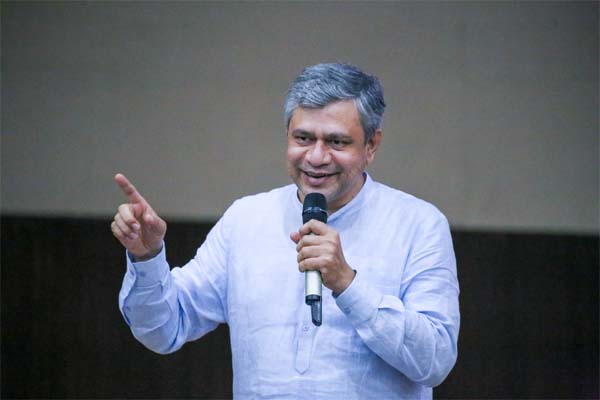
- Ashwini Vaishnaw to launch tunnel-boring operations for Mumbai–Ahmedabad High-Speed Rail, unlocking a new chapter in India’s engineering history
- German-engineered giant TBMs to carve a 20.37-km underground corridor, including a 7-km tunnel beneath Thane Creek
- Project combines global technology, Indian engineering expertise and high-speed mobility to reshape western India’s transport landscape
NE RAILWAY BUREAU
NEW DELHI, JULY 4
India’s first bullet train project will cross a defining engineering milestone on Sunday when Railway Minister Ashwini Vaishnaw inaugurates tunnel-boring operations for the country’s first undersea high-speed rail tunnel, signalling the start of one of the most technologically challenging phases of the Mumbai-Ahmedabad High-Speed Rail (MAHSR) corridor.
The ceremony at Vikhroli in Mumbai will mark the first deployment of a Tunnel Boring Machine (TBM) for the 508-km bullet train project, with excavation commencing nearly 56.6 metres below ground level towards the Bandra Kurla Complex (BKC) station.
The launch comes as the flagship India-Japan high-speed rail project gathers momentum, with Japan reaffirming support for India’s target of commencing operations on priority sections from 2027.
According to officials of the National High Speed Rail Corporation Limited (NHSRCL), “The Railway Minister will push a button to commence the operation of the tunnel boring machine stationed 56.6 metres below ground level at Vikhroli.”
The first machine will excavate a 5.8-km stretch between Vikhroli and BKC, while a second TBM, currently being assembled at Sawli, will undertake the 9.7-km section towards Vikhroli, including the country’s pioneering 7-km undersea tunnel beneath Thane Creek.
Imported by sea from China in March this year, the customised German-built TBMs are owned by Afcons Infrastructure Ltd, which is executing the project’s most technically demanding package.
A senior railway expert said, “Each TBM is expected to excavate about 300 metres of tunnel every month. Once both machines become operational, around 600 metres of tunnelling will be completed every month.”
He further explained, “The 20.37-km tunnel stretches from the BKC station to Shilphata. Of the total length, 15.4 km between BKC and Sawli will be excavated using TBMs. The remaining 4.8-km stretch from Sawli to Shilphata has already been completed using the drill-and-blast method.”
The underground corridor will consist of a single large-diameter tube accommodating twin tracks for bi-directional bullet train operations.
India’s Biggest Railway Tunnel Machines
The two TBMs rank among the largest and costliest ever deployed for railway construction in India.
Each machine features a massive 13.6-metre cutter head, dwarfing the 5-6 metre TBMs commonly used for metro rail projects. Weighing over 3,000 tonnes, the machines are specifically designed to negotiate Mumbai’s complex geology comprising soft soil, mixed strata and the challenging undersea alignment beneath Thane Creek.
Engineering experts say the unusually large tunnel diameter is essential to accommodate twin high-speed tracks, minimise aerodynamic pressure created by trains travelling at 320 kmph, and provide enhanced evacuation space in line with international safety standards.
Construction is being facilitated through deep shafts at Vikhroli (approximately 56 metres) and Sawli (around 39 metres), while 39 equipment rooms across 37 locations will support tunnel operations and maintenance.
Afcons’ Engineering Legacy
Afcons Infrastructure brings extensive experience in executing nationally significant engineering projects.
Its portfolio includes the iconic Chenab Rail Bridge, India’s first under-river metro tunnel for the Kolkata East-West Metro, and the strategic Atal Tunnel beneath Rohtang Pass, placing it among the country’s foremost tunnelling specialists.
Game-Changer for Western India
Stretching 508 km, the Mumbai-Ahmedabad High-Speed Rail Corridor will connect Mumbai, Thane, Virar, Boisar, Vapi, Bilimora, Surat, Bharuch, Vadodara, Anand, Ahmedabad and Sabarmati.
Bullet trains operating at speeds of up to 320 kmph are expected to reduce end-to-end travel time to nearly 2 hours and 7 minutes for limited-stop services, dramatically transforming passenger mobility, business travel and regional economic integration between Maharashtra and Gujarat.
The commencement of TBM operations is widely viewed as one of the most significant milestones since construction began, pushing India’s first bullet train project into its most ambitious underground phase and bringing the long-envisioned high-speed rail network a decisive step closer to reality.