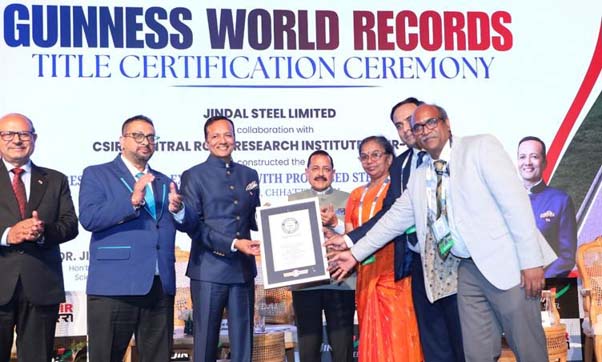
- 85-km Raigarh road earns Guinness World Record as India turns steelmaking waste into infrastructure wealth
- Jitendra Singh calls for technology to move “from one project to many projects, from one State to many States”
- Steel slag roads can cut construction costs by around 40% and deliver up to four times the strength, Minister says
- CSIR-CRRI gets work order for 40-km Odisha road from Jindal Steel’s Angul plant
- AM/NS India’s Hazira project had already demonstrated the technology on a six-lane road connecting NH-6 with Hazira Port
- From Hazira to national highways, Arunachal and now Raigarh: India’s waste-to-wealth highway journey gathers momentum
R MANICKAVASAGAM
NEW DELHI, SEPT 13
What if the waste generated by India’s steel plants could become the very material used to build the country’s roads?
That question is rapidly turning into an infrastructure reality.
India has moved from a pioneering 1.2-km steel slag road at Hazira to a 1.85-km Guinness World Record road at Raigarh, and now towards a proposed 40-km steel slag road in Odisha—signalling a potentially transformative shift in how the country builds roads while conserving natural aggregates.
The latest milestone came with the recognition of the 1.85-km Raigarh road in Chhattisgarh as the world’s longest road built with processed steel slag aggregates, developed through collaboration between CSIR-Central Road Research Institute (CSIR-CRRI) and Jindal Steel.
Union Minister of State (Independent Charge) for Science & Technology and Earth Sciences, MoS PMO, Personnel, Public Grievances, Pensions, Atomic Energy and Space, Jitendra Singh, described the technology as capable of reducing road construction costs by around 40%, while delivering up to four times the strength of conventional roads.
He also said that, in suitable applications, the technology could substantially extend maintenance cycles, with major maintenance required only after about 15 years.
The Minister’s message was unmistakable: the Guinness record should not become the destination; it should become the launchpad.
“From one project to many projects, from one State to many States.”
That is the challenge now before India’s road-building ecosystem.
From steel waste to national infrastructure
The Raigarh project demonstrates how processed steel slag—a by-product of steel production—can be converted into aggregates for road construction.
The initiative brings together Indian science, industry and infrastructure, with CSIR-CRRI providing the scientific and technological backbone and Jindal Steel providing the industrial scale for field implementation.
The programme also saw the virtual inauguration of the road, release of a scientific documentary, signing of a Technology Transfer Agreement between CSIR-CRRI and Jindal Steel, launch of the Steel Grit brand and recognition of the project team.
Among those present were Naveen Jindal, Chairman, Jindal Steel and President, Indian Steel Association; N. Kalaiselvi, Secretary, DSIR and Director General, CSIR; V.K. Saraswat, former Member, NITI Aayog and former Director General, DRDO; and Ch. Ravi Sekhar, Director, CSIR-CRRI, besides representatives of Guinness World Records, scientists, engineers and industry leaders.
Singh said the initiative fits squarely into Prime Minister Narendra Modi’s repeated emphasis on “Waste to Wealth”, demonstrating how industrial by-products can be transformed into productive infrastructure resources.
Why the technology matters
India’s infrastructure expansion is creating enormous demand for road-building aggregates traditionally sourced through mining and quarrying.
Steel slag technology offers a potential double dividend—productive utilisation of an industrial by-product while reducing dependence on natural aggregates.
The Minister said the significance becomes even greater in difficult geographies and high-rainfall regions, where conventional roads can face durability challenges.
He recalled his experience of the Northeast, where heavy rainfall can restrict construction activity to only a few months and damage road sections before the next construction cycle.
The technology could also become relevant as rural roads experience a transformation in traffic patterns.
Roads initially designed for light vehicles can begin carrying heavy trucks when surrounding areas industrialise. Stronger and more durable pavement technologies can therefore become increasingly important as India’s economic geography changes.
AM/NS India showed the road ahead
Interestingly, the journey to Raigarh did not begin with the Guinness record.
ArcelorMittal Nippon Steel India (AM/NS India) was among the pioneering industry partners to demonstrate the potential of processed steel slag for road construction at Hazira, Gujarat.
Working with CSIR-CRRI, AM/NS India built India’s first all-steel-slag road at Hazira, using 100% processed steel slag aggregates in all layers of a six-lane bituminous road connecting NH-6 with Hazira Port. The project used about 1 lakh tonnes of processed steel slag aggregates.
AM/NS India’s own sustainability disclosures say the approximately 1-km road carries 1,200–1,500 trucks a day and has demonstrated strong durability and load-bearing performance. The company has reported 30–40% cost savings compared with conventional road construction and a reduction in road-section thickness of about 32% because of the superior strength of the processed slag aggregate.
The company’s sustainability disclosures also document the wider use of its processed steel slag in infrastructure—including supply for nearly 37 km of the Vadodara–Mumbai Expressway, state highways and roads in Surat, as well as applications connected with Surat airport and the Mumbai–Ahmedabad high-speed rail corridor. Four one-kilometre patches connecting the highway to the upcoming Surat Diamond Bourse were also constructed using steel slag aggregates.
AM/NS India subsequently became the first company to secure CSIR-CRRI’s technology licence for scientifically processing steel slag aggregates at its Gujarat plant for use in steel slag road construction, further signalling the potential for scaling the technology beyond individual demonstration projects.
This makes the Hazira experience an important precursor to the present national push: what began as an experiment in Gujarat is now becoming a template for larger infrastructure applications across India.
From Hazira to Raigarh—and now Odisha
The technology has subsequently travelled beyond Gujarat.
CSIR-CRRI has been involved in applications involving the NH-66 Mumbai–Goa Highway, where about 80,000 tonnes of processed steel slag were used for a one-kilometre, four-lane road section, as well as heavy-duty road infrastructure in Arunachal Pradesh.
Now, the next major leap is coming from Odisha.
- Kalaiselvi announced that CSIR-CRRI has received a work order for a 40-km road from Jindal Steel’s Angul plant, potentially taking the technology from the 1.85-km Guinness milestone to a project more than 20 times longer. She said CSIR-CRRI and Jindal Steel are poised to create another milestone with the Odisha project.
That could change the conversation from “Can steel slag be used for roads?” to “How widely can it be used?”
A whole-of-government road map
Singh called for adoption of the technology not only by the Ministry of Road Transport and Highways but also by Railways, other government departments, State governments, private builders, contractors and infrastructure operators.
He urged a concerted awareness campaign so engineers and implementing agencies understand the technology and can determine where it is technically and economically appropriate.
The Minister described the initiative as a “whole-of-government plus whole-of-nation” collaboration, bringing together government, research institutions, industry and engineers.
He also called on more steel companies to collaborate with scientific institutions to move indigenous innovations from laboratories and demonstration projects to large-scale field implementation.

The Guinness record is only the beginning
The significance of the Raigarh achievement lies not merely in the Guinness certificate.
Its larger message is that India is beginning to convert industrial waste into infrastructure wealth at scale.
From steel plants to roads, from waste disposal to resource recovery, and from laboratory research to national infrastructure, the steel slag story brings together three of India’s biggest priorities—cost efficiency, resource conservation and circular economy.
The next test will be implementation.
If the 40-km Odisha project delivers on its promise, India’s steel slag road journey could move decisively from isolated demonstrations to a national infrastructure movement.
And the most compelling chapter may be this: the road to India’s next infrastructure revolution could literally be made from yesterday’s industrial waste.