
- AICTE-VAANI-backed national seminar brings automation, sustainability and human-centric innovation closer to regional learners
- 74 delegates from colleges and universities across Gujarat explore smart factories, AI, robotics and future-ready skills
- Industry experts decode the roadmap from automation to sustainable and resilient manufacturing
- AI Lab robot demonstration gives participants hands-on glimpse of Industry 5.0’s intelligent future
NE EDUCATION BUREAU
SIDDHPUR, SEPT 14
Can the factory of the future speak the language of its workforce? Gokul Global University has offered a compelling answer by taking the emerging Industry 5.0 paradigm to learners in Gujarati, bringing artificial intelligence, robotics, automation and sustainability into a regional-language academic setting while keeping the human being at the centre of technological progress.
Hansaba College of Engineering & Technology (HCET), a constituent college of Gokul Global University, Siddhpur, concluded a two-day AICTE-VAANI-sponsored National Seminar on “Industry 5.0 Roadmap: Automation & Sustainability”, held on September 9 and 10.
Organised under the guidance of Balwantsinh Rajput, President, Gokul Global University, the seminar sought to build awareness about the next phase of industrial transformation and equip students, educators and professionals with an understanding of technologies and skills shaping future manufacturing.
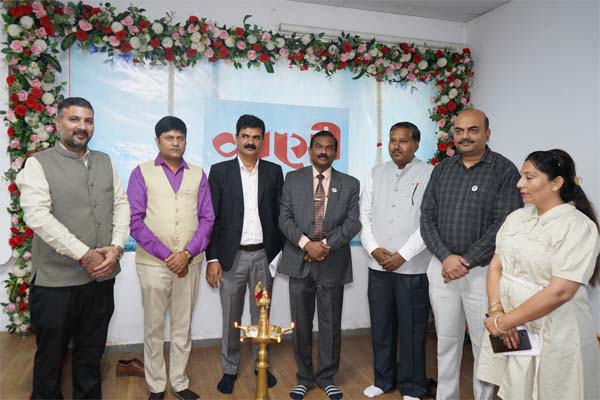
The seminar was inaugurated in the presence of Prof. (Dr.) M. S. Rao, Provost, Gokul Global University; Prof. (Dr.) Chetansinh Vaghela, Registrar; Dr. Raman Kumar, Dean Research; and Prof. (Dr.) Arvind Kumar Chauhan, Academic Director, Allied Health.
In their inaugural addresses, the dignitaries emphasised the critical shift towards human-centric, sustainable and resilient manufacturing systems, while commending the initiative to communicate cutting-edge engineering concepts in the regional language.
From smart factories to smarter human-machine collaboration
The programme drew 74 participants from colleges and universities across Gujarat, reflecting growing academic and professional interest in Industry 5.0 and advanced manufacturing technologies.
Expert sessions brought industrial and academic perspectives to the emerging technology landscape. Haresh Suthar, Manager, Gokul Agri Limited, Siddhpur; Dr. Raman Kumar, Dean Research, Gokul Global University; Guruprit Singh Saini, CEO and Director, App Aspect Technologies, Ahmedabad; and Nikita Sharma, Project Head, ICRAFT ADS, shared insights into industrial automation, smart factories, workforce reskilling and sustainable technology integration.
Unlike the Industry 4.0 emphasis on automation and connected systems, the Industry 5.0 approach discussed at the seminar highlighted the need to place people, sustainability and resilience alongside technology, preparing industries for a future in which humans and intelligent machines work more closely together.
Gujarati becomes a bridge to frontier technology
A key feature of the seminar was its conduct in Gujarati, enabling participants to engage with complex technological themes in a language that encouraged accessible and meaningful interaction.
The sessions covered Industry 5.0, automation, sustainability, human-centric innovation, artificial intelligence, robotics and future-ready skills, creating a platform for educators and participants to connect emerging industrial trends with the needs of Gujarat’s evolving manufacturing ecosystem.
The second day deepened the academic discussions through an expert panel comprising Dr. D. S. Patel, Principal, HCET, GGU; Dr. J. M. Rathod, Professor and Associate Dean, GTU, BVM Engineering College; Dr. Dhaval M. Patel, Professor, Government Engineering College, Palanpur; and Dr. Sunil Lavadiya, Associate Professor, Marwadi University, Rajkot.
Robot takes centre stage at AI Lab demonstration
A special attraction was the presentation and live demonstration of an AI Lab robot by Dr. D. S. Patel, offering participants practical exposure to the application of artificial intelligence and robotics within the Industry 5.0 ecosystem.
The seminar was coordinated by Dr. Vipulkumar Dabhi, Academic Director, Technical Programs, and Dr. Jatinder Kaur, Research Department.
The two-day programme thus sought to bridge the gap between emerging industrial technologies and accessible education, reinforcing the idea that the factory of tomorrow will not simply be more automated—it will need to be more sustainable, resilient and human-centric.