R ARIVANANTHAM
CHENNAI, JUNE 20
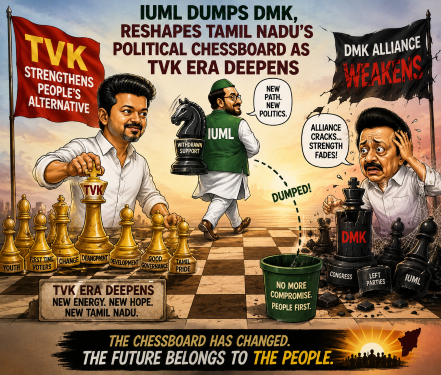
In a move that could redraw the contours of Tamil Nadu’s post-election political landscape, the Indian Union Muslim League (IUML) on Saturday formally announced its withdrawal from the DMK-led alliance, ending a long-standing electoral partnership and opening the door to a new phase of coalition politics under the emerging TVK-led dispensation.
- General Council resolution formally ends decades-old alliance, signalling a fresh round of coalition politics ahead of local body polls and bye-elections
- With its minister already part of the TVK government and future options kept open, the IUML’s strategic exit could trigger a realignment among minority and regional forces in the state
The decision, taken unanimously at the party’s General Council meeting through one of 14 resolutions adopted during the session, comes against the backdrop of sweeping political changes that followed the landmark 2026 Assembly elections.
Party leaders clarified that while ties with the DMK alliance have now been formally severed, decisions regarding future electoral partnerships will be taken at an appropriate time, particularly before forthcoming bye-elections and local body polls.
The development assumes significance because the IUML, despite contesting the Assembly election as part of the DMK front, is now effectively aligned with the ruling establishment after extending support to the TVK-led government.
Tamil Nadu witnessed one of its most fiercely contested Assembly elections on April 23, 2026, with all 234 constituencies going to the polls in a single phase. The contest featured the DMK alliance, AIADMK alliance, BJP and several regional players, while Tamilaga Vettri Kazhagam (TVK) under actor-turned-politician C. Joseph Vijay and Naam Tamilar Katchi (NTK) chose to fight independently.
Adding another dimension to the contest, PMK founder Dr. S. Ramadoss and former Chief Minister V.K. Sasikala joined forces to enter the electoral fray.
With more than 4,000 candidates in the race, the election produced a fragmented mandate but also heralded the arrival of a new political force. TVK emerged as the single-largest party by securing 108 seats, while the DMK-led alliance won 73 seats and the AIADMK alliance settled for 53 seats.
Although TVK fell short of the majority mark, it successfully formed the government with the support of several parties that had earlier contested under the DMK banner, including the Congress, VCK, CPI, CPI(M) and the IUML, subsequently proving its majority through a trust vote in the Assembly.
The IUML itself won two Assembly seats, with one of its legislators, A.M. Shahjahan, currently serving as a minister in the TVK-led Cabinet.
Party leaders maintained that the prevailing political circumstances no longer justified continuing within the DMK alliance, prompting the formal decision to walk out while simultaneously keeping future political alignments flexible.
Political observers believe the move could have far-reaching implications for Tamil Nadu’s coalition arithmetic. By distancing itself from the DMK while remaining part of the ruling ecosystem, the IUML has positioned itself to negotiate from a stronger vantage point ahead of local body elections and future electoral contests.
The decision is also likely to intensify competition among regional parties for minority votes and may encourage further recalibration among alliance partners as Tamil Nadu’s political landscape continues to evolve under the new balance of power.