NE DEFENCE BUREAU
JODHPUR, SEPT 20
In a landmark first for India-Japan military aviation ties, Japanese fighter aircraft are operating from Indian soil for the first time, taking bilateral air cooperation into a new phase of operational engagement—with Air Chief Marshal A.P. Singh describing the deployment as a “great milestone” and Japan Air Self-Defense Force (JASDF) Chief of Staff General Takehiro Morita underscoring the growing ability to deploy air assets across the Indo-Pacific.
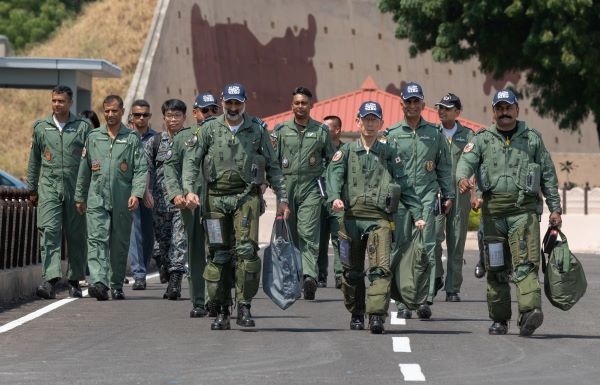
As part of Exercise Veer Guardian 26, General Takehiro Morita, Chief of Staff, Japan Air Self-Defense Force (JASDF) and Air Chief Marshal AP Singh, Chief of the Air Staff, visited Air Force Station Jodhpur and flew the indigenous #Tejas fighter aircraft.
Air… pic.twitter.com/s4KTCjdkvH
— Indian Air Force (@IAF_MCC) September 20, 2026
The milestone is unfolding at Air Force Station Jodhpur during the ongoing 14-day bilateral air exercise, Veer Guardian-2026, where India’s Tejas, Su-30MKI and Rafale fighters are training alongside Japan’s F-2A aircraft.
- Historic deployment: Japanese F-2A fighters operate from Indian soil for the first time during the bilateral exercise.
- Tejas diplomacy takes flight: Both air chiefs fly the indigenous fighter, underscoring professional trust and aviation cooperation.
- Indo-Pacific operational reach: JASDF chief says the deployment goes beyond exercises, demonstrating the ability to deploy air assets across the region.
- Learning, training, improving together: Singh highlights mutual learning, operational understanding and enhanced capabilities.
- Indigenous aviation push: Tejas Mk-2 development expected to take India’s defence aviation industry and R&D to “much higher heights”.
Air chiefs take to the skies in Tejas
The exercise, being held from September 9 to 22, has brought together frontline combat aircraft of the Indian Air Force (IAF) and the Japan Air Self-Defense Force (JASDF) for advanced operational missions and professional exchanges.
In a striking demonstration of the partnership, General Morita flew in a Tejas with an Indian pilot, while Air Chief Marshal Singh undertook a solo sortie in the indigenous fighter.
The two air chiefs also exchanged badges in a gesture symbolising mutual respect and the close professional relationship between the two air forces.
“This exercise, especially because the Japanese fighters are operating from Indian soil for the first time, is a great milestone in the history of our relationship and our partnership,” Singh said at a press conference after the sortie.
He said the exercise reflected the deepening strategic partnership between India and Japan, founded on mutual respect, professional trust and a shared commitment to peace and stability.
‘We fly together, train together, improve together’
Emphasising the operational value of joint exercises, Singh said they enabled both sides to learn from each other and improve their capabilities.
“When we do exercises together, we learn from each other. We fly together. We train together. So both sides improve together,” he said.
The IAF chief added that such engagements provided opportunities to understand each other’s operational practices and enhance capabilities through joint training.
The ongoing exercise includes advanced operational missions, alongside professional exchanges and discussions on mission planning, engineering and aerospace safety.
Japanese chief hails Indo-Pacific deployment capability
General Morita said the deployment of Japanese fighters to India had taken defence cooperation beyond simply conducting exercises.
He said it demonstrated the ability to deploy air assets across the Indo-Pacific region, while advanced training would deepen mutual understanding, strengthen trust and enhance sustained practical cooperation between the two countries.
Reflecting on his flight in the Tejas, Morita described the indigenous fighter as a symbol of India’s technological innovation and the ‘Make in India’ initiative.
He said the experience had brought into focus the efforts of military personnel and industry professionals who contributed to the aircraft’s development.
“I will remember it not only as a truly invaluable experience, but also as a powerful symbol of the trust, confidence, and partnership that have been built between our two air services over many years,” he said.
Tejas programme and Mk-2 development in focus
The exercise also provided an opportunity to highlight India’s indigenous combat aircraft programme.
On Tejas procurement, Singh said a large number of aircraft had been ordered, although some deliveries had been affected by global supply-chain issues.
He said the development of the Tejas Mk-2, an advanced medium combat aircraft, would take India’s defence aviation industry and research and development to “much higher heights”.
The exercise comes as the two air forces continue to deepen professional engagement through operational training and exchanges, with the participation of India’s indigenous Tejas alongside the Su-30MKI and Rafale, and Japan’s F-2A fighters.
A new chapter in bilateral air cooperation
Veer Guardian-2026, being conducted at Air Force Station Jodhpur from September 9 to 22, brings together the two air forces for a series of joint missions and professional interactions.
The first-time deployment of Japanese fighter aircraft on Indian soil marks a notable expansion in the practical dimensions of India-Japan defence cooperation, while the air chiefs’ Tejas sorties offered a visible expression of the professional trust underpinning the partnership.