- Three-day Mahoba conference demands same facilities for all working journalists covered by new Labour Codes, irrespective of accreditation
- Union seeks nationwide journalist pension, ₹5,000 minimum PF pension, stronger healthcare and permanent relief for families of journalists who die in service
- Journalists’ Protection Law, affordable housing, advertising quota for small and medium newspapers and web-media policy figure among key demands
- Rail fare concession, desk-journalist accreditation and broader medical cover among benefits sought to be restored
- More than 300 delegates from across Uttar Pradesh deliberate on journalists’ rights, professional accountability and challenges confronting the Fourth Estate
NE MEDIA BUREAU
LUCKNOW, SEPT 15
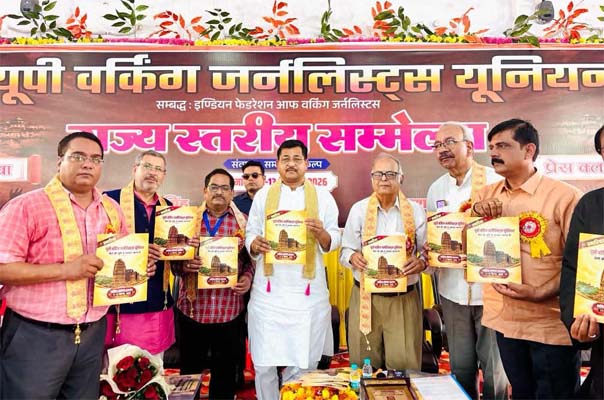
A journalist’s right to social security, healthcare and professional dignity should not depend on whether he or she carries an accreditation card. That was the central message emerging from the three-day state-level representatives’ conference of the Uttar Pradesh Working Journalists’ Union in Mahoba, which demanded an end to what it described as discrimination between accredited and non-accredited journalists.
The Union called for all working journalists covered by the new Labour Codes to receive the facilities being extended by the Uttar Pradesh government to accredited journalists, putting equality of treatment at the centre of its charter of demands.
The conference, attended by more than 300 representatives from most districts of Uttar Pradesh, also placed journalist pension, healthcare, protection from attacks, housing, advertising policy and the future of digital media on the agenda.
‘Equal work, equal welfare’
The Union expressed concern over the government’s decision to restrict medical facilities at government hospitals—previously available to working journalists on the lines of benefits enjoyed by state employees—to accredited journalists.
It also raised the issue of accreditation for desk journalists, alleging that the matter had been put on the back burner.
The conference demanded that these facilities be restored and that the distinction between accredited and non-accredited journalists be removed wherever welfare and social-security benefits are concerned.
The representatives also sought clarity and action on Patrakar Bandhu, an initiative constituted during the Rajnath Singh government in Uttar Pradesh.
Another major concern was the withdrawal of the 50% railway fare concession for journalists during the COVID-19 pandemic. The Union demanded its restoration.
The underlying argument was straightforward: professional recognition may have different criteria, but basic social security should not create a hierarchy among journalists performing the same public-service role.
Pension emerges as a major battlefront
The memorandum presented by Union state president Haseeb Siddiqui called for a nationwide pension system for journalists.
The Union also demanded that the minimum pension available through the Provident Fund be increased from ₹1,000 to ₹5,000 per month, arguing for stronger financial security for journalists after their working years.
The memorandum further sought a permanent financial-assistance mechanism for families of journalists who die in accidents or other untimely circumstances.
With journalism increasingly becoming a high-pressure and vulnerable profession, the demand for social security was placed alongside concerns over attacks on journalists.
The Union called for a Journalists’ Protection Law, seeking institutional safeguards against growing threats to media professionals.
Healthcare, homes and a new media economy
Healthcare featured prominently in the charter.
The Union demanded simplification of the medical facilities available to journalists based at the state headquarters through PGI, and sought extension of the benefits to journalists across the state.
It also sought residential plots for journalists at concessional rates, recognising housing as an important component of long-term social security.
For the media industry, the Union demanded a fixed percentage of government advertising for small and medium newspapers, arguing that smaller publications require predictable access to advertising to remain economically viable.
A dedicated web-media policy was another key demand, reflecting the structural transformation of journalism from traditional print and broadcast platforms to digital-first operations.
The Union also sought the establishment of a state-level Press Council.
Ayushman cover welcomed, but wider access sought
The conference expressed gratitude to Chief Minister Yogi Adityanath for bringing journalists under the Ayushman scheme.
At the same time, delegates suggested that shortcomings in the scheme should be addressed and its coverage made more comprehensive so that journalists can derive meaningful healthcare protection from it.
The message from the conference was that healthcare support should function as a genuine social-security mechanism rather than remain limited by administrative classifications.
Union turns the spotlight on journalists themselves
Significantly, the conference did not restrict its deliberations to demands from the government.
Speakers also highlighted shortcomings within the journalistic community, calling for introspection and corrective measures.
Representatives were invited to submit written suggestions. After receiving the recommendations, the Union said it would engage with the government on a code of conduct for journalists.
This emphasis on rights alongside responsibilities gives the conference a wider significance: a stronger Fourth Estate, the Union suggested, must combine institutional protection with professional accountability.
Ministers assure delegates
Addressing the conference, Minister of State for Jal Shakti Ramkesh Nishad and Minister of State for Labour and Employment Manohar Lal Mannu Kori assured the delegates that the Union’s memorandum would be forwarded to the Chief Minister.
Shivsharan Singh, chairman of the reception committee, welcomed the delegates, while General Secretary Devraj Singh presented a report on the Union’s activities during the past year.
The conference was also addressed by IFWJ Vice-President Prem Kant Tiwari and Headquarters Secretary K. Vishwadev Rao.
Sanjay Mishra, Mahoba district president and chairman of the organising committee, proposed the vote of thanks. Mishra was also appointed president of the Chitrakoot division.
The conference combined organisational deliberations with local culture, with delegates enjoying Bundeli cultural programmes on both days. On the final day, representatives visited Khajuraho, the world-famous heritage site.
The Mahoba conference has thus put a larger question before the government: in an age when journalism is being reshaped by technology, economic pressures and new forms of risk, can social security for the people who sustain the Fourth Estate remain tied to an accreditation label?
For the Uttar Pradesh Working Journalists’ Union, the answer is clearly no.