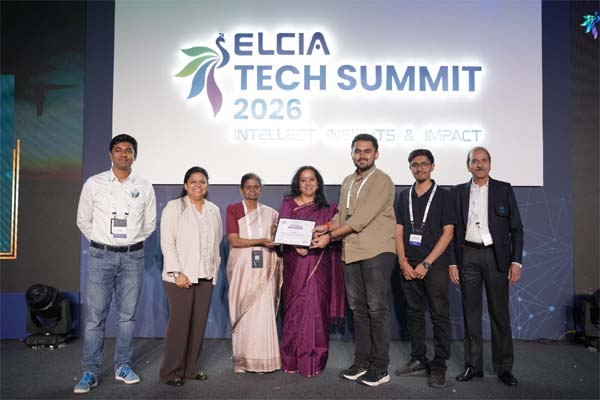
- GSFC University teams sweep the top two spots at ELCIA Smart City Drone-AI Challenge 2026, taking home ₹85,000 of the ₹1.10-lakh prize pool
- HYDRO-VISION-3D and CivicPulse deploy drone imagery, AI, GIS and GPS to detect potholes, waterlogging, open manholes and other urban hazards
- 183 teams, 343 participants and 18 states: competition challenges young innovators to transform real-world city data into actionable solutions
- From detecting a civic problem to tracking its repair, GSFC University students showcase how AI can move urban governance from reaction to prediction
NE SCIENCE & TECHNOLOGY BUREAU
VADODARA, SEPT 15
When a drone flies over a city, it does more than capture images—it can potentially see the warning signs of a civic crisis before they become a public hazard. Two student teams from GSFC University have demonstrated precisely that proposition, combining artificial intelligence, drone imagery, GIS and data analytics to tackle some of the most persistent problems confronting urban India.
The teams secured the First Prize and First Runner-Up at the ELCIA Next-Gen Innovative Tech Hackathon 2026 – Smart City Drone-AI Challenge, jointly organised by the Electronics City Industries Association (ELCIA), IIIT-Bangalore and VLSI System Design (VSD).
Together, they won ₹85,000 from the total ₹1.10-lakh prize pool, with GSFC University emerging as the only institution to capture both the top two positions and the only institution to have two teams among the Top 5 finalists.
From aerial images to municipal action
The winning team, Drone404, comprising third-year B.Tech Computer Science & Engineering student Krishay Shah and second-year B.Tech CSE student Tatva Shah, presented HYDRO-VISION-3D.
The project goes beyond merely identifying problems from drone footage. Its AI-powered 3D Ground Control Station is designed to detect potholes, waterlogging, open manholes, drainage overflow and damaged footpaths.
It combines AI-based detection, object tracking, depth estimation, GIS mapping and risk analytics, converting visual evidence of civic hazards into actionable municipal work orders.
The larger idea is significant: instead of waiting for citizens to report a dangerous pothole, flooded road or open manhole, technology can help authorities spot, map, prioritise and act on the problem systematically.
CivicPulse takes intelligence from detection to restoration
The First Runner-Up team, CivicPulse, comprising third-year B.Tech CSE students Manthan Chawda and A. Manav Prasath, developed AI-Assisted Monsoon Civic Risk Intelligence.
The system processes drone footage and GPS data to identify civic hazards, while providing operators with tools to verify incidents, assign repairs, monitor their progress and confirm restoration.
The AI pipeline was trained on a dataset of 8,063 images, giving the project a substantial data-driven foundation for identifying monsoon-related civic risks.
Together, the two projects demonstrate an important evolution in smart-city technology: the objective is not simply to detect a problem, but to create an intelligence loop from detection to decision, intervention and verification.
A national innovation challenge
The scale of the competition underlines the significance of the achievement.
The hackathon attracted 183 team registrations and 343 participants representing 18 states, challenging students to develop AI-powered solutions for real-world urban problems using drone and city-video footage.
Both GSFC University teams competed in the Monsoon, Roads & Civic Infrastructure Intelligence track.
Their success also highlights how engineering education is increasingly moving beyond classroom concepts towards problem-solving based on real-world datasets, emerging technologies and public-sector applications.
Technology with a civic purpose
The achievements came against the backdrop of the ELCIA Tech Summit 2026, held on September 10 at The Oterra, Electronics City, Bengaluru, under the theme “Intellect. Insights. Impact.”
The summit brought together more than 1,000 participants and 50-plus speakers and partners from across the technology ecosystem.
For GSFC University, however, the bigger prize may extend beyond the ₹85,000 won by its students.
Their projects point towards a future in which drones become the eyes of smart cities and AI becomes the intelligence layer that helps governments respond faster and more precisely.
In cities increasingly challenged by intense monsoons, deteriorating roads and overloaded civic infrastructure, such technologies could transform urban governance from complaint-driven response to evidence-driven intervention.
The real innovation, therefore, is not the drone flying above the city.
It is the intelligence that tells the city what needs attention—and helps ensure that the problem is actually fixed.