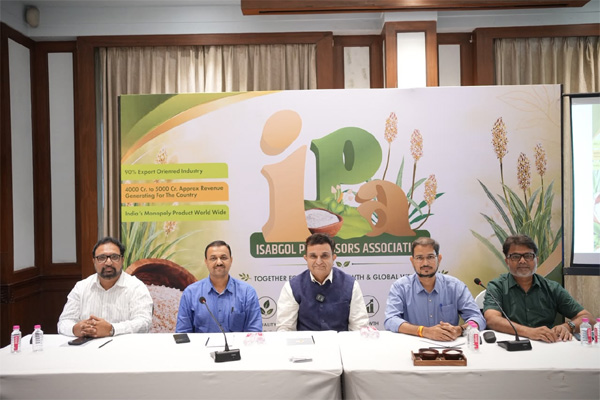
- Unjha’s Isabgol trade grinds to a halt as Gujarat-Rajasthan tax interpretations diverge
- IPA urges GST Council, Finance Ministry, CBIC and TRU to issue an urgent pan-India clarification
- CBIC FAQ says fresh Isabgol seeds are Nil-rated; dried seeds attract 5% GST
- Tax uncertainty threatens farmers, traders, processors, exporters and thousands of jobs
- With 90% of finished Isabgol Husk exported, industry warns of global customers shifting to rival suppliers
- IPA meets Gujarat Finance Minister Kanu Desai; seeks immediate intervention to prevent wider shutdown
SEO Keywords: Isabgol GST dispute 2026, Isabgol GST rate, Psyllium seeds GST, Unjha Isabgol market, Isabgol Processors Association, Gujarat Rajasthan GST dispute, fresh Isabgol Nil GST, dried Isabgol 5% GST, GST Council Isabgol, Kanu Desai Isabgol, Isabgol exporters Gujarat, One Nation One Tax, Psyllium Husk exports India
R MANICKAVASAGAM
AHMEDABAD, AUG 25
A tax interpretation may sound like a technical matter in a file—but in Unjha, it has become a question of whether farmers can sell their crop, processors can keep their factories running, exporters can honour overseas contracts and India can retain its commanding position in the global Isabgol market.
The Isabgol Processors Association (IPA) has made an urgent appeal to the GST Council, Ministry of Finance, Central Board of Indirect Taxes and Customs (CBIC) and Tax Research Unit (TRU) to end what it describes as a damaging ambiguity over the GST treatment of naturally procured Isabgol (Psyllium) seeds.
At the heart of the dispute is a deceptively simple question: when Isabgol seeds are purchased directly from farmers in their natural, raw and unprocessed condition, without intentional drying or processing, are they “fresh” and therefore Nil-rated, or do they become “dried” and attract 5% GST merely because they are stored in dry, ventilated premises?
The stakes are enormous. Unjha, one of India’s principal Isabgol trading centres, has seen trading activity severely disrupted amid the uncertainty, with processors, traders and exporters seeking a single national position before normal transactions can resume. Recent reports put the annual value of Unjha’s Isabgol trade at around ₹5,000 crore, while the disruption is already affecting raw-material supplies and export schedules.
The tax question that has frozen a ₹5,000-cr market
The irony confronting the industry is stark: the GST framework itself distinguishes between fresh and dried Isabgol.
The CBIC’s official GST FAQ states that Isabgol seeds fall under HSN 1211, with fresh Isabgol attracting Nil GST and dried or frozen Isabgol attracting 5% GST.
The Gujarat Authority for Advance Ruling (GAAR), in GUJ/GAAR/R/2026/21 dated May 29, 2026, held that Psyllium seeds supplied in their natural, raw and unprocessed form, procured directly from farmers through APMC auctions and without drying, freezing, crushing or other processing, qualify as fresh Isabgol and are exempt from GST. The GST Council’s own AAR database records this ruling.
But subsequent Rajasthan AAR rulings have taken a different view in several cases, holding that seeds stored in dry and ventilated godowns acquire a dried character and attract 5% GST. The official GST Council database records such rulings dated July 29, 2026, including cases involving Shrigopal Jaju, Jai Mata Di, Rajendra Prasad and Mahavir Parsad Agarwal.
That is where the trouble begins.
For a commodity that routinely moves across Gujarat, Rajasthan and Madhya Pradesh, divergent tax interpretations can turn an ordinary interstate transaction into a potential future liability involving tax, interest and penalties.
IPA: Give the industry one rule, not two interpretations
IPA President Ashwin Nayak said the industry needs an unambiguous national position that farmers, APMC traders, processors and exporters can follow without fear of retrospective action.
The Association has specifically urged the GST Council, Finance Ministry, CBIC and TRU to clarify that Isabgol seeds purchased from farmers in their natural condition and supplied to processing units without intentional or mechanical drying should be treated as fresh and therefore remain exempt from GST.
The demand has acquired urgency because the uncertainty is no longer confined to tax files.
Industry reports indicate that the deadlock has affected auctions at Unjha, with traders reluctant to transact because of fears that a future assessment could impose GST, interest and penalties on transactions treated as exempt at the time of sale.
For a market dependent on continuous procurement, the consequences quickly cascade—from farmer to trader, trader to processor, processor to exporter and exporter to overseas customer.
“Nearly 25 units have shut shop,” says IPA
Nayak said the situation has already inflicted a heavy economic and employment cost on the processing industry.
“Owing to this vexatious issue, out of nearly 80 units in the state, nearly 25 units have shut shops. Thousands of daily labourers have been rendered jobless, putting a question mark on their livelihood,” he said.
According to Nayak, the Association has already taken up the matter with Gujarat Finance Minister Kanu Desai and sought immediate intervention.
“Desai has already spoken to the higher authorities of GST on our demand,” Nayak said.
He warned that the present crisis could spread unless the ambiguity is resolved on a war footing.
“If no measure is taken to address this issue on a war footing, the remaining units will also be shut down,” he said.
The industry, therefore, is not merely seeking a tax concession. It is seeking predictability—a basic requirement for an agricultural commodity whose supply chain crosses State boundaries and feeds an export-oriented processing sector.
90% of isabgol husk output heads abroad
The urgency becomes even clearer when the export dimension is considered.
According to the IPA, nearly 90% of finished Isabgol Husk is exported, while around 10% is sold domestically at 5% GST. Nearly 70% of annual seed procurement takes place between April and June, whereas exports continue throughout the year.
This creates a peculiar working-capital challenge.
If GST is imposed on naturally procured fresh seeds, processors could face substantial blockage of funds through input tax credit in an industry whose overwhelming output is exported. The Association says the accumulated credit would ultimately have to be utilised or refunded, adding financial and procedural pressure to businesses already operating in a globally competitive market.
And there is a larger danger.
If Indian processors cannot procure raw material smoothly, they cannot process and ship Isabgol Husk reliably. If shipments are delayed, overseas buyers may look elsewhere.
Nayak put the international risk bluntly:
“This cascading effect will not only impact our foreign revenue, but our global customers will also turn to other countries for supply.”
Farmers, workers and exporters all in the same tax boat
The immediate casualty of the dispute may appear to be the processor, but the impact travels much further.
Unjha’s market functions as a critical price-discovery mechanism for Isabgol growers. When auctions stop or buyers become hesitant, farmers can face difficulty selling their produce at the appropriate time. Recent reporting has noted concerns over farm payments, factory under-utilisation and delayed export consignments.
The industry’s concern is particularly acute because Isabgol is not merely a local agricultural commodity.
It feeds a specialised processing ecosystem comprising cleaning, grading, processing, husk production, domestic distribution and exports.
Industry estimates cited in recent reports indicate that around 65 processing units operate around the Unjha ecosystem, handling substantial volumes of Psyllium for overseas markets.
Thus, a dispute over whether a naturally procured seed is “fresh” or “dried” can ultimately affect:
Farm income → APMC auctions → processor capacity → employment → exports → foreign exchange earnings → India’s global market position.
Why “one nation, one tax” needs one isabgol rule
The IPA’s appeal carries a broader GST message.
The very purpose of a unified GST regime is to create certainty, uniformity and seamless movement of goods across State borders.
But if substantially similar Isabgol transactions are treated differently merely because the commodity moves from one State to another, the industry argues that the objective of a common national tax regime is undermined.
The issue is particularly sensitive because Advance Rulings are generally binding only on the applicant and the concerned jurisdiction, rather than automatically creating a nationwide precedent. This is precisely why the Association wants the GST Council/CBIC to step in with a common clarification rather than leaving individual traders to navigate conflicting interpretations.
The official GST Council database itself demonstrates the divergence: while the Rajasthan case M/s Surendra Bucha was ruled Nil-rated/fresh on July 27, 2026, several other Rajasthan rulings two days later treated comparable seeds as dried and taxable at 5%.
That inconsistency makes a central clarification even more compelling.
IPA’s message to the powers that be: Act before the crisis spreads
The Association’s appeal is therefore directed not only at tax administrators but at every stakeholder with a role in India’s agricultural, industrial and export ecosystem.
To the GST Council: establish one nationally applicable interpretation.
To the CBIC and TRU: remove the ambiguity between naturally procured fresh seeds and genuinely dried seeds.
To the Finance Ministry: recognise the cascading employment, working-capital and export implications.
To Gujarat and Rajasthan authorities: ensure that farmers and traders are not caught between contradictory interpretations.
To policymakers: protect India’s hard-earned position in the global Isabgol market before international customers begin seeking alternative sources.
And to the wider industry, the IPA’s message is unmistakable: a tax dispute must not be allowed to become a supply-chain crisis.
For an export-oriented agricultural processing industry, clarity is not a favour—it is the foundation on which contracts, prices, employment and global credibility are built.
The IPA is consequently pressing for an urgent, nationally applicable clarification so that the Unjha market can resume normal operations, farmers can sell with confidence, processors can restart procurement, workers can return to work and exporters can honour their global commitments.
The question now before the powers that be is simple: if GST is one national tax, why should one naturally procured Isabgol seed have two tax identities?