
NE DEFENCE BUREAU
JODHPUR, OCT 10
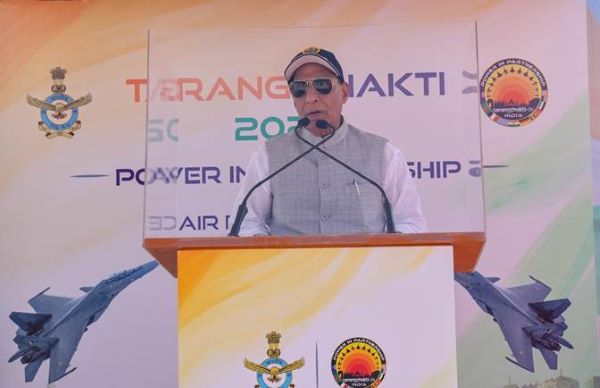
The future of air power will not be decided by aircraft numbers alone, but by how rapidly a nation can detect a threat, process information, make decisions and act with precision. That was the strategic message Defence Minister Rajnath Singh delivered at Exercise Tarang Shakti 2026 in Jodhpur on Saturday, calling for a defence ecosystem that combines indigenous technological strength with trusted international partnerships.
Addressing participants of the multinational air exercise at Air Force Station Jodhpur on October 10, Singh underscored the growing importance of artificial intelligence, unmanned systems, advanced sensors, electronic warfare and long-range precision weapons in modern conflict. His message was clear: India must strengthen its ability to develop and sustain critical defence technologies at home while deepening cooperation with countries that share common security interests.
- Defence Minister Rajnath Singh addresses multinational air exercise in Jodhpur as Tarang Shakti 2026 enters its final phase
- Seven foreign air forces and 32 observer nations join India in a major demonstration of international defence cooperation
- “Future military power will be defined by the speed of sensing, understanding, deciding and acting”
- Tejas, Prachand and indigenous defence systems showcase India’s growing aerospace manufacturing capabilities
- “The defence relationships of the future will be about technology and trust, not just about platforms”
- India calls for stronger co-development, co-production, advanced aero-engine technology and resilient defence supply chains
“Future military power will be defined less by the number of platforms we possess. It will be determined by the speed of sensing, understanding, deciding, and acting,” he said, highlighting speed, precision, information and integration as defining attributes of future military capability.
Hosted by the Indian Air Force (IAF) from September 26 to October 12, 2026, the second edition of Exercise Tarang Shakti has brought together air forces from seven Friendly Foreign Countries — Australia, Bangladesh, France, Germany, Sri Lanka, the United Arab Emirates and the United States — along with 32 observer nations.
Congratulating the IAF and the organisations and personnel involved in conducting the exercise, Singh welcomed the participating contingents and said their presence had enriched professional understanding and operational cooperation. He expressed confidence that they would return with valuable insights into India’s capabilities and perspectives.
From traditional warfare to a multidomain battlespace
Singh observed that warfare was undergoing a profound transformation, extending beyond the traditional domains of land, sea and air to include space, cyberspace, the electromagnetic spectrum and the information domain.
The growing influence of drones, unmanned platforms, artificial intelligence, electronic warfare and long-range precision weapons has altered the way military operations are planned and executed. These developments, he said, require continuous vigilance, rapid adaptation and the ability to integrate information and capabilities across multiple domains.
The changing geopolitical environment and uncertainties surrounding technological advances make it imperative for armed forces to remain prepared for emerging threats. For air forces in particular, the ability to connect sensors, command systems, aircraft and precision weapons into a coordinated operational network is becoming increasingly important.
Self-reliance: The foundation of strategic autonomy
Highlighting India’s defence transformation under Prime Minister Narendra Modi, the Defence Minister said Atmanirbharta in defence had become a national policy aimed at strengthening the country’s resilience against emerging security challenges.
He stressed that a nation must possess the capability to manufacture its own weapons and critical technologies to sustain itself during prolonged conflicts and periods of uncertainty.
India’s journey from the resource constraints of the early post-Independence years to a modern aerospace power illustrated the scale of the transformation, he said. The IAF today operates advanced aircraft, precision weapons, sophisticated sensors and integrated networks, alongside an expanding range of indigenous technologies.
Singh clarified that self-reliance did not mean isolation from the international community. Instead, it meant developing the domestic capacity to design, develop, manufacture, maintain and upgrade critical systems while engaging constructively with trusted partners.
Tejas to AMCA: Building India’s aerospace future
Defence Minister highlighted India’s expanding aerospace and defence manufacturing ecosystem, citing indigenous platforms and technologies including the Tejas fighter aircraft; Dhruv, Rudra and Prachand helicopters; the Light Utility Helicopter; the Akash air defence system; AESA radars; and emerging unmanned and aerospace technologies.
He also referred to the Advanced Medium Combat Aircraft (AMCA) programme as an important step towards mastering fifth-generation stealth fighter technology.
Advanced aero-engine development, he emphasised, would be another critical area for technological progress. India is keen to explore cooperation with like-minded countries in research, co-development, co-production, maintenance, training and innovation.
The objective is to strengthen domestic design and manufacturing capabilities, reduce vulnerabilities in critical supply chains and create opportunities for collaboration in advanced technologies.
“The defence relationships of the future will be about technology and trust, not just about platforms,” Singh said.
The statement underlined the importance of moving beyond conventional buyer-seller relationships towards partnerships that involve shared research, technology development, industrial collaboration and long-term support.
India, he said, must be capable of acting independently when required while working effectively with other nations when their interests and responsibilities converge.
Tarang Shakti: Interoperability tested in the skies
Singh described Exercise Tarang Shakti as an important platform for translating capability, technology, interoperability and trust into operational experience.
The exercise has enabled participating air forces to operate alongside one another, exchange professional knowledge, assess procedures and understand different platforms, doctrines and approaches to mission planning. Such engagements allow aircrews and commanders to examine assumptions, learn from one another and identify opportunities to improve systems and operational processes.
Summing up the spirit of the exercise, Singh said: “Different nations. Different aircraft. Different experiences. But one sky. That is the message of Tarang Shakti.”
He emphasised that the value of the exercise extended beyond sorties flown and scenarios practised. The ability to communicate, coordinate and operate effectively with partner forces was equally important.
Defence Minister called upon the IAF to incorporate the lessons learnt into its training, tactics, technology, doctrine and future capability development. He also expressed confidence that the professional relationships established during the exercise would lead to further opportunities for aerospace and defence cooperation.
The second edition builds on the inaugural exercise held in 2024. Its mix of combat, transport, surveillance and air-to-air refuelling capabilities has provided opportunities for joint mission planning, operational learning and improved interoperability. The participation of indigenous platforms, including the Light Combat Aircraft Tejas and Light Combat Helicopter Prachand, has also showcased India’s aerospace engineering and manufacturing progress.
Operation Sindoor and the lessons of modern air power
The exercise’s contemporary relevance has also been linked to the role of air power in Operation Sindoor, which highlighted the importance of operational preparedness, integrated planning, credible deterrence and the calibrated application of military capability in a complex security environment.
The experience of operational employment reinforces the need for armed forces to assess emerging threats, refine procedures and maintain readiness. Multinational exercises such as Tarang Shakti provide a complementary setting for professional exchanges and learning, helping participating forces understand how different systems and operational approaches can work together.
For India, the wider strategic objective is to combine credible indigenous capabilities with the ability to cooperate effectively with trusted partners, without compromising the capacity to act independently when national security requires it.
Beyond sorties: Building lasting defence relationships
Tarang Shakti has extended beyond flying operations to include professional engagements, industrial visits and cultural exchanges. Activities such as yoga sessions, heritage visits and an International Night celebrating the traditions of participating nations have added a people-to-people dimension to the exercise.
Chief of Defence Staff General N. S. Raja Subramani, Chief of the Air Staff Air Chief Marshal A. P. Singh, Chief of the Naval Staff Admiral Krishna Swaminathan, Ministry of Defence officials and representatives of participating countries attended the event.
As the exercise approaches its conclusion on October 12, its larger message extends beyond the aircraft and formations in the skies over Jodhpur. India’s defence ambitions rest on three connected priorities: stronger domestic technological capabilities, sustained investment in advanced military systems and partnerships built on mutual trust.
In a battlespace increasingly shaped by data, autonomy and speed, Tarang Shakti has offered a forum to test interoperability while reinforcing the principle that strategic self-reliance and international cooperation can strengthen each other.