
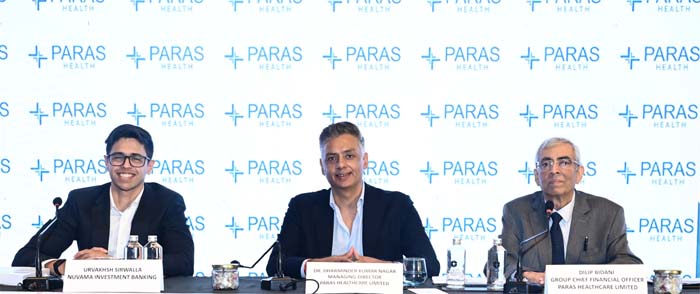
- Price band fixed at ₹660–693 per share; subscription opens October 21
- Group CFO announces ₹375-crore debt repayment and plans to add 800 beds
- Fresh issue of ₹500 crore and ₹950-crore offer for sale by existing shareholders
- FY26 revenue rises 24.1% to ₹1,606 crore; company returns to profitability with ₹43.83-crore PAT
- Management highlights approximately ₹50-crore Q1 FY27 PAT at Ahmedabad press conference
- MD defends ethical practices, cites PM-JAY adoption in J-K and backs family doctors
R MANICKAVASAGAM
AHMEDABAD, OCT 16
Can a fast-growing corporate hospital chain deliver stronger shareholder returns while keeping quality healthcare accessible and affordable for ordinary families? This question assumes particular significance as Paras Healthcare Ltd prepares to raise ₹1,450 crore through an initial public offering (IPO), with plans for an additional 800 beds, two more hospitals by 2028 and a renewed focus on financial consolidation amid rising patient volumes and improving profitability.
The Gurugram-based company, which operates eight multispeciality hospitals under the Paras Health brand, has fixed the IPO price band at ₹660–693 per equity share. The issue will open for subscription on Wednesday, October 21, and close on Friday, October 23. Bidding by anchor investors is scheduled for October 19.
The IPO comprises a fresh issue of equity shares worth up to ₹500 crore and an offer for sale (OFS) of ₹950 crore by existing shareholders. At the upper end of the price band, the company’s post-issue market capitalisation is estimated at approximately ₹7,500 crore.
Debt reduction, capacity expansion
Addressing the media in Ahmedabad on Friday, Paras Health Group CFO Dilip Bidani announced plans for ₹375 crore in debt repayment and an additional 800 beds across the hospital network.
The proposed expansion is intended to strengthen the group’s treatment capacity as demand for its services grows, while debt repayment would help improve its financial position.
Under the stated objects of the IPO, the company proposes to utilise the net proceeds from the fresh issue for prepayment or scheduled repayment of certain outstanding borrowings, investment in its wholly owned subsidiary, Plus Medicare Hospitals Private Limited, to facilitate repayment or prepayment of the subsidiary’s borrowings, and general corporate purposes. The subsidiary also operates the group’s hospital in Srinagar.
The ₹950-crore OFS will allow existing shareholders to sell part of their holdings, with the proceeds going to the selling shareholders rather than the company.
The equity shares, with a face value of ₹1 each, are proposed to be listed on the BSE and the National Stock Exchange of India.
JM Financial Ltd, BofA Securities India Ltd and Nuvama Wealth Management Ltd are the book-running lead managers to the issue.
Investors can bid for a minimum of 21 equity shares and in multiples of 21 shares thereafter. The net offer has reserved 75% for qualified institutional buyers, 15% for non-institutional investors and 10% for retail investors.
Patient volumes and earnings rise
Paras Healthcare’s operating performance has strengthened over the past two financial years, with growth in inpatient admissions, surgeries and outpatient consultations.
According to its June 2026 draft abridged prospectus, inpatient volumes increased 42.5% to 1,15,496 in FY26 from 81,047 in FY24. Surgeries rose 31.3% to 39,687 from 30,219, while outpatient consultation visits climbed 36.8% to 7,78,707 from 5,69,139 over the same period.
Revenue from operations increased 24.1% year on year to approximately ₹1,606 crore in FY26 from ₹1,294 crore in FY25.
The company reported consolidated profit after tax (PAT) of ₹43.83 crore in FY26, reversing a loss of ₹57.98 crore in the preceding financial year. At the Ahmedabad press conference, the management also highlighted a PAT of approximately ₹50 crore for the first quarter of FY27, indicating a strong start to the current financial year. The quarterly figure should be read alongside subsequent financial disclosures to assess the sustainability of its earnings performance.
The improvement in profitability coincided with higher bed occupancy and an expansion in operational capacity. Overall bed occupancy rose to 61.75% in FY26 from 52.46% in FY24.
As of March 31, 2026, Paras Healthcare had 1,502 operational beds, up from 1,332 two years earlier. Its intensive care unit (ICU) bed capacity increased to 559 from 425 over the same period.
While these figures point to rising utilisation and capacity, they do not, by themselves, establish improvements in clinical outcomes or demonstrate that treatment has become more affordable.
Growing presence beyond Gurugram
Paras Health operates eight hospitals across five states and one Union Territory. Its facilities are located in Gurugram and Panchkula in Haryana, Patna and Darbhanga in Bihar, Kanpur in Uttar Pradesh, Udaipur in Rajasthan, Ranchi in Jharkhand and Srinagar in Jammu and Kashmir.
Hospitals outside Gurugram contributed 68.18% of revenue from operations in FY26, compared with 62.35% in FY24, reflecting a growing contribution from facilities beyond its principal base.
The group’s key specialties include cardiac sciences, oncology, neurosciences, gastro sciences, orthopaedics and renal sciences.
Paras Health was ranked joint third alongside Manipal Hospitals in the National Group Ranking 2026 for private multispeciality hospital groups.
Affordability versus shareholder returns
The company’s growth in revenue, patient numbers and surgical volumes also raises a larger public-interest question: what safeguards ensure that improved financial performance does not come at the cost of affordable and appropriate treatment?
Asked what concrete measures Paras Healthcare had to prevent revenue growth from depending excessively on higher treatment prices, unnecessary procedures or expensive diagnostic packages, and whether it would disclose the proportion of patients treated under government health schemes and the revenue generated from them, Paras Health Managing Director Dr Dharminder Kumar Nagar said the group’s expansion carried a responsibility to strengthen clinical capabilities.
“Our growth in inpatient volumes and surgeries brings a responsibility to strengthen the clinical teams and infrastructure supporting that care. We are focused on building specialist capabilities and critical care capacity across our hospitals, while maintaining consistent standards as more patients use our network,” he said.
Rejecting concerns over unnecessary interventions, Dr Nagar added: “We run our hospitals ethically and do not thrust any unnecessary procedures or expensive diagnostic packages.”
Highlighting the company’s participation in government-supported healthcare, he said: “We are the first corporate hospital in J-K to adopt PMJAY of the government scheme to help all needy patients.”
Disclosure of the proportion of patients covered under government health schemes and the corresponding revenue would help investors and the public assess the extent of the group’s contribution to publicly supported healthcare. Such information would also provide a clearer picture of how the company’s commercial growth intersects with the objective of making treatment accessible to economically vulnerable patients.
Family doctors remain vital, says MD
Dr Nagar also addressed concerns that the expansion of corporate hospitals could undermine the survival of family doctors and primary healthcare practitioners.
He said primary health centres and family doctors continued to play a vital role in the healthcare system. Observing that many medical graduates aspired to become super-specialists, he emphasised the need to strengthen the role of family doctors.
“We advocate the services of the family doctors to strengthen our country’s healthcare system,” he said.
Family doctors and primary health centres often provide the first point of contact for patients, supporting preventive care, early diagnosis, continuity of treatment and timely referrals to specialists. Their role remains particularly important in ensuring that patients receive appropriate care at the right level.
As Paras Healthcare approaches the capital market, investors will assess its financial performance, debt position and expansion plans. Equally important for the wider public will be whether its growing network can combine specialised treatment and commercial sustainability with transparency, ethical clinical practices and affordable access to healthcare.