
R ARIVANANTHAM
At a time when political parties are crafting narratives for electoral gain, a deeper test of democratic commitment lies in whether they will address the silent crisis facing India’s journalists—the absence of a uniform, dignified pension system. As Assembly elections gather momentum and a special session of Parliament is set to be convened, the demand for a ‘One Nation, One Pension’ (ONOP) scheme for journalists must move from the margins to the centre of political discourse. This is not just a manifesto point waiting to be written—it is a national obligation waiting to be fulfilled.
- Assembly Polls Offer the Perfect Moment to Correct a Historic Blind Spot
- From OROP to ONOP: Extending Dignity to the Fourth Pillar
- Patchwork State Schemes Underscore Urgent Need for National Uniformity
- Parliamentary Committees Have Already Laid the Groundwork
- Raise It in the Special Parliamentary Session: Turn Promise into Policy
- Launch from Gujarat, Name It After Sardar Patel at 150
A democratic debt long overdue
Journalists form the backbone of public accountability, yet their post-retirement lives are marked by uncertainty and neglect. While the Working Journalists and Other Newspaper Employees (Conditions of Service) and Miscellaneous Provisions Act, 1955 provides statutory recognition, it stops short of ensuring social security.
As leaders of the Indian Federation of Working Journalists have repeatedly asserted: “A nation that values informed citizenship must value those who inform it. Pension is not charity—it is recognition.”
From OROP to ONOP: A logical extension
India has already demonstrated its commitment to honouring national service through the One Rank One Pension scheme. Extending a similar principle to journalists is both logical and necessary.
In its representations to Prime Minister Narendra Modi, and Gujarat Chief Ministers since 2018, the Gujarat Journalists Union has been stating: “On the same lines, to improve the living standards and strengthen the Fourth Pillar of democracy, we seek implementation of ‘One Nation, One Pension’ for all journalists covered under the Working Journalists Act.”
A nation divided by welfare
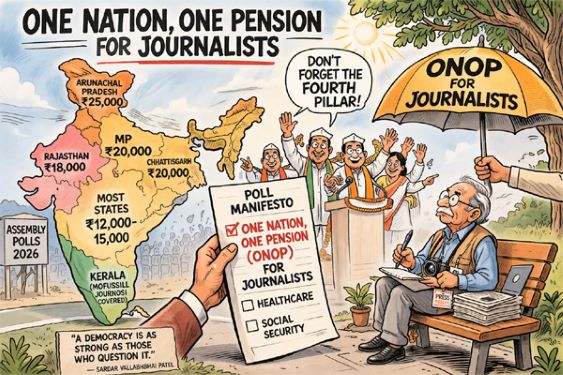
The current landscape reveals stark disparities:
- Arunachal Pradesh: ₹25,000 (highest)
- Madhya Pradesh & Chhattisgarh: ₹20,000
- Rajasthan: ₹18,000
- Most states: ₹12,000–₹15,000
Kerala remains the only state extending pension to mofussil journalists and press workers—highlighting both leadership and the scale of exclusion elsewhere.
Even as most BJP-ruled states have implemented such schemes, Gujarat—despite sustained demands since 2018—continues to lack one.
R Manickavasagam, Joint Secretary of the Gujarat Journalists Union aptly noted: “Same profession, different fortunes—this inequality weakens the very idea of a national media ecosystem.”
Parliament has already spoken—act now
Multiple Parliamentary Standing Committee reports have flagged:
- The absence of a uniform national welfare policy for journalists
- The urgent need for pension, insurance, and social security mechanisms
- The vulnerability of non-metro and freelance journalists
The policy groundwork is thus complete. What remains is decisive legislative action.
Take It to the Special Parliamentary Session
This is where intent must translate into action. All political parties—across ideological divides—must:
- Include ONOP for journalists in their Assembly poll manifestos
- Collectively raise and debate the issue in the upcoming special session of Parliament
- Push for a time-bound national policy framework with budgetary backing
A bipartisan resolution on ONOP would send a powerful message: that the Indian state values not just those who defend its borders, but also those who defend its democratic discourse.
As the Indian Federation of Working Journalists, which was led by veteran trade unionist late Vikram Rao, emphasises: “Democracy does not distinguish between a metro editor and a district stringer. Neither should welfare policy.”
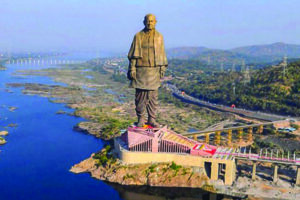
A Gujarat launch, a national tribute
Launching the scheme from Gujarat—and naming it after Sardar Vallabhbhai Patel on his 150th birth anniversary—would lend it both symbolic gravitas and historical resonance.
Patel unified India politically. A national pension scheme for journalists can unify its democratic conscience.
From promise to policy
The contours are clear:
- Minimum ₹25,000 monthly pension, inflation-linked
- Coverage for all under the Working Journalists Act, including mofussil and press workers
- Spouse benefits, as practised in states like Haryana
- Periodic revision, on the lines of OROP
What is needed now is political will.
As election rhetoric intensifies and Parliament prepares for a special sitting, the question before India’s political class is simple yet profound: Will they stand by those who stand for democracy?
(Author of this article is R Arivanantham, Executive Editor (Former Sr Correspondent, THE HINDU) navjeevanexpress.com He can be contacted – hindukgi@gmail.com, navjeevanexpress@gmail.com Mobile: 9444671601)