- India’s first home-grown private equity player heads for the bourses with ₹450 crore fresh issue and ₹100 crore OFS
- ₹152–₹160 price band; 93-share lot means minimum retail ticket of ₹14,880 at the upper end
- IPO opens August 19 and closes August 21; listing proposed on BSE and NSE on August 26
- ₹387 crore of fresh proceeds earmarked for sponsor commitments to existing and proposed funds and bridge-loan repayment
- A 20-plus-year mid-market investment franchise bets on domestic capital, technology-led value creation and India’s alternative-investment boom
R MANICKAVASAGAM
AHMEDABAD, AUG 14
What if investors could buy a piece of the very machine that has spent two decades picking India’s potential winners? That is the unusual proposition arriving on Dalal Street next week as Gaja Alternative Asset Management Ltd, operating under the Gaja Capital brand, takes the private-equity business itself to the public markets—in what is set to be India’s first IPO by a home-grown private-equity firm.
Gaja has fixed the price band at ₹152–₹160 a share for its ₹550-crore IPO, which will open on August 19 and close on August 21, 2026. The shares are proposed to list on both BSE and NSE on August 26.
The offer comprises a fresh issue of 2.81 crore equity shares aggregating ₹450 crore and an offer for sale of 0.63 crore shares worth ₹100 crore.
At the upper end of the band, the minimum retail application of 93 shares will require ₹14,880, with bids permitted in multiples of 93 shares.
The IPO is really a bet on India’s ‘investment machine’
The most interesting angle for investors is not simply the ₹550-crore issue size or the listing debut—it is the attempt to bring the economics and institutional architecture of private equity into the listed-company universe.
Gaja Alternative Asset Management acts as investment manager to India-focused Category I and Category II AIFs and provides advisory services to offshore funds investing in Indian companies. The business has operated for more than two decades and has built a portfolio spanning areas such as financial services, education, consumer businesses, technology and software.
Its investment pedigree includes names such as RBL Bank, TeamLease, Lighthouse Learning, Educational Initiatives, LeadSquared, Signzy and Fractal Analytics, giving public-market investors an opportunity to participate in the platform behind a diversified set of Indian growth stories.
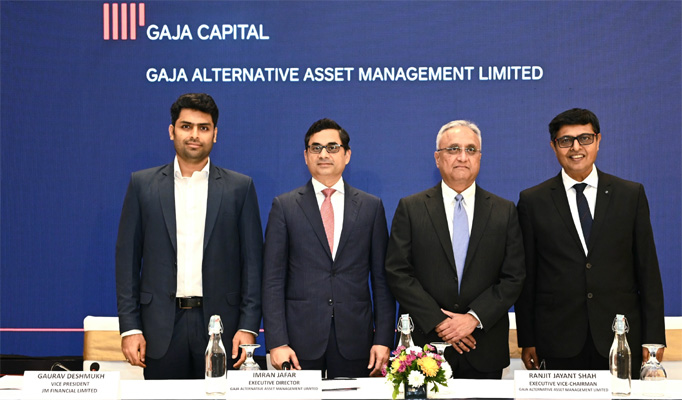
Gaja’s leadership team includes Gopal Jain, Managing Director & CEO; Ranjit Jayant Shah, Executive Vice-Chairman; and Imran Jafar, Executive Director.
‘Domestic capital must become the foundation’
The IPO arrives against a larger structural shift in India’s alternative-investment landscape: the increasing effort to channel domestic savings into home-grown private-market managers.
Ranjit Jayant Shah, Executive Vice-Chairman, has argued that “domestic capital must become the foundation” of India’s private-equity ecosystem, even as foreign capital continues to play an important role.
“We believe Indian GPs (general partners—fund managers) and LPs (limited partners—investors in PE funds) must take the lead in investing in India. While foreign capital will continue to play an important role, domestic capital must become the foundation,” Jain said.
His larger thesis is particularly relevant to the proposed listing: “We see a future where Indian private equity is truly Indian—driven by domestic capital, home grown expertise, and long-term commitment to building enduring businesses aligned with strategic national goals.”
That makes Gaja’s public-market debut more than a conventional capital-raising exercise—it is also a test of whether India’s stock-market investors are ready to value an alternative asset manager on the strength of its investment platform, fund franchise and future capital-raising ability.
₹450 crore fresh capital: Where the money will go
Of the ₹450 crore fresh issue, Gaja plans to deploy approximately ₹387 crore towards sponsor commitments to certain existing and proposed funds and repayment of a bridge loan.
The allocation includes commitments to Gaja Capital India Fund 2020 LLP, Gaja Capital India Fund 2020, the proposed Fund V and the Secondaries Fund.
Another ₹24.91 crore is earmarked for partial or full repayment of outstanding borrowings, with the balance intended for general corporate purposes.
This use of proceeds offers investors an important clue to the company’s strategy: rather than simply expanding a conventional corporate balance sheet, the IPO is designed to strengthen Gaja’s ability to back its own fund platform and participate in future investment opportunities.
The ‘tech as a horizontal enabler’ bet
Gaja’s investment thesis is also increasingly technology-led.
Shah has described technology not as a standalone sector but as a “horizontal enabler” across industries. The firm has built expertise in education, employment and employability, consumer, BFSI, software and automation, while increasingly tracking AI and tech-enabled businesses.
“Technology is now integral to value creation across sectors and we treat this more as a horizontal capability that is a must-have across all companies,” Jain has said.
For public investors, this creates an unusual proposition: instead of betting on one technology company, the listed Gaja platform offers exposure to a manager that seeks to identify and create value across multiple technology-enabled sectors.
Earnings show a profitable, asset-light model
Gaja Alternative Asset Management reported total income of ₹110.38 crore for the six months ended September 2025, compared with ₹123.31 crore for FY25.
Profit after tax stood at ₹41.26 crore during the six-month period, against ₹44.74 crore in FY25 and ₹61.95 crore in FY24.
Its net worth strengthened substantially to ₹574.55 crore as of September 30, 2025, from ₹388.97 crore at the end of FY25.
Total borrowings, however, increased to ₹40.88 crore, compared with ₹4 crore as of March 31, 2025.
That combination—profitability, rising net worth and increased borrowings—will make earnings quality, fund-management income visibility, sponsor commitments and capital allocation important parameters for investors assessing the IPO.
JM Financial Limited and IIFL Capital Services Limited (formerly known as IIFL Securities Limited) are the book running lead managers to the issue.