

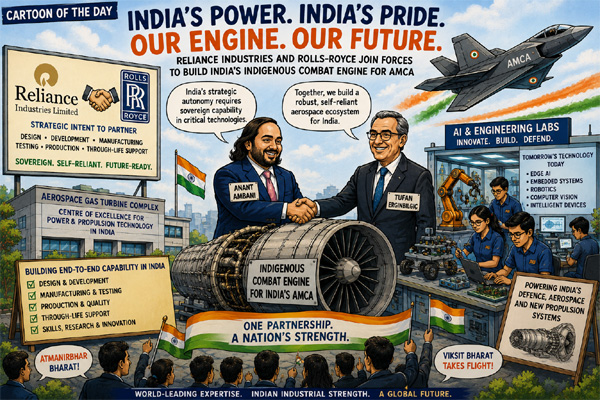
- Reliance and Rolls-Royce target the AMCA’s most critical technology frontier with an indigenous combat-engine proposition
- Proposed Aerospace Gas Turbine Complex could create an end-to-end Indian hub for engine design, development, testing and manufacturing
- Anant Ambani and Tufan Erginbilgiç pitch strategic autonomy, advanced propulsion expertise and industrial scale as the partnership’s core strengths
- AMCA engine push could propel India deeper into high-end aerospace technology while opening wider defence and civil propulsion opportunities
NE BUSINESS BUREAU
LONDON / MUMBAI, AUG 14
India’s quest for strategic autonomy is moving into the most demanding frontier of defence technology—the fighter-jet engine. In a potentially transformational aerospace play, Reliance Industries Limited and Rolls-Royce on Friday announced their strategic intent to partner on the design, development, manufacturing and delivery of a sovereign indigenous combat engine for the Advanced Medium Combat Aircraft (AMCA) programme.
Aerospace Gas Turbine Complex Could Become India’s Propulsion Powerhouse
As part of the proposed partnership, the two companies will explore setting up a dedicated Aerospace Gas Turbine Complex in India, envisaged as a centre of excellence for power and propulsion technology.
The proposition brings together Rolls-Royce’s global advanced-engine and propulsion expertise with Reliance’s technology, manufacturing, scale and execution capabilities. The companies said the initiative could establish an end-to-end Indian capability spanning design, development, manufacturing, testing, production and through-life support.
Importantly, the announcement is a strategic intent to partner, not yet a government-awarded engine contract. The proposed complex and partnership would need to progress through the relevant processes before becoming an operational AMCA engine programme.
Anant Ambani: ‘Strategic Autonomy Requires Sovereign Capability’
Anant Ambani, Executive Director, Reliance Industries Limited, said: “India’s strategic autonomy requires sovereign capability in critical technologies. Our intent with Rolls-Royce is to combine their world-leading expertise in advanced propulsion with Reliance’s technology, manufacturing, scale and execution capabilities to build an indigenous aero-engine ecosystem in India.”
He added: “Together, we aim to build an enduring national capability that can make India self-reliant and, over time, globally competitive in advanced propulsion technologies. This is our contribution to the Hon’ble Prime Minister Shri Narendra Modi’s vision of an Atmanirbhar Viksit Bharat.”
The partnership comes as India seeks to deepen domestic capabilities in critical defence technologies, with the AMCA positioned as a key future combat-aircraft programme. Reuters reported that the AMCA prototype is expected by 2028 and that the aircraft is central to India’s future air-combat strategy.
Rolls-Royce Sees ‘Major Milestone’ for India’s Aerospace Ecosystem
Tufan Erginbilgiç, CEO, Rolls-Royce plc, said: “I welcome the opportunity to join forces with Reliance Industries, bringing together our century-long heritage in advanced engineering and proven engine expertise with their homegrown leadership in Indian industry.”
“Together, with our existing partnerships and capabilities in India, this marks a major milestone towards building a robust, self-reliant aerospace ecosystem in the country,” he added.
Beyond the AMCA programme, the proposed Aerospace Gas Turbine Complex could open the door to wider collaboration in defence, civil aerospace and new power and propulsion systems, according to the companies.
The move also potentially broadens the competitive landscape for India’s future fighter-engine ambitions, with other international technology partnerships being explored for AMCA propulsion.
For Reliance, the initiative marks a significant push into one of the world’s most technologically challenging industrial domains. For Rolls-Royce, it offers another opportunity to deepen its aerospace and defence footprint in India.
If realised, the partnership could make a critical shift in India’s aerospace story—from buying propulsion technology to building sovereign capability around it.