

- Multimodal transport expo themed ‘Towards Safe, Smart & Sustainable Passenger Mobility’ showcases the technologies driving India’s public transport transformation
- Union Minister urges industry to embrace clean, indigenous and cost-effective transport solutions to reduce pollution and fuel imports
- World-class buses, EVs, hydrogen, biofuels and smart mobility technologies take centre stage as India targets greener and safer transportation
- Government says infrastructure-led growth, technological innovation and modern public transport are key to employment generation and Viksit Bharat
- Industry leaders, policymakers and transport operators converge in Gandhinagar to shape the next generation of passenger mobility
R MANICKAVASAGAM
GANDHINAGAR, JULY 9
Calling for a transportation revolution driven by clean energy, cutting-edge technology and uncompromising road safety, Union Minister for Road Transport and Highways Nitin Gadkari said India’s vision is to build a pollution-free, accident-free and world-class transport ecosystem that supports economic growth, creates employment and improves the quality of life.
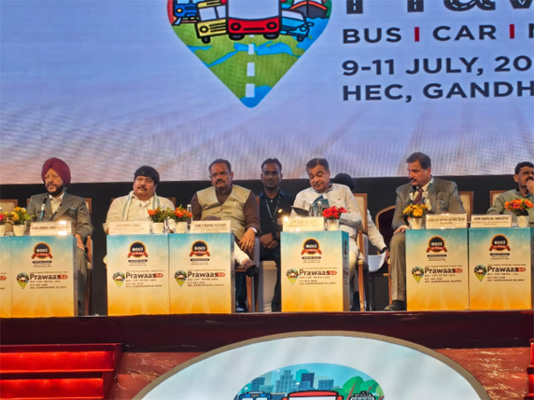
Inaugurating Prawaas 5.0, the country’s biggest multimodal public transport exhibition, at the Helipad Exhibition Centre in Gandhinagar, Gadkari said the event’s theme—”Towards Safe, Smart & Sustainable Passenger Mobility”—perfectly reflects the direction in which India’s transport sector must move.
Addressing policymakers, transport operators, automobile manufacturers and industry leaders, the Minister stressed that modern infrastructure remains the backbone of India’s economic transformation.
“India is the fastest-growing economy in the world. Infrastructure comprising water, power, transport and communication is the foundation for industrial growth, trade, business and employment generation. A strong transport sector has the potential to create millions of jobs and play a decisive role in eradicating poverty,” he said.
Gadkari said four fundamentals determine the success of any industry—proven technology, availability of raw materials, economic viability and effective marketing—adding that public transport must increasingly adopt innovative technologies that are efficient, affordable and environmentally sustainable.
“Clean transport is the need of the hour. The three ‘E’s—Ethics, Economy and Ecology & Environment—must guide the future of India’s transport sector,” he said.
Highlighting the environmental challenge, the Minister pointed out that the transport sector contributes nearly 40 per cent of the country’s air pollution, while India spends around ₹22 lakh crore annually on fossil fuel imports.
“To reduce pollution and save foreign exchange, we must focus on import substitutes, cost-effective technologies, pollution-free mobility and indigenous solutions. I urge everyone associated with the transport industry to join this national mission,” he said.
He also emphasised that efficient public transport depends not only on cleaner vehicles but also on timely services, last-mile connectivity and passenger comfort, urging automobile manufacturers to adopt world-class technologies capable of meeting rising customer expectations.
“This is the time for the automobile industry to develop world-class technologies and create comfortable, reliable and technologically advanced public transport systems,” he said.
Road safety, Gadkari asserted, remains the Government’s foremost priority.
“Nearly five lakh road accidents occur every year in India, claiming around 1.8 lakh lives. Alarmingly, nearly 60 per cent of those who lose their lives are between 18 and 34 years of age. Preventing accidents is the Government’s topmost priority,” he said.
He said the Ministry is working extensively on road engineering improvements, black-spot identification and rectification, and better highway design in collaboration with State governments.
Highlighting India’s remarkable automotive growth, Gadkari noted that the country’s automobile industry has expanded from ₹14 lakh crore to ₹22 lakh crore, overtaking Japan to become the third-largest automobile market globally, behind only the United States and China.
He said the industry is rapidly embracing electric mobility, hydrogen, biofuels, ethanol, methanol, biodiesel and LNG, while the Ministry has launched hydrogen mobility pilot projects across 10 strategic routes, including Ahmedabad–Vadodara–Surat, as part of India’s transition to clean-energy transportation.
The Minister added that the automobile sector today contributes nearly ₹4.5 lakh crore in GST revenues and supports employment for approximately 4.5 crore people, making it one of India’s most important economic pillars.
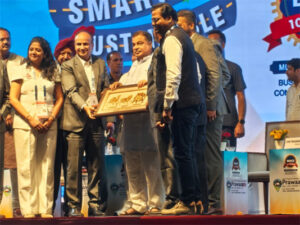
The inaugural ceremony was attended by Jitubhai Vaghani, Minister of State, Gujarat; Kantilal Amrutiya, Minister of State, Gujarat; Ministers from Uttarakhand and West Bengal; the President of the Bus and Car Operators Confederation of India (BOCI); and senior leaders from the transport and automobile industry.
Read also