
- AIESL to convert six A321 aircraft from commercial to ‘green’ configuration for India’s next-generation airborne early-warning and control platform
- Adani Defence Systems and Technologies brought in as Development Cum Production Partner for AEW&C MK-II mission systems
- DRDO, industry and Indian Air Force to jointly integrate, test and certify the advanced platform for enhanced surveillance and command capabilities
- Longer endurance, secure communications and extended-range threat detection to strengthen India’s air-defence architecture
NE DEFENCE BUREAU
NEW DELHI, JULY 23
India is turning commercial airliners into strategic assets—and building a new generation of airborne command centres capable of seeing threats before they reach the battlefield.
In a major step towards strengthening indigenous aerospace capabilities and advancing Aatmanirbhar Bharat, the Defence Research and Development Organisation (DRDO) has signed two significant contracts with Indian industry partners for the Airborne Early Warning & Control (AEW&C) MK-II Programme.
The Centre for Air Borne Systems (CABS), DRDO, has signed a contract with AI Engineering Services Limited (AIESL), New Delhi, for the conversion of six A321 aircraft from commercial configuration to ‘green’ configuration, paving the way for the development and production of the AEW&C MK-II platform.
In a parallel move, CABS has signed a separate contract with Adani Defence Systems and Technologies Limited (ADSTL), Ahmedabad, to engage the company as the Development Cum Production Partner (DcPP) for the mission systems designed for the AEW&C MK-II Programme.
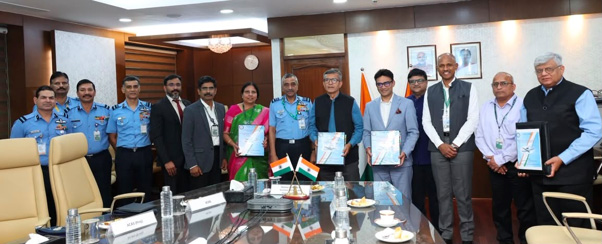
The contracts were signed by the Director, CABS, with the CEO, AIESL, and Head–Airborne Platform, ADSTL, in the presence of Defence Secretary and Secretary, Department of Defence R&D and Chairman, DRDO, Rajesh Kumar Singh, in New Delhi on Wednesday.
From airliners to airborne command centres
The programme will see the modified AEW&C MK-II platform, delivered by Airbus Defence & Space, serve as the airborne platform for the integration of advanced mission systems developed by DRDO.
CABS, DRDO, with support from ADSTL as the Development Cum Production Partner, will be responsible for integrating the mission systems on the modified AEW&C MK-II platform.
The next phase will involve extensive flight testing by CABS and ADSTL in association with the Indian Air Force.
The aircraft will subsequently undergo certification by the relevant airworthiness agencies—the Centre for Military Airworthiness and Certification (CEMILAC) and the Directorate General of Aeronautical Quality Assurance (DGAQA).
A bigger, sharper eye over the battlespace
With CABS as the nodal laboratory, the DRDO’s AEW&C MK-II system is designed to deliver a significant upgrade in India’s airborne surveillance and command-and-control capabilities.
The advanced system will provide:
- Enhanced endurance
- Advanced airborne surveillance
- Secure communications
- Improved situational awareness
- Enhanced command-and-control capabilities
Together, these capabilities are expected to significantly strengthen India’s air-defence architecture and support the detection and neutralisation of threats across extended ranges.
Industry partnership at the heart of Aatmanirbhar Bharat
The engagement of AIESL and ADSTL under the AEW&C MK-II Programme underlines the growing role of Indian industry in the development, integration, testing and production of advanced defence platforms.
The contracts reaffirm the Government’s commitment to achieving greater self-reliance by building a robust domestic ecosystem for innovation, research, aerospace engineering, systems integration and defence manufacturing.
The AEW&C MK-II programme thus represents more than the development of a new airborne surveillance platform. It marks a decisive shift towards an ecosystem in which Indian research, Indian industry and the Indian armed forces work together to create strategic capabilities for India’s future battlespace.