- State’s oldest and largest journalists’ body to march peacefully to Visnagar against defamation notice served on editor Jayeshbhai Vyas
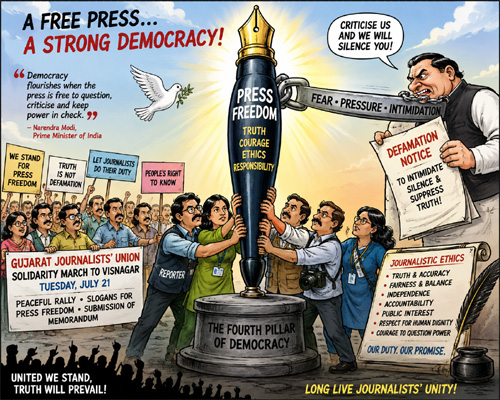
- Delegation to submit memorandum, reaffirming that questioning those in power is a democratic duty—not a democratic offence
- Journalists urged to report without fear or favour, uphold facts over propaganda, and remain the conscience keepers of society
- Press Council of India reiterates its twin mandate—preserving press freedom while maintaining the highest standards of journalism
- Prime Minister Narendra Modi has repeatedly urged journalists to fight fake news, uphold credibility and strengthen democracy through responsible journalism
- Peaceful Gandhian solidarity programme calls upon media fraternity to unite in defence of constitutional freedoms and the people’s right to know
NE NEWS SERVICE
AHMEDABAD, JULY 20
A vibrant democracy flourishes only when its citizens are informed, its institutions remain accountable and its journalists can pursue the truth without fear or favour. Acting as the vital bridge between the people and those in power, the media is expected to highlight both achievements and shortcomings of governments in the larger public interest. It is this constitutional responsibility of ensuring transparency, accountability and checks and balances that the Gujarat Journalists’ Union (GJU) seeks to reinforce through a peaceful solidarity programme at Visnagar on Tuesday.
The State’s largest and oldest representative body of journalists has called upon media professionals across Gujarat to participate in a peaceful delegation to Visnagar for submitting a memorandum against the defamation notice served on Jayeshbhai Vyas, Editor of the weekly Lokshahi Samarthan.
Union leaders said the programme is not merely about supporting an individual journalist but about reaffirming the constitutional principle that constructive scrutiny of those in authority strengthens democracy rather than weakens it.
The delegation will assemble at the Gujarat Journalists’ Union office at Lal Darwaja, Bhadra, Ahmedabad, at 7.30 a.m., before departing in a convoy at 8 a.m. for Visnagar. The participants are expected to reach the Prant Officer’s Office by 10 a.m., where they will hold a peaceful rally, raise slogans in support of press freedom and submit a memorandum to the authorities.
The organisers have appealed to journalists wishing to participate to register their names in advance so that transportation and meal arrangements can be made.
The Union has emphasised that the entire programme will be conducted strictly in accordance with Gandhian principles, reflecting journalism’s enduring commitment to peaceful democratic engagement.
Journalism, the Union observed, is not adversarial to governance; rather, it serves as an indispensable democratic institution that informs citizens, exposes wrongdoing, amplifies public grievances and enables governments to rectify shortcomings. Ethical journalism requires reporters to verify facts meticulously, distinguish news from opinion, provide balanced coverage, protect credible sources, avoid sensationalism and remain accountable to the public interest above every other consideration.
The Press Council of India, constituted under the Press Council Act, 1978, describes its twin objectives as preserving the freedom of the Press and maintaining and improving the standards of newspapers and news agencies in India.
The Council has consistently underlined that journalists must report the truth without fear or favour, while maintaining fairness, accuracy and responsibility. It has also cautioned that media credibility depends upon separating verified facts from opinion and resisting pressures that may compromise editorial independence.
Prime Minister Narendra Modi, while emphasising the need to combat misinformation and strengthen public trust, has repeatedly called upon journalists to uphold credibility, factual reporting and responsible journalism, recognising that a robust and ethical media ecosystem contributes to stronger democratic institutions.
The Union said journalists have historically played a transformative role—from India’s freedom movement to exposing corruption, highlighting administrative lapses and giving voice to the voiceless. A fearless yet responsible press remains essential for ensuring that governance remains transparent and responsive to the aspirations of ordinary citizens.
Issuing a clarion call for unity, the Gujarat Journalists’ Union urged media professionals across the State to stand together in defence of press freedom, constitutional values and the public’s fundamental right to know.
The appeal has been jointly issued by B.R. Prajapati (President), Natwarlal Bhatt (General Secretary), Vijay Mehta (Working President), Nitin Khambholja (Vice President), Vinay Pandya, R. Manickavasagam and Parmanand Soni (Joint Secretaries), Jagdish Meva (Office Secretary), along with executive members and journalist members of the Union.
“Long Live Journalists’ Unity.”