- Sixth Project 17A stealth frigate with over 75% indigenous content joins Eastern Fleet, strengthening India’s blue-water combat capability
- Defence Minister Rajnath Singh says advanced technologies and conventional military strength must go hand in hand to secure the future battlefield
- BrahMos-capable frontline warship to dominate aerial, surface and underwater warfare while reinforcing India’s strategic presence across the Indo-Pacific
- Navy’s indigenous warship programme sets new benchmarks with faster construction timelines, reduced sea trials and a thriving defence industrial ecosystem
- INS Mahendragiri emerges as a powerful symbol of Aatmanirbhar Bharat, maritime security and India’s rise as a global naval force
NE DEFENCE BUREAU
VISAKHAPATNAM, JULY 11
India’s quest to emerge as a dominant maritime power received a decisive boost on Saturday with the commissioning of INS Mahendragiri, the sixth indigenous stealth frigate under the prestigious Project 17A programme, marking yet another milestone in the nation’s march towards defence self-reliance and a technologically superior blue-water Navy.
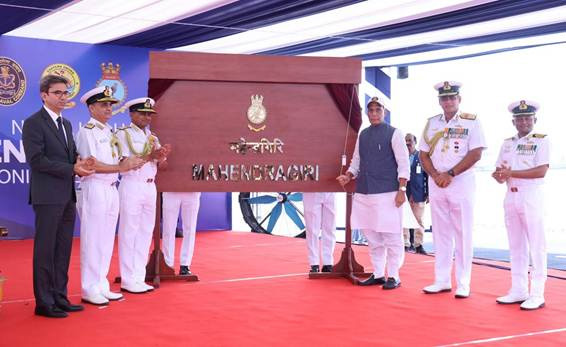
Commissioning the state-of-the-art warship into the Eastern Fleet at Visakhapatnam, Defence Minister Rajnath Singh declared that INS Mahendragiri is not merely another frontline combat platform but a defining symbol of Aatmanirbhar Bharat, India’s rapidly expanding defence manufacturing ecosystem and its unwavering resolve to build a technologically advanced, combat-ready naval force capable of protecting national interests across the Indo-Pacific and beyond.
Designed by the Indian Navy’s Warship Design Bureau and constructed by Mazagon Dock Shipbuilders Limited (MDL), Mumbai, the 6,670-tonne stealth frigate incorporates more than 75 per cent indigenous content, reflecting India’s remarkable progress in defence design, engineering and manufacturing.
“INS Mahendragiri is another symbol of Aatmanirbhar Bharat and the nation’s commitment to building a technologically advanced and combat-ready Navy,” Rajnath Singh said.
Calling the commissioning a landmark moment for India’s maritime ambitions, the Defence Minister said the induction of six advanced Project 17A frigates within just one-and-a-half years demonstrates the country’s rapidly maturing naval-industrial ecosystem and growing confidence in indigenous warship construction.
“There was a time when we depended on other nations for our defence requirements. Today, we are building sophisticated warships in our own shipyards with our own technology and our own people,” he observed.
Blue-water warrior with formidable firepower
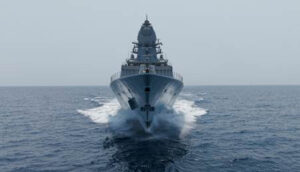
Equipped to undertake the entire spectrum of maritime operations—including fleet air defence, anti-surface warfare, anti-submarine warfare, surveillance, maritime interdiction and humanitarian assistance—INS Mahendragiri represents one of the most advanced surface combatants ever built in India.
The frigate is capable of speeds of up to 28 knots and is armed with an impressive array of cutting-edge weapon systems, including the BrahMos supersonic cruise missile, medium-range surface-to-air missiles, indigenous rocket launchers, torpedo launchers, an Integrated Anti-Submarine Defence System, advanced electronic warfare suites, Close-In Weapon Systems and an embarked multi-role helicopter.
Its sophisticated stealth architecture, modern sensors, multifunction radar and network-centric combat systems significantly enhance survivability while enabling the warship to dominate aerial, surface and underwater threats simultaneously.
“INS Mahendragiri can be equipped with the BrahMos surface-to-surface missile, one of the world’s fastest and most lethal cruise missiles. These capabilities make the warship formidable and resilient,” Rajnath Singh said.
Describing the vessel as a true “blue-water ship,” he said it would not merely safeguard India’s coastline but project Indian naval strength deep into the oceans while securing maritime trade routes and strategic interests.
“INS Mahendragiri will strengthen the eastern seaboard, extend India’s blue-water reach and further consolidate our presence in the Indian Ocean Region,” he said.
Future wars demand both technology and military resolve
Highlighting the changing character of warfare, Rajnath Singh cautioned against viewing emerging technologies as substitutes for conventional military capability.
He noted that drones, Artificial Intelligence, cyber warfare, hypersonic weapons, space technologies and autonomous systems are transforming military operations, but stressed that national resolve and conventional strength remain decisive.
“Future wars may be fought with Artificial Intelligence, but they will still be won by national resolve, trained soldiers and credible military power.”
He asserted that advanced technologies and conventional combat platforms complement each other.
“A conventional platform is incomplete without new technology, and new technology is weakened without a strong conventional platform.”
Recalling the success of Operation Sindoor, the Defence Minister said it demonstrated the effective integration of modern technology with conventional military capability, reaffirming the Government’s commitment to simultaneously invest in next-generation defence technologies while strengthening traditional combat assets.
Guardian of India’s economic and maritime interests
Emphasising that maritime security and economic prosperity are inseparable, Rajnath Singh said secure seas remain essential for global trade, energy supplies, logistics and supply chains.
Reiterating India’s commitment to the MAHASAGAR vision—Mutual and Holistic Advancement for Security and Growth Across Regions—he described India as a “net security provider” and a trusted strategic partner across the Indo-Pacific.
He praised the Indian Navy’s expanding humanitarian and operational role through anti-piracy missions, disaster relief operations and evacuation efforts.
“The Indian Navy has earned recognition as the First Responder and Preferred Security Partner in the Indo-Pacific through its timely and effective operational response.”
Referring to the recent conflict in West Asia, Rajnath Singh said Operation Urja Suraksha highlighted the Navy’s growing strategic relevance.
“The Indian Navy safely escorted 18 merchant vessels carrying essential cargo worth over ₹9,000 crore. It has emerged not merely as a fighting force but also as a strong guardian of India’s economic interests.”
Warship programme reshaping India’s defence industry
The Defence Minister underlined that indigenous warship construction extends well beyond military capability, driving growth across steel, electronics, propulsion systems, sensors, software, precision engineering and logistics while generating skilled employment and technological innovation.
He reiterated the Government’s vision of making India a global hub for shipbuilding and maritime defence innovation through initiatives such as Maritime India Vision 2030, the Maritime Development Fund, Shipbuilding Financial Assistance Scheme and Shipbuilding Development Scheme.
Calling upon India’s innovators, engineers, entrepreneurs, researchers and investors, he urged them to develop future battlefield technologies that would strengthen India’s strategic autonomy.
Project 17A achieves unprecedented milestones
Chief of the Naval Staff Admiral Krishna Swaminathan described INS Mahendragiri as another shining example of India’s growing maritime capability and technological self-reliance.
“The commissioning of the sixth Project 17A frigate marks another milestone in indigenous warship construction and significantly enhances the Indian Navy’s operational capability.”
He affirmed that the Indian Navy remains “combat-ready, credible, cohesive and future-ready.”
Highlighting the remarkable efficiency achieved under the programme, Admiral Swaminathan said MDL and the Navy have dramatically reduced delivery timelines.
The launch-to-delivery cycle has been nearly halved—from 63 months to just 31 months—while the total construction period has been reduced from 95 months to 75 months. Even more significantly, all technical evaluations were successfully completed during a single sea trial, compared to the conventional five to seven trials.
He credited these achievements to the close collaboration between MDL, the Navy, Indian manufacturers, MSMEs, trial agencies, the Warship Overseeing Team and the ship’s crew.
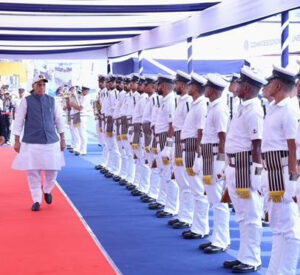
The commissioning ceremony featured the traditional breaking of the Commissioning Pennant and the maiden hoisting of the National Flag aboard the warship.
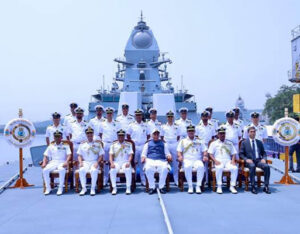
Among those present were Flag Officer Commanding-in-Chief, Eastern Naval Command Vice Admiral Sanjay Bhalla, CMD, Mazagon Dock Shipbuilders Limited Captain Jagmohan (Retd.), senior naval officers, defence veterans and representatives of India’s shipbuilding industry.