NE HEALTH BUREAU
NEW DELHI, DEC 16
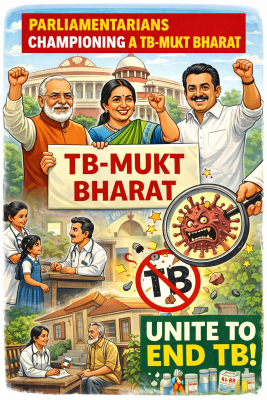
In a decisive push toward eliminating tuberculosis, Union Minister of Health and Family Welfare Jagat Prakash Nadda on Monday held an in-depth interaction with Members of Parliament from Tamil Nadu, underscoring the pivotal role of parliamentary leadership in achieving the national goal of a TB-Mukt Bharat.
Union Health Minister Shri J.P. Nadda Engages Tamil Nadu MPs to Accelerate TB-Mukt Bharat at the Grassroots
Early Detection and Jan Bhagidari Central to TB Elimination: Shri J.P. Nadda to Tamil Nadu MPs
Tamil Nadu Parliamentary Leadership Reaffirms Commitment to Ending TB… pic.twitter.com/OjCnFPM6fq
— Ministry of Health (@MoHFW_INDIA) December 16, 2025
The meeting, organised under the initiative “Parliamentarians Championing a TB-Mukt Bharat” at the Extended Parliament House Annexe on the sidelines of the Winter Session, focused on strengthening community engagement, reducing stigma, and ensuring early detection and timely treatment at the grassroots. Union Minister of State for Health and Family Welfare Smt. Anupriya Patel was also present.
- Early detection, Jan Bhagidari and innovation key to last-mile TB elimination, says Union Health Minister J.P. Nadda
- India records one of the world’s sharpest TB declines; political leadership critical to finishing the job
- AI X-rays, rapid diagnostics and shorter drug regimens reshape India’s TB response
- Tamil Nadu MPs reaffirm grassroots commitment to end TB in vulnerable communities
Addressing the MPs, Shri Nadda described tuberculosis as one of the world’s most pressing public health challenges, while highlighting India’s emergence as a global frontrunner in TB control under the leadership of Prime Minister Shri Narendra Modi. He stressed that sustained political commitment, scientific innovation and people’s participation have together transformed India’s TB response into a nationwide movement.
India’s TB control measures gains among the world’s best
Highlighting measurable progress, the Union Health Minister said TB incidence in India has declined by 21 per cent—from 237 to 187 cases per lakh population between 2015 and 2024—nearly double the global average decline of around 12 per cent. TB-related mortality has fallen by about 25 per cent, while treatment coverage has crossed 92 per cent, surpassing global benchmarks.
“These achievements are rooted in early case detection, universal access to rapid NAAT testing, and strong Jan Bhagidari that has turned TB elimination into a true people’s movement,” he said.
Technology, treatment and nutrition as pillars
Nadda highlighted India’s leadership in TB innovation, pointing to the nationwide rollout of AI-enabled handheld X-ray machines and an expanded NAAT network of more than 9,300 machines covering every block in the country. He also drew attention to shorter and more effective treatment regimens such as BPaL-M, which have reduced treatment duration for drug-resistant TB from 9–12 months to just six months.
Nutrition, he noted, remains central to recovery. Under the Nikshay Poshan Yojana, monthly nutritional support has been doubled from ₹500 to ₹1,000 per patient, with over ₹4,400 crore transferred directly to more than 1.3 crore beneficiaries since 2018.
Focus on Tamil Nadu’s challenges
Commending Tamil Nadu’s sustained efforts in TB control, Nadda flagged persistent challenges in urban slums, tribal and migrant populations, and among unorganised industrial workers. He also cautioned that rising non-communicable diseases such as diabetes, along with tobacco use and alcoholism, increase vulnerability to TB.
He praised the State’s strong Jan Bhagidari model, highlighting the active involvement of MPs, MLAs, Panchayati Raj Institutions and MY Bharat volunteers. Emphasising that higher TB notification reflects better programme reach, he urged leaders to view early identification of every case as essential to breaking transmission chains and preventing avoidable deaths.
MPs key to last-mile impact
Calling on Tamil Nadu MPs to sustain momentum, Nadda encouraged proactive screening of vulnerable groups, regular reviews with District Collectors, prioritisation of TB in DISHA meetings, visits to health facilities, and direct engagement with patients and frontline workers. He also urged optimal use of handheld X-ray machines and mobilisation of local resources, including Nikshay Mitras, to strengthen last-mile delivery.
Senior officials, including Mission Director of the National Health Mission Smt. Aradhana Patnaik, shared detailed updates on national and State-level progress and outlined strategies to accelerate TB elimination in Tamil Nadu through closer coordination between parliamentarians, State health authorities and district teams.
Tamil Nadu MPs welcomed the interaction and reaffirmed their resolve to champion TB elimination in their constituencies, committing to ensure early detection, effective treatment and comprehensive support for every person affected—bringing India closer to the goal of a TB-Mukt Bharat.