
R ARIVANANTHAM
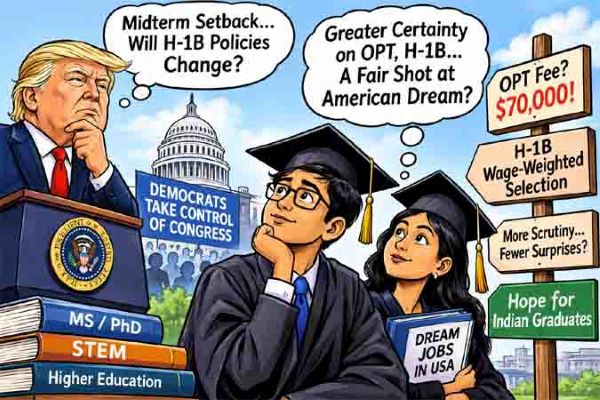
Can an Indian student who has invested $100,000 or more in an American postgraduate education look forward to a job in the United States without the uncertainty of immigration restrictions overshadowing academic achievement? Will a PhD in semiconductor technology, artificial intelligence, biotechnology or engineering carry the same employment promise it once did? And could President Donald Trump’s midterm electoral setback finally change the equation?
- Democrats’ victory in both chambers of Congress could put the brakes on further immigration restrictions, but will it translate into jobs for international graduates?
- Indian students completing Master’s and PhD programmes look for greater certainty over OPT, H-1B sponsorship and long-term employment prospects.
- Proposed $70,000 initial OPT fee and $30,000 subsequent fee could become a fresh obstacle for universities and employers if approved.
- Wage-weighted H-1B selection favours higher-paying positions, potentially changing the recruitment equation for fresh graduates.
- Experts see greater congressional scrutiny and resistance to restrictive legislation, but caution that an immediate rollback of Trump-era policies is unlikely.
The November 3 US midterm elections, in which Democrats secured control of both the House of Representatives and Senate, have injected a new dimension into America’s immigration debate. For thousands of Indian students pursuing postgraduate and doctoral degrees, the outcome offers a measure of hope. But it is important to distinguish political change from an actual change in immigration law.
A CHECK ON TRUMP, NOT AN AUTOMATIC POLICY REVERSAL
The Democratic victory could strengthen congressional oversight of Trump’s immigration agenda, make restrictive legislative proposals harder to advance and intensify scrutiny of measures affecting international students and skilled foreign professionals.
However, Trump retains executive authority, including veto powers, and the incoming Congress will assume office only in January 2027. Existing executive actions and agency regulations will not automatically disappear.
Karan Gupta, founder of an education consultancy, told The Economic Times that Democratic control could create stronger resistance to measures discouraging international students, but Congress cannot simply reverse executive decisions.
Akshay Chaturvedi, founder of Leverage Edu, offered an important distinction: “Democrats taking both chambers is, in my view, a sentiment shift, not yet a policy shift.”
He added that students should expect fewer new shocks rather than an immediate rollback of existing restrictions.
THE OPT QUESTION: A NEW FINANCIAL ROADBLOCK?
For Indian graduates, Optional Practical Training (OPT) is often the crucial bridge between an American university degree and the first professional appointment.
The existing framework generally permits 12 months of post-completion OPT, with eligible STEM graduates able to seek a further 24-month extension.
However, a potentially far-reaching DHS proposal published on October 8, 2026, has raised fresh concerns. It proposes a $70,000 initial fee for OPT and another $30,000 for subsequent OPT participation, including the STEM extension.
Importantly, the proposed fees would be payable by SEVP-certified educational institutions, not directly by students. Nevertheless, universities could become more selective about recommending graduates for practical training, potentially narrowing employment opportunities.
The proposal is not yet a final rule. Public comments on its main provisions are due by November 9, making this an immediate issue for universities, student associations and employers to examine. <Cite refs={[“turn870471view0″,”
H-1B: WILL THE JOB-SPONSORSHIP CLIMATE IMPROVE?
For graduates hoping to remain in America beyond OPT, employer-sponsored H-1B employment remains a critical pathway.
The Trump administration has introduced a wage-weighted selection system effective February 27, 2026, for the FY2027 cap season. Instead of treating all registrations equally, it gives higher selection weight to positions corresponding to higher prevailing-wage levels.
Registrations at Wage Level IV receive four entries in the selection pool, Level III three, Level II two and Level I one. While this may benefit highly paid specialist positions, fresh graduates entering the job market at relatively modest salaries could face a disadvantage.
The regular H-1B cap remains 65,000, with an additional 20,000 places under the US advanced-degree exemption for eligible graduates of American institutions. A qualifying US master’s or doctoral degree can therefore provide an additional opportunity, although it does not guarantee selection. <Cite refs={[“turn337958search3″,”
The administration’s $100,000 payment requirement for certain new H-1B petitions has also faced legal challenges. Separately, a further $103,265 cap-subject petition fee has been proposed. These developments make it essential for graduates to ascertain the actual legal and financial position before accepting an employer’s sponsorship assurances. <Cite refs={[“turn452547search5″,”
WHY MASTER’S AND PHD GRADUATES COULD HAVE DIFFERENT PROSPECTS
The employment equation is not identical for every discipline.
For postgraduate students in computer science, semiconductor engineering, AI, cybersecurity and advanced manufacturing, specialised technical skills and demonstrable industry experience could strengthen their bargaining position.
Doctoral graduates may have additional opportunities in university research departments, laboratories, eligible nonprofit research institutions and other employers that may qualify for H-1B cap exemptions. Such positions can provide an alternative to the regular annual lottery, subject to the employer and job meeting the applicable requirements.
A PhD, however, is not an automatic immigration advantage. Research appointments, postdoctoral positions and academic salaries vary considerably. Employers must still comply with the relevant work-authorisation requirements.
Adarsh Khandelwal, co-founder of Collegify, articulated the changing priorities of Indian families: the central question is no longer simply, “Can my child get into a leading US university?” but increasingly, “What opportunities will be available after graduation?”
WHAT SHOULD INDIAN STUDENTS EXPECT NOW?
Rohit Jain, managing partner at Singhania & Co, identified preventing legislation that drastically reduces or eliminates H-1B visas as an immediate potential benefit of Democratic congressional control. Longer-term possibilities include reforming employment-based green-card provisions, particularly the per-country ceiling and recapture of unused visas.
But these possibilities require sustained legislative action.
For students graduating in 2027 and beyond, the practical priorities are clear: choose programmes with demonstrable industry connections, develop specialised skills, pursue internships and research collaborations, understand OPT and STEM eligibility, and assess prospective employers’ willingness and ability to sponsor work visas.
Universities, too, must strengthen career-placement support and provide transparent guidance on immigration compliance.
The midterm results have changed the political balance in Washington, but not yet the immigration rules governing Indian graduates. The real test will be whether congressional scrutiny translates into predictable policies, affordable post-study work opportunities and a recruitment environment in which academic merit and specialised talent receive due recognition.