R ARIVANANTHAM
CHENNAI, DEC 10
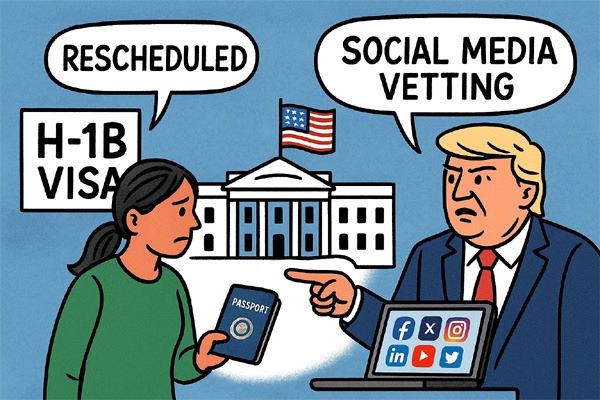
A sudden tightening of vetting norms by the US State Department has triggered widespread disruption for Indian professionals, students and employers, with hundreds of H-1B visa appointments being cancelled or pushed as far as March and April 2026. The move—linked to new mandatory social-media disclosure requirements—has shaken both Indian and American industries that depend heavily on high-skilled mobility.
- H-1B appointments pushed to March–April as social-media scrutiny cripples consular capacity
- US firms fear talent shortages; Indian IT giants activate contingency hiring and near-shore strategies
- Business captains in the US call policy ‘self-defeating’ amid global skill race
- Indian government readies diplomatic outreach, fast-track helpdesk and student advisory support
Appointments Cancelled After Biometrics Done
In multiple cases across Hyderabad and Chennai, applicants who had completed biometrics in early December were shocked to see their interview dates moved by four to six months. A Hyderabad student who returned for H-1B stamping after completing her studies in the US saw her December 18 appointment shifted “post-April”, despite all formalities being completed.
In another instance, a Chennai-based applicant completing biometrics found his December 15 interview rescheduled to March 12, 2026.
The disruption stems from the new rule requiring H-1B and H-4 dependents to make their social-media accounts public and share all their usernames across platforms like Facebook, X, Instagram, LinkedIn, and YouTube for the past five years.
This additional layer of vetting, applicable for appointments scheduled on or after December 15, has slowed down processing dramatically and sharply reduced interview slots.
How Trump’s Return-to-Stringency Policy Impacts US Firms
Corporate America, especially sectors reliant on Indian STEM talent, sees the move as a direct blow at a time when vacancies in tech, healthcare, R&D and chip manufacturing are widening.
Top technology and consulting firms warn that prolonged visa delays will:
- Intensify ongoing talent shortages in AI, cybersecurity, engineering and cloud computing
- Slow project delivery for US clients, especially quarter-end digital transformation rollouts
- Increase operational costs due to emergency near-shore staffing
- Reduce competitiveness against Europe and Canada, both aggressively attracting global talent
An executive at a leading Silicon Valley tech major said the new screening norms were “well-intentioned but poorly timed”, noting that stringent social-media scrutiny could result in unpredictable delays, even for highly vetted professional profiles.
US business chambers have also expressed concern that excessively restrictive mobility rules could undermine American innovation ecosystems dependent on H-1B professionals.
What This Means for Indian Students in the US
While the policy currently targets H-1B/H-4 applicants, higher education advisers say this sends a chilling signal to Indian students, especially those on OPT and STEM-OPT pathways who aim to transition to H-1B.
Worries include:
- Long gaps between graduation and work authorisation
- Risk of losing employer sponsorship due to appointment uncertainty
- Increased financial burden from forced prolonged stay in India
- Stress over compliance, given the retroactive social-media transparency rule
Universities fear this could affect the next admission cycle, as Indian students may prefer Canada, UK or Australia until clarity returns.
How Indian Firms Are Responding
India’s IT and engineering giants are moving swiftly, activating contingency plans to counter a potential talent bottleneck.
Key strategies include:
- Shifting to near-shore hubs in Mexico, Costa Rica, Canada and Europe
- Accelerating local hiring at US development centres
- Expanding remote-delivery models to maintain project continuity
- Staggered travel planning for employees likely to need stamping
- Engaging immigration compliance experts to ensure social-media disclosures do not lead to inadvertent legal complications
Indian outsourcing firms say they anticipate higher bench costs in Q1 and Q2 due to delayed deployments.
Indian Government Steps In
New Delhi has begun diplomatic engagement with Washington to seek clarity and minimise disruption. Senior officials have initiated communication channels with US consular posts and are pushing for transitional arrangements for applicants already in process.
Government measures likely to be announced:
- A dedicated helpdesk for stranded visa applicants
- A formal communication to the US mission seeking additional interview slots for affected H-1B holders
- Legal and advisory guidance for students on OPT and F-1 transition stages
- Consular outreach sessions in Chennai, Hyderabad and Mumbai
- A request for short-term waivers for individuals who have already completed biometrics
Officials emphasise that India will “work constructively but firmly” to safeguard its professionals and students.