NE POLITICAL BUREAU
CHENNAI, APR 11
In a calibrated blend of welfare pitch and political attack, Tamil Nadu Chief Minister M. K. Stalin has foregrounded his government’s flagship social schemes as the cornerstone of the upcoming electoral battle, even as he sharpened his criticism of the Bharatiya Janata Party over its alleged approach towards minorities.
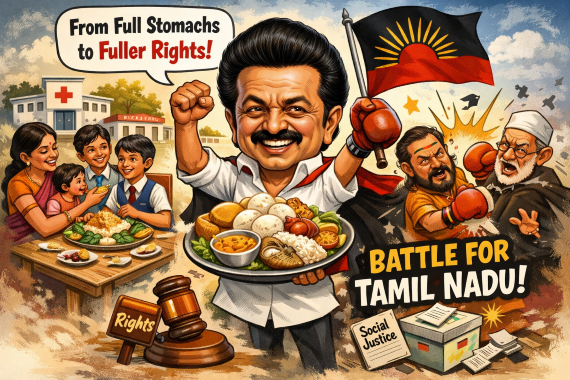
Positioning the Dravida Munnetra Kazhagam government’s welfare architecture as a defining success of the “Dravidian model,” Stalin said two initiatives remain particularly close to him—the women’s monthly entitlement scheme and the Chief Minister’s Breakfast Scheme.
“All the schemes that we have implemented in the Dravidian model regime are very important initiatives. However, I would like to say that though we have implemented various schemes, two schemes are close to my heart. They are the women’s monthly entitlement scheme and the CM’s Breakfast Scheme,” he told PTI.
Women First: ‘Historic Scheme’ Set for Expansion
Highlighting the impact of the women’s entitlement scheme, which provides ₹1,000 per month to women heads of families, Stalin described it as a transformative initiative now being replicated across states.
“When we first announced this scheme as a promise, the opposition parties criticised it, saying that it could not be implemented at all… But today, the women’s rights scheme is the best implemented scheme in India,” he said.
He added that critics have since reversed their stance: “Those who criticised it then are the ones who are implementing this scheme today in the states ruled by their parties.”
Signalling an electoral promise, he said:
“In our next regime, we are going to increase this amount to Rs 2,000. This scheme will go down in history as a very important scheme.”
No Child Hungry: Breakfast Scheme Expansion
Equally emphasised was the Chief Minister’s Breakfast Scheme, aimed at improving child nutrition and learning outcomes.
“Similarly, another programme close to my heart is the breakfast programme for school children. The cost of this programme is less than the others, but its benefits are immeasurable,” Stalin said.
He underlined the urgency behind its rollout: “We immediately introduced the breakfast programme in schools so that not a single child should go to school hungry.”
The scheme has since been expanded to government-aided schools, with further plans ahead:
“Now, in our next government, we are going to expand it up to Class 8.”
Expressing satisfaction, he noted: “Now, we have created a situation where not a single child comes to school hungry. The children’s stomachs are full and they are studying well. I am truly satisfied with the implementation of this programme.”
Sharp Attack on BJP Over Minority Issues
Switching to national politics, Stalin launched a strong critique of the BJP, alleging that its agenda revolves around creating fear among minorities.
“The BJP’s main agenda is to keep minorities in fear and that everyone is aware of what is happening in the states governed by the saffron party,” he said.
He further alleged: “Now a situation has arisen where even Christmas could not be celebrated peacefully. Christians are being targeted. The entire country is witness to what is happening in Manipur. The BJP’s plan of action is that a state of insecurity for minorities should spread like wildfire across the country.”
Referring to legislative measures, he added that the party had enacted the Citizenship Amendment Act, followed by amendments to Waqf-related laws, and is now “desperate” to amend the FCRA.
AIADMK in Crosshairs Over Alliance Politics
Stalin also targeted Edappadi K. Palaniswami, accusing him of aligning with policies detrimental to minorities.
“Palaniswami, who supports all these three amendments and has formed an alliance with the BJP, does not have any concern for the welfare of minorities,” he said.
DMK Stakes Claim as Secular Shield
Reaffirming his party’s ideological stance, Stalin asserted:
“However, the DMK is always firm in its commitment to ensure that India remains a secular state, that people belonging to all religions are equally respected, and that the Constitutional safeguards conferred on minorities are upheld. If any of these is threatened, the DMK will be the first party to raise its voice against it.”
With welfare delivery and ideological positioning forming twin pillars of its campaign, the DMK appears set to frame the upcoming elections as both a referendum on governance and a battle over the country’s secular fabric.