
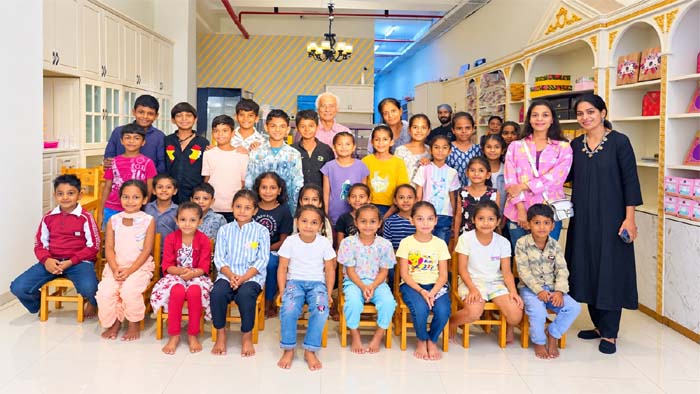
- 31 children from Thaltej Mathuranagri discover the joy of Indian traditions through a lively, learning-filled celebration
- Hanuman-themed cupcake workshop adds a delicious dash of creativity to cultural learning
- Maa Durga storytelling session turns mythology into lessons in courage, values and inner strength
- Bubble spectacle and STEM activities blend wonder, scientific curiosity and unbridled childhood fun
- Peacemaker Manashree’s 17-year-old initiative seeks to bridge Indian heritage, modern education and social harmony
NE FEATURES BUREAU
AHMEDABAD, OCT 6
What happens when Navratri, Indian mythology, hands-on learning, science and sheer childhood wonder come together under one roof? Ahmedabad offered an engaging answer as 31 children from the Thaltej Mathuranagri area stepped into a world where culture was not merely explained, but experienced, created and celebrated at the Gujarat edition of ‘Amritayu Anandotsav’ at Sunshine Lab.
Organised by Peacemaker Manashree, who has been taking the Amritayu Anandotsav initiative to different parts of the world for the past 17 years, the Ahmedabad celebration brought together faith, culture, creativity and contemporary learning in a child-centric format.
Held on the auspicious occasion of Navratri, Durga Puja and Dussehra, the Gujarat edition was organised with the support and cooperation of Sunshine Lab and co-host Riddhi Patel, a social entrepreneur and parenting coach. The event sought to connect children with India’s cultural heritage, moral values and traditions while encouraging modern education, scientific curiosity and social harmony.
The celebration began on a warm and participatory note in the presence of children from Thaltej Mathuranagri and social educator Rupal Barot.
Rather than leaving culture as something children simply watch or listen to, the organisers turned it into an experience involving their hands, imagination and questions. Under the guidance of Sushma Lama, an expert from the Sunshine Lab Cooking Academy, the children enthusiastically took part in a Hanuman-themed saffron cupcake-making workshop.
The activity added a creative and contemporary dimension to cultural learning, allowing children to engage with a familiar cultural theme through cooking and craft.
The focus then shifted from the kitchen to storytelling. Anisha Kapoor, lawyer and POCSO advocate, conducted a special storytelling session centred on the bravery and inner strength of Maa Durga. Through the narrative, children were encouraged to understand courage, resilience, moral values and the importance of standing up for what is right.
The organisers ensured that learning never became monotonous. An ‘Iridescent Bubble Spectacle’, featuring a colourful and magical bubble show, transformed the venue into a space of laughter, amazement and uninhibited childhood joy.
Adding another layer to the celebration were specially curated ‘STEM Play and Exploration’ activities. Through play-based experimentation and exploration, children were encouraged to observe, question and think scientifically—demonstrating that cultural rootedness and modern scientific learning need not exist in separate worlds.
Nutritious and delicious refreshments were also served to the participating children.
For co-host Riddhi Patel, the initiative reflects a larger commitment to the holistic development of children by bringing together modern STEM education and Indian heritage. The event thus went beyond a conventional festive gathering to create a space where children could learn, imagine, create, question and celebrate together.
Photographers Sharan Delhiwala and Bihag Srinivas documented the memorable moments of the celebration.
The organisers also expressed their gratitude to Jodhpur Art Gallery (AMC) and Amit Barot for their special support and encouragement.
At a time when children are increasingly surrounded by screens and digital distractions, Amritayu Anandotsav offered a refreshing proposition: perhaps the most meaningful way to preserve culture is not to ask children merely to remember traditions, but to let them experience, question and enjoy them.