- Miloni Thakkar and Mitwa Goswami’s TrustGate combines network intelligence with physical sensor data to detect attacks conventional security tools can miss
- IITGN undergraduates secure Second Prize at Intel’s global Electronic System Design Contest in Shanghai
- AI system identifies not just an anomaly but the affected plant component, helping operators act in seconds
- On-device architecture avoids cloud dependence, while TPM 2.0 and self-healing safeguards strengthen system resilience
- Research prototype tackles a cyber-physical gap exposed by the 2021 Oldsmar water-treatment attack
NE SCIENCE & TECHNOLOGY BUREAU
GANDHINAGAR, SEPT 24
What if a cyberattack on a water-treatment plant looked perfectly legitimate to every conventional security system—but its physical consequences were potentially lethal? Two undergraduate students at the Indian Institute of Technology Gandhinagar (IITGN) have built an AI-based system designed to answer precisely that question, earning international recognition in the process.
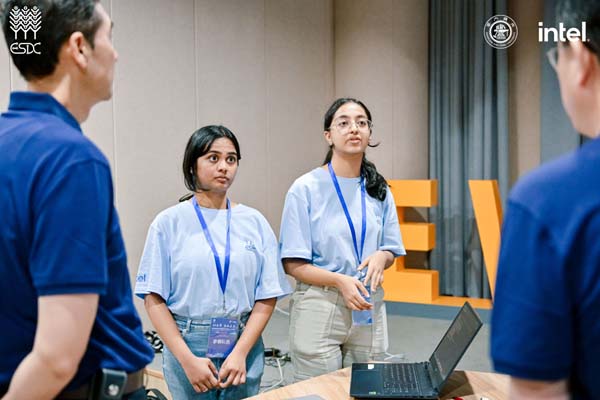
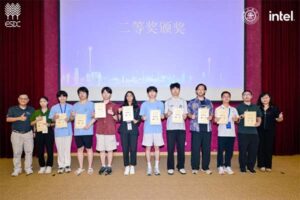
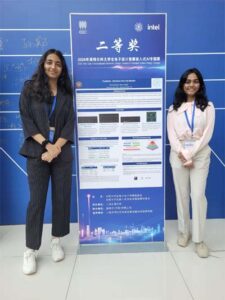
Miloni Thakkar, a third-year Computer Science and Engineering student, and Mitwa Goswami, a third-year Electrical Engineering student, won the Second Prize at the Intel Electronic System Design Contest 2026, held at Shanghai Jiao Tong University, for TrustGate, an AI-powered cybersecurity system designed to detect attacks on industrial control systems used in water-treatment plants, power grids and manufacturing facilities.
The project was inspired by a chilling real-world incident. In February 2021, an unidentified attacker remotely accessed the control system of a water-treatment plant in Oldsmar, Florida, and attempted to raise the level of sodium hydroxide—used to balance water pH—to nearly 100 times its safe concentration.
The potentially dangerous command was not detected by an automated security system. A plant operator happened to notice his computer mouse moving on its own and reversed the command in time.
That gap between what a computer sees and what a plant experiences became the central problem the IITGN students sought to solve.
Beyond network traffic
Most industrial control systems running critical infrastructure are decades old and were not originally designed with cybersecurity as a priority. Conventional security tools can identify unauthorised access, unusual network activity or known malware, but may struggle when a malicious command appears legitimate at the protocol level while producing a dangerous physical consequence.
“TrustGate closes that gap by understanding both the cyber and physical sides of an attack together,” said Miloni. “This matters well beyond the competition, because these are the systems that keep basic services like clean water running, and their failure can cost a lot in terms of money and health.”
The students chose water-treatment infrastructure both because the stakes were clear and because it offered a well-established research environment. They used the SWaT (Secure Water Treatment) dataset, based on a six-stage scaled-down water-treatment testbed maintained by the iTrust Centre at the Singapore University of Technology and Design. The dataset captures both network traffic and physical sensor data during normal operations and staged cyberattacks.
Two streams, one security picture
At the heart of TrustGate is a dual-stream Bi-directional Long Short-Term Memory (BiLSTM) model with what the students call cross-modal attention. Network traffic and physical sensor readings are analysed separately but allowed to inform one another.
“Think of it as two specialists working together instead of one generalist working alone,” explained Mitwa. “One part of the model studies network traffic patterns, while a separate part studies physical sensor readings from the plant. The key innovation is the cross-modal attention step.”
Instead of simply combining the two streams at the end, the model allows them to cross-check one another—for example, whether physical sensor readings before or after a suspicious network command indicate that the command is genuinely dangerous.
This approach is designed to detect disguised or gradual attacks that may not appear suspicious in either stream independently. When TrustGate identifies an anomaly, it also attempts to identify the nature of the attack and the physical component involved, displaying the information on a live plant map.
“In a real plant, ‘something is wrong’ isn’t actionable on its own,” said Miloni. “What is important is for the operator to know where to look and what to shut down, in seconds and not minutes. TrustGate identifying the specific affected component is the difference between a useful alert and a paralysing one.”
Designed to survive an attack
The students deliberately designed TrustGate to operate on embedded hardware rather than depend on cloud connectivity—a significant consideration for critical infrastructure that may be deliberately kept offline.
“A cloud dependency would introduce a new attack surface and a single point of failure,” said Mitwa. “Running fully on-device means the system keeps working even if external connectivity is cut, which is exactly the scenario you’d worry about during a real attack.”
TrustGate incorporates TPM 2.0, which helps verify that system code and hardware have not been tampered with, along with a self-healing watchdog that automatically restarts a core process if it hangs or crashes.
Mitwa led the hardware integration, TPM attestation and embedded Linux deployment, while Miloni led the AI model architecture, training, ablation studies and OpenVINO deployment.
Mentorship that challenged assumptions
The students were mentored by Sameer Kulkarni, Assistant Professor in the Departments of Computer Science and Engineering and Electrical Engineering at IITGN.
“When Miloni and Mitwa first approached the project, they were thinking about it primarily as a pattern-analysis problem, a model that would learn statistical patterns and produce an anomaly score,” Kulkarni said. “My role was never to give them the answers, but to keep asking the questions that would make them examine their assumptions more critically. The students took ownership of the exploration and development, and that was important to me.”
Their international presentation provided another test. The duo had to present in English before a predominantly Mandarin-speaking panel within a strict 30-minute limit.
“One real lesson from that experience was learning to actually read the room while speaking, and adjusting on the spot; it’s a skill that’s stuck with us for life beyond that presentation,” said Miloni.
From laboratory prototype to real-world possibility
The Shanghai recognition comes with an important caveat: TrustGate remains a research prototype, validated on a laboratory testbed rather than a live industrial installation. It still requires testing on live plant data, support for additional industrial protocols and formal security certifications before any real-world pilot.
The students believe the underlying idea of combining network and physical data—effectively creating a cyber-physical view of infrastructure—could potentially extend to power grids and oil-and-gas facilities, although each application would require adaptation.
“What’s next is to build up on this idea, and make the system more efficient, maybe even trying out other models or methods to test,” said Miloni.
For Mitwa, the international prize is less an endpoint than a launchpad.
“We built this in a fairly short amount of time, and to successfully defend it at an international stage is something we are proud that we pushed ourselves to do,” she said. “It has further motivated us to keep working on this rather than treating it as a one-time project.”