R ARIVANANTHAM
CHENNAI, SEPT 21
What if the biggest obstacle between a patient and life-saving medical attention is not the availability of an ambulance—but the traffic standing between them? Kauvery Hospital is attempting to answer that challenge with a new emergency-care model that puts trained medical responders on two wheels and takes first response directly to the point of crisis.
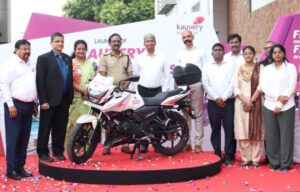
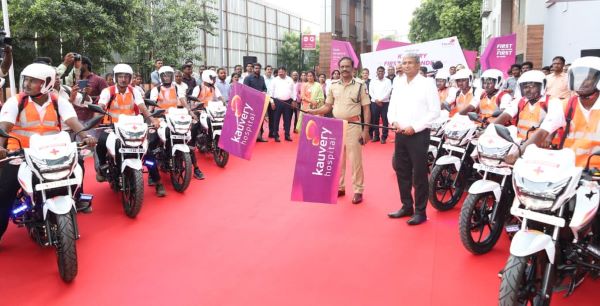
Kauvery Hospital has launched “Kauvery First Responders”, a network of 10 bike ambulances deployed across its Chennai network to bring trained medical personnel and essential emergency equipment closer to patients during the critical first minutes of an emergency.
- Kauvery Hospital launches “Kauvery First Responders” with 10 bike ambulances across Chennai
- Trained medical responders to reach emergency scenes faster with AEDs, oxygen and essential emergency kits
- Bikes are designed for first response—not patient transport—while conventional ambulances handle onward care
- 5G, GPS/live tracking and webcams connect responders at the scene with hospital clinical teams
- Traffic police urge motorists to obey road rules as Chennai moves towards AI-enabled automated traffic signals
- Motor Vehicles Act mandates motorists to give way to ambulances and notified emergency vehicles
The initiative is designed around a simple proposition: reach first, respond first and then connect the patient to the full ambulance-and-hospital system.
The bikes have been deployed across Kauvery Hospital’s Alwarpet, Vadapalani, Radial Road and Maa Kauvery locations, with the network intended to overcome one of Chennai’s most persistent emergency-response challenges—traffic congestion and difficult road access.
Two wheels to close the critical response gap
The First Responders are not intended to transport patients. Instead, trained medical responders travel rapidly to the emergency scene, assess the patient and provide appropriate first-response care within established training and clinical protocols.
At the same time, a conventional ambulance can be coordinated for transportation and further management whenever required.
Each bike carries essential emergency-response equipment, including an Automated External Defibrillator (AED), oxygen support and an emergency medical kit.
In a suspected cardiac arrest, the AED can analyse the patient’s heart rhythm and deliver an electrical shock when indicated. Oxygen can be administered when clinically appropriate, while the emergency medical kit allows the responder to undertake immediate assessment and provide first-response care in accordance with established protocols.
The initiative therefore seeks to address the often-critical interval between the emergency occurring and a conventional ambulance reaching the patient.
‘It is not about replacing the ambulance’
Dr. Manivannan Selvaraj, Founder & Managing Director, Kauvery Group of Hospitals, said the initiative was conceived around the reality of Chennai’s traffic.
“In an emergency, reaching the patient is the first challenge, and in a city like Chennai, traffic can sometimes make that challenge even greater. We wanted to create a system that works around this reality and brings medical assistance closer to the point where it is needed. Kauvery First Responders are designed to put trained medical responders and essential emergency equipment on the road, so that appropriate care can begin at the scene while the ambulance and hospital teams coordinate the next stage. It is not about replacing the ambulance; it is about making sure that the wait for an ambulance does not also mean a wait for the first response.”
The distinction is important: the bike responder is conceived as the first clinical link, while the conventional ambulance remains the vehicle for patient transportation and further emergency management.
Connected care from the street to the hospital
The First Responders are also designed as part of a connected emergency-care system rather than as standalone motorcycle units.
Equipped with 5G connectivity, webcams and GPS/live tracking, the responder can remain connected with the hospital team from the emergency scene, enabling real-time coordination and facilitating the transition to further care once the patient is moved by ambulance.
People requiring emergency care can contact Kauvery Hospital’s emergency service at 044-40006000.
Dr. Aravindan Selvaraj, Co-Founder & Executive Director, Kauvery Group of Hospitals, in a statement said the quality of those first few minutes is as important as the speed of arrival.
“Emergency care is not only about how quickly we reach a patient, but also about what happens in those first few minutes. A faster response becomes meaningful when it is backed by trained personnel, the right equipment and a connected clinical system. With Kauvery First Responders, we are extending the emergency-care pathway beyond the hospital and bringing that first point of clinical response closer to the community. The combination of mobility, emergency preparedness and real-time connectivity can help our teams make those early minutes more purposeful, while ensuring that the patient remains connected to the larger continuum of care.”
Traffic police: Save lives, give way
P. Pakalavan, IPS, Joint Commissioner of Police (Traffic – South), Chennai, who participated as Chief Guest and flagged off the First Responders, used the occasion to underline the public’s role in reducing preventable road deaths.
Addressing the media on the sidelines of the inauguration, Pakalavan appealed to the public to abide by traffic regulations to avoid the loss of precious lives in road accidents.
He also disclosed that the Greater Chennai City Police Traffic Wing is in the process of setting up automated traffic signals across all four corridors.
According to him, the automation will be AI-enabled, allowing signals to optimise their operation according to traffic volume. The system is expected to reduce the need for physical deployment of police personnel at junctions, enabling them to be utilised more extensively for traffic-enforcement duties, he added.
The development is particularly relevant to emergency response: every reduction in unnecessary congestion and every improvement in traffic-flow management can potentially help emergency vehicles and first responders reach their destinations faster.
What the law says about giving way to ambulances
The new initiative also brings into focus an often-overlooked legal responsibility of motorists.
Under Section 194E of the Motor Vehicles Act, 1988, a person driving a motor vehicle who fails to draw to the side of the road on the approach of an ambulance, fire-service vehicle or another emergency vehicle specified by the State Government can face imprisonment of up to six months, a fine of ₹10,000, or both.
The legal framework thus places a clear responsibility on road users to facilitate the movement of emergency vehicles.
The Act also contains provisions relevant to emergency assistance at accident scenes. Section 134 lays down duties relating to securing medical attention for persons injured in a motor-vehicle accident, while Section 134A provides statutory protection to Good Samaritans who, in good faith and without expectation of reward, provide emergency medical or non-medical assistance at an accident scene.
In the context of Kauvery First Responders, this legal framework reinforces a wider public message: emergency response is not solely a hospital responsibility; road users also have a role in ensuring that medical help can move through the city without avoidable obstruction.
From 5G ambulances to two-wheeler first response
Kauvery Hospital already operates a connected emergency ambulance network in Chennai, with 5G-enabled ambulances supporting real-time patient monitoring and remote clinical guidance during transport.
The First Responders add another layer to this system by moving the first clinical response closer to where the emergency actually begins.
The model effectively creates three connected stages: rapid first response at the scene, ambulance-based transportation and hospital-based definitive care.
The larger public-health message is equally significant. In emergencies such as cardiac arrest, severe trauma or other time-critical conditions, the value of technology and infrastructure ultimately depends on how quickly trained assistance can reach the patient and initiate appropriate care.
For Chennai, Kauvery’s 10-bike pilot is therefore more than a fleet addition. It is an experiment in re-engineering emergency response around the city’s traffic reality—using mobility, medical preparedness and connectivity to make the first few minutes count.