NE AGRICULTURE BUREAU
CHENNAI, SEPT 21
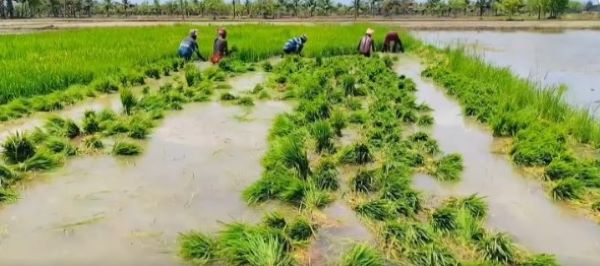
For a Cauvery delta farmer, the harvest is supposed to be the moment when months of water, labour, money and hope finally turn into grain. This year, however, the paddy fields are telling two very different stories — early harvests offering some relief, while crops that stayed longer in the field are paying a steep price for heat and inadequate water.
Across the delta, farmers harvesting kuruvai paddy are reporting mixed fortunes, with the timing of harvest emerging as a crucial dividing line. Fields harvested in August have in several pockets produced reasonable yields, but prolonged high temperatures and water stress have taken a visible toll on later crops.
- Early harvests offer a glimmer of hope, but delayed crops are yielding sharply less as heat and water stress bite
- Thanjavur kuruvai acreage falls to 64,755 hectares from 79,800; Nagapattinam plunges 96% to just 1,720 hectares
- A farmer’s harvest drops from 45–50 bags to 30 bags an acre as late-season crop losses deepen
- Tiruvarur records better average yield, but officials warn heat stress could hit fields yet to be harvested
- With procurement expected to shrink, the delta’s kuruvai story raises fresh questions over water security for the next crop
The problem began even before the crop entered the field. The delay in releasing water from the Mettur reservoir, the principal irrigation source for the Cauvery delta, sharply restricted the area farmers could bring under kuruvai cultivation. The State Government subsequently ordered release of Mettur water from September 1, 2026, for drinking-water and irrigation requirements, underscoring the continuing importance of reservoir flows to the delta’s agricultural cycle.
Thanjavur: Acreage down, yield story still unfolding
In Thanjavur, kuruvai was cultivated on 64,755 hectares this year, against 79,800 hectares last year. Harvesting has been completed on around 37,700 hectares, with the average yield so far at about 5,500 kg a hectare, broadly comparable with last year.
But agriculture officials have sounded a note of caution: the final average could fall because several heat-affected fields are still awaiting harvest.
Farmers who completed harvesting early have had reason to breathe easier. In Tirukkattupalli, those who harvested during the last week of August reported yields of around 5,500 kg a hectare.
For others, however, the picture has been starkly different.
S Sivakumar of Manathidal village said: “I got only 30 bags (60 kg each) of paddy per acre this year compared to 45-50 bags last year.”
His experience reflects the unevenness of this year’s harvest. In a nearby village, he said, about half the farmers obtained a decent yield while the other half suffered poor returns.
Nagapattinam: From 30,000 hectares to 1,720
Nowhere is the contraction more dramatic than Nagapattinam.
Kuruvai coverage has collapsed from 30,000 hectares last year to just 1,720 hectares this year — a contraction of about 94%. The average yield has also declined from 4,940 kg to 4,200 kg a hectare.
The district’s dependence on Cauvery irrigation makes the shortage particularly painful, while saline groundwater limits the scope for farmers to compensate through borewells. Recent reporting indicates that Tirumarugal accounted for almost the entire kuruvai area, as it was among the few pockets with adequate usable groundwater.
The experience of a Tirumarugal farmer captures the magnitude of the loss. A four-acre holding that produced around 170 bags of 62 kg each last year yielded only 47 bags this season. Farmers have also reported grains drying and turning brown on the plant because of intense heat and inadequate moisture.
That is not merely a yield statistic. It is a direct subtraction from a farm family’s income.
Tiruvarur bucks the trend — but heat lurks
Tiruvarur presents a more complicated picture.
Kuruvai cultivation fell sharply from 77,573 hectares to 46,339 hectares, with harvesting completed on 25,658 hectares. Yet the average yield so far stands at 4,468 kg a hectare, higher than last year’s 3,898 kg.
Officials, however, have cautioned that this encouraging average may not tell the whole story because the impact of heat stress could become evident in fields yet to be harvested.
That uncertainty — a good number today, but a potentially weaker final number tomorrow — runs through much of the delta this season.
Mayiladuthurai the exception; Tiruchy also shrinks
Mayiladuthurai is the notable exception on acreage. Kuruvai cultivation increased from 39,700 hectares last year to 41,000 hectares this year.
In Tiruchy, meanwhile, coverage declined from 7,233 hectares to 5,763 hectares. Cultivation was concentrated largely in Lalgudi, where farmers relied on borewells, while Anthanallur and Manachanallur recorded relatively limited acreage.
The pattern across districts points to one broad reality: where water was available, farmers tried to keep kuruvai alive; where it was not, acreage simply disappeared.
THE NEXT QUESTION: WHO WILL PAY FOR THE SHORTFALL?
The consequences will extend beyond the farm gate.
Officials of the Tamil Nadu Civil Supplies Corporation expect paddy procurement across the delta to decline in line with the contraction in cultivated area. In Nagapattinam, the projected procurement is only around 5,000 metric tonnes, against 1.30 lakh tonnes last year; the number of Direct Procurement Centres has also been sharply reduced.
For farmers, however, the immediate worry goes beyond kuruvai.
The availability of Cauvery water is already influencing decisions on the next crop. Farmers and agricultural representatives have expressed uncertainty over taking up samba cultivation where irrigation water remains inadequate.
The delta’s kuruvai harvest, therefore, is emerging as more than a seasonal production report. It is a warning from the fields: when water arrives late and heat stays too long, the farmer may harvest not just less paddy, but less hope.