- MoU creates framework for joint R&D, specialised training and technology-driven solutions
- Project Spandan seeks to connect advanced research with real-world national security challenges
- ATS personnel to access professional development programmes; students to get internship opportunities
- Data science, machine learning, energy and computational technologies among potential collaboration areas
- Three-year partnership brings academic expertise and frontline policing challenges to the same table
NE SCIENCE & TECHNOLOGY BUREAU
GANDHINAGAR, SEPT 17
What happens when frontline intelligence challenges meet cutting-edge academic research? In a significant convergence of science, technology and modern policing, the Indian Institute of Technology Gandhinagar (IITGN) and the Gujarat Anti-Terrorist Squad (Gujarat ATS) have entered into a three-year partnership aimed at turning research capabilities into technology-driven solutions for real-world challenges.
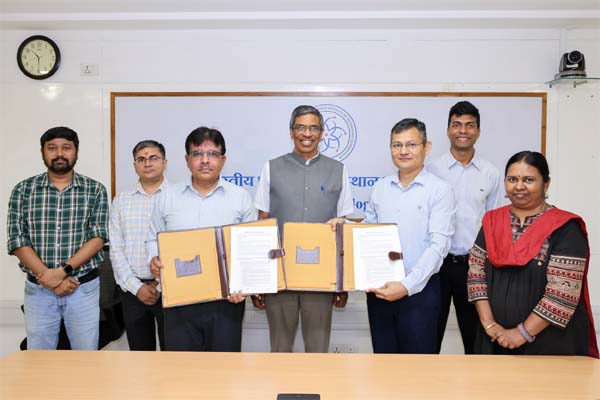
The two institutions signed a Memorandum of Understanding (MoU) on September 15 to strengthen collaboration in research, technology, capacity building and professional development, opening a new interface between IITGN’s academic ecosystem and Gujarat ATS’s operational expertise.
The MoU was signed by Sunil Joshi, IPS, Deputy Inspector General, Gujarat ATS, and Prof Vimal Mishra, Dean R&D, IITGN, in the presence of Prof Rajat Moona, Director, IITGN; Prof Sivapriya Kirubakaran, Chemistry, IITGN; Siddharth Korukonda, IPS, Gujarat ATS; Anand Pandey, Chief Operating Officer, IIEC, IITGN, and faculty members.
From laboratory to field
The partnership will provide a framework for joint research and development projects, specialised workshops, webinars and capacity-building programmes for working professionals and students.
The R&D initiatives will focus on areas relevant to Gujarat ATS and could bring together researchers, subject matter experts and professionals from both institutions.
“For us, this partnership is about taking research and technology beyond the laboratory and connecting it with real-world needs. Gujarat ATS brings valuable domain expertise and practical challenges, while IIT Gandhinagar can contribute through its research, technology and academic capabilities. We hope this collaboration will create meaningful opportunities for joint research, professional learning and for our students and researchers to engage with challenges that have a direct relevance to society,” said Prof Rajat Moona, Director, IITGN.
Prof Vimal Mishra, Dean R&D, IITGN, said: “The MoU brings together IIT Gandhinagar’s research capabilities and Gujarat ATS’s domain expertise to explore opportunities for joint R&D and technology-driven solutions. It also opens avenues for knowledge exchange and greater engagement of our students and researchers with real-world challenges.”
Project Spandan: science enters the policing grid
According to Sunil Joshi, IPS, Deputy Inspector General, Gujarat ATS, Project Spandan, driven by the strategic vision of the Chief Minister, Deputy Chief Minister and Director General of Police, Gujarat, represents a shift towards bringing advanced research into modern policing.
He said collaboration with premier institutions such as IIT Gandhinagar could help bridge the gap between academic expertise and the operational challenges faced by Gujarat ATS in national security.
“It is a true convergence of science and strategy. By bringing our on-ground challenges to top academic minds, we will co-develop bespoke, actionable tools for intelligence and digital investigations,” he said, adding that the initiative would directly empower frontline officers and strengthen operational capabilities.
Learning works both ways
The partnership is not confined to joint research. Gujarat ATS personnel will have opportunities for professional development through IITGN’s Executive Masters and other academic programmes.
Subject matter experts from Gujarat ATS may also contribute to IITGN’s online courses through special lectures and as instructors or co-instructors. They may provide inputs for curricula for professional online degree programmes such as e-Masters or equivalent programmes.
For IITGN students, the collaboration could open opportunities to pursue internships and job opportunities with Gujarat ATS, subject to the requisite eligibility and selection process.
Technology as the common ground
Potential areas of collaboration include Energy Policy and Regulation, Data Science and Decision Making, Applications of Machine Learning in Engineering, Composites, Energy Sustainability and Computational Fluid Dynamics.
The MoU also contains provisions concerning confidentiality, publications, intellectual property rights and sharing of financial benefits. Specific terms for individual projects and activities will be mutually agreed upon before their commencement.
The agreement will remain effective for three years from the effective date, unless extended, amended or terminated by mutual agreement.
The larger significance of the partnership lies in the possibility of creating a two-way knowledge pipeline: operational challenges moving into laboratories for scientific investigation, and academic innovations moving back into the field for practical application. The success of that model will ultimately depend on how effectively individual R&D projects translate this institutional handshake into deployable solutions.