

R ARIVANANTHAM
CHENNAI, AUG 29
There are wetlands that merely hold water—and there are wetlands that hold an entire living world. Perungulam in Thoothukudi belongs emphatically to the second category.
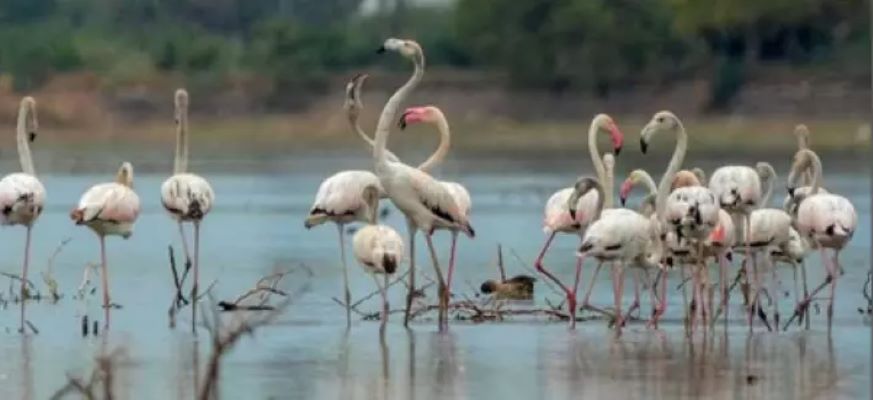
Spread across 860 acres, this Thamirabarani-fed irrigation tank has quietly evolved into an extraordinary ecological refuge where resident birds, long-distance migrants, fish, grasslands, open scrub and aquatic life converge. Now, after a year-long scientific assessment recorded 147 bird species, the State has begun moving towards a larger ambition: securing Ramsar recognition for Perungulam and placing its fragile ecosystem under a stronger conservation spotlight.
- 860-acre Thoothukudi wetland emerges as a biodiversity lifeline as Tamil Nadu moves to secure international recognition
- 147 species, 14 Schedule-I birds and an Endangered Egyptian Vulture turn Perungulam into a conservation priority
- Thamirabarani-fed tank sustains irrigation, fish, grasslands and migratory flyways in a fragile ecological mosaic
- ‘Blue-Green Centre’ tag also on the horizon as experts demand a comprehensive conservation management plan
- Perungulam could become another green jewel in Tamil Nadu’s expanding wetland conservation landscape
The initiative by the Thoothukudi district administration and Tamil Nadu Forest Department could transform a relatively lesser-known irrigation tank into an internationally recognised wetland of importance.
And the timing could not be more significant.
At a time when Tamil Nadu is seeking to balance development with ecological resilience, Perungulam offers a compelling test of whether conservation can begin not after an ecosystem is damaged, but before its ecological character is irreversibly altered.
A living ark with 147 species
A detailed study carried out between July 2023 and June 2024 recorded 147 bird species belonging to 22 orders and 60 families at the Perungulam wetland. As many as 100 species were resident, underscoring the tank’s importance not merely as a seasonal stopover but as a sustained habitat.
The diversity becomes even more significant when viewed through the lens of conservation status.
Five species—the Indian Roller, Spot-billed Pelican, Bar-tailed Godwit, Black-tailed Godwit and Asian Woollyneck—are classified as “Near Threatened” by the International Union for Conservation of Nature (IUCN).
The Egyptian Vulture is classified as “Endangered”, while the Curlew Sandpiper is categorised as “Vulnerable”.
Even more strikingly, 14 species recorded at the wetland enjoy Schedule-I protection under the Wildlife Protection Act, placing them among species receiving the highest level of statutory protection.
Perungulam is also an important staging and stopover habitat for migratory visitors such as the Little Tern, Gull-billed Tern, Whiskered Tern, Caspian Tern and Slender-billed Gull.
This is no ordinary bird list. It is an ecological warning—and an ecological opportunity.
Where the Thamirabarani meets the flyway
Perungulam’s strength lies in its ecological diversity.
Its grasslands, open scrub habitats, aquatic vegetation, food resources and nesting and foraging grounds create a mosaic of habitats capable of supporting a remarkably broad spectrum of birds.
Bird watcher and study author Thomas Mathibalan said the diversity of migratory and native birds was linked to the wetland’s suitable foraging and nesting sites, food availability, grasslands and open scrub habitats. He stressed that “a clear plan for conservation is the need of the hour” to protect Perungulam and its ecosystem.
Earlier observations have also highlighted Perungulam’s importance within the Thamirabarani river basin, with aquatic vegetation and associated insects providing an important food base for waterbirds.
The wetland is, therefore, performing several functions simultaneously—water storage, irrigation support, biodiversity conservation, bird habitat and ecological sustenance.
That makes its protection a matter not merely of wildlife conservation but of water security and climate resilience.
From irrigation tank to international wetland
Forest officials are now discussing the proposal to seek Ramsar recognition for Perungulam, citing its diverse avifaunal assemblage and biodiversity.
District Forest Officer M Ilayaraja said discussions were under way to propose the wetland for Ramsar recognition and that there were also plans to seek a “Blue-Green Centre” tag to disseminate awareness about the tank’s ecological importance.
The proposal will incorporate requirements of the Water Resources Department before being placed before the district wetland committee for scrutiny and further consideration.
The move comes amid renewed public demands for stronger protection. Earlier this week, Thoothukudi Collector Vishu Mahajan inspected Perungulam, where thousands of migratory and native waterbirds had gathered, amid calls to declare the wetland a bird sanctuary or Ramsar site.
The inspection itself underlines a growing realisation: Perungulam is no longer an obscure waterbody on the administrative map. It is emerging as a major ecological asset.
A green vision for a water-stressed future
The Perungulam initiative fits into a broader environmental conversation in Tamil Nadu, where wetland conservation has increasingly become part of climate-resilient governance.
Chief Minister C. Joseph Vijay, whose government has placed climate resilience, renewable energy and coastal protection among its stated green priorities, has proposed a ₹3,000-crore annual Climate Budget and a target of 50% renewable-energy-based electricity by 2030. His climate agenda also envisages stronger coastal resilience and ecological protection.
For Perungulam, the larger challenge is to translate such a green vision into wetland-level protection—where water quality, ecological flows, habitat integrity, traditional irrigation needs and biodiversity are treated as interconnected priorities.
The State’s experience with Ramsar recognition provides an important foundation. Tamil Nadu’s Wetlands Authority lists a substantial network of Ramsar sites and has developed restoration and awareness initiatives across wetlands, including Perungulam.
The State’s earlier Ramsar journey has also demonstrated the value of integrated management plans and scientific monitoring. When Tamil Nadu’s Ramsar tally expanded, officials stressed that international recognition could help prevent encroachments and strengthen conservation while respecting traditional community rights.
The real test begins before the Ramsar tag
For Perungulam, however, the Ramsar label should be seen not as the destination but as the beginning of a much larger conservation mission.
The wetland has already faced environmental pressures. Earlier environmental reporting highlighted concerns over illegal lotus cultivation, while conservationists have repeatedly called attention to the need to safeguard its avian habitat.
A Ramsar proposal should therefore be accompanied by a scientifically prepared and enforceable conservation management plan covering water quality, catchment protection, invasive vegetation, habitat restoration, bird nesting areas, pollution control, human disturbance, power-line risks and sustainable livelihood interests.
The objective must be simple: keep Perungulam ecologically alive while allowing the communities that depend on it to remain economically secure.
From bird habitat to green heritage
Perungulam’s significance extends beyond its 147 recorded species.
The tank represents the kind of living infrastructure that modern climate policy increasingly needs—natural systems that store water, support biodiversity, sustain agriculture and moderate ecological stress without demanding the enormous costs associated with engineered alternatives.
- Its grasslands are habitat.
- Its water is livelihood.
- Its birds are ecological indicators.
- Its migratory visitors are evidence of a functioning landscape.
- And its connection to the Thamirabarani makes it part of a much larger riverine story.
The proposed Ramsar recognition could give this landscape international visibility. The proposed “Blue-Green Centre” could turn that visibility into public awareness.
But the ultimate measure of success will be neither the certificate nor the signboard.
It will be whether, years from now, the skies above Perungulam still darken with wings—and whether the tank continues to give farmers water while giving wildlife a place to live.
That is the green legacy worth fighting for.