
- Housing affordability crisis: Property prices outpace incomes, putting decent homes beyond the reach of growing sections of urban India
- Redevelopment with a human face: Experts warn against displacing established communities through unaffordable reconstruction
- Livability beyond buildings: Walkable streets, public spaces, clean air and water must become integral to urban planning
- Cities need financial muscle: Experts call for stronger municipal revenues, land value capture and long-term regeneration plans
- Professionalising real estate: GREMI’s specialised management programme seeks to prepare future-ready talent for the built environment
NE EDUCATION BUREAU
AHMEDABAD, OCT 31
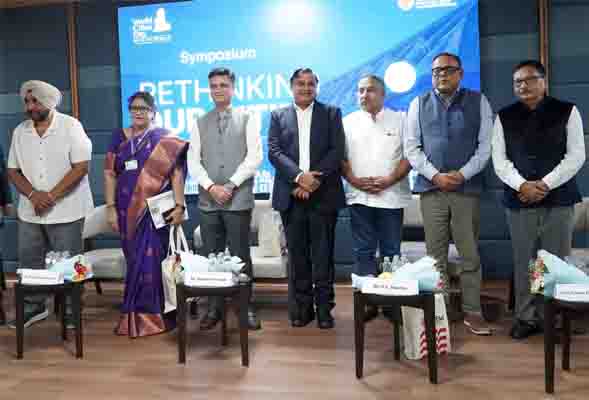
India’s urban future will be judged not by how many skyscrapers rise or how rapidly city limits expand, but by whether ordinary citizens can afford a decent home, access essential services and live in healthy, inclusive neighbourhoods. That was the central message emerging from a World Cities Day symposium organised by Ganesh Real Estate Management Institute (GREMI) in Ahmedabad, where experts called for a fundamental shift from construction-led growth to people-centric urban development.
Titled “Rethinking Our Cities: Urban Regeneration, Adequate Housing and Better Use of Existing Urban Assets”, the October 30 symposium brought together academics, urban planners, policymakers and real estate industry leaders to examine how Indian cities can accommodate rapid urbanisation without sacrificing affordability, inclusivity and livability.
The deliberations raised a critical question for policymakers and developers alike: can India’s expanding cities remain engines of opportunity if housing becomes unaffordable, redevelopment uproots established communities and urban infrastructure fails to keep pace with growth?
From urban expansion to better cities
Opening the discussion with a thematic presentation, “Cities at a Crossroads”, Dr Anil Kashyap, Director General, GREMI, said India’s position at the forefront of the next global wave of urbanisation by 2050 would place significant responsibilities on governments, planners and developers.
“With nearly 45 per cent of the world’s population already living in cities, the focus must shift from simply expanding our cities to improving the quality, sustainability and inclusiveness of the urban environments we already have,” he said.
The message was clear: urban growth must be measured not merely in terms of new buildings, roads and commercial districts, but also by improvements in the everyday lives of residents.
For Indian cities confronting mounting pressure on land, housing and infrastructure, urban regeneration offers an opportunity to make better use of existing assets while revitalising neighbourhoods, strengthening public amenities and improving the quality of urban life.
Housing affordability cannot be an afterthought
Housing affordability emerged as one of the most pressing concerns during the symposium.
Panellists highlighted the growing disconnect between property prices and household incomes, citing a global house price-to-income ratio that has increased from 9.4 years in 2010 to 11.7 years today.
The concern extends beyond first-time homebuyers. When residential prices rise faster than incomes, households face mounting financial pressure, younger people struggle to enter the housing market, and access to well-connected neighbourhoods becomes increasingly dependent on purchasing power.
The experts also cautioned that redevelopment, if poorly planned, can deepen existing inequalities. Replacing ageing housing with expensive new apartments may improve the physical appearance of a neighbourhood while making it impossible for its original residents to return.
Their recommendation was to consider redevelopment at the scale of entire neighbourhoods rather than treating individual housing societies as isolated projects.
Such an approach would enable planners to integrate housing, transport, public spaces, infrastructure and community needs into a coordinated regeneration strategy.
The larger challenge is to ensure that urban renewal improves the lives of existing residents instead of merely increasing property values.
Livability means more than impressive skylines
The symposium stressed that a city’s quality cannot be judged by its buildings alone.
Walkable streets, accessible public spaces, clean air, safe neighbourhoods and reliable water supplies are fundamental to urban well-being. Yet, the experts observed, the health and environmental costs of development are not always adequately incorporated into project planning and decision-making.
The panel underlined the importance of evidence-based urban planning, making the observation that “pictures tell stories, but numbers rewrite them.”
The message has particular relevance for rapidly transforming Indian cities, where ambitious infrastructure projects and high-rise developments can dominate public discussion while neighbourhood-level deficiencies remain unresolved.
Reliable data, measurable outcomes and transparent assessments are essential to determining whether urban investments genuinely improve residents’ quality of life.
Urban development, the discussion suggested, must place equal emphasis on the spaces between buildings and the public services that make neighbourhoods functional.
Municipal finance and governance need an overhaul
Financing emerged as another critical challenge. The experts observed that Indian cities remain severely underfinanced and called for urban local bodies to strengthen their own revenue-generating capacity, including through land value capture.
The underlying argument is that cities need predictable financial resources to maintain infrastructure, upgrade public services and undertake long-term regeneration, rather than depending excessively on isolated projects or short-term funding arrangements.
The panel called for comprehensive urban visions, investment plans and dedicated financing mechanisms for regeneration.
It also advocated making Town Planning Schemes and development control regulations more enabling and performance-based, with greater emphasis on the quality of outcomes rather than rigid compliance alone. GIFT City was cited as an example of performance-based regulation in practice.
The experts identified fragmented governance, agencies working in silos, limited stakeholder participation and weak accountability as obstacles to better urban outcomes.
They called for stronger collaboration among governments, academia and the private sector, alongside meaningful forums through which citizens can participate in decisions affecting their neighbourhoods.
Ultimately, successful urban regeneration requires more than financial investment and technical expertise. It demands institutional coordination, public trust and accountable leadership.
GREMI seeks to build expertise for India’s urban future
As India’s cities grapple with housing affordability, urban regeneration, infrastructure financing and sustainable development, the real estate sector needs professionals who can combine business acumen with an understanding of markets, regulations, finance and emerging technologies.
Post Graduate Certificate in Management (PGCM) in Real Estate
GREMI, which focuses on real estate management and the wider built environment, offers a one-year Post Graduate Certificate in Management (PGCM) in Real Estate. Its published programme highlights case-based and research-driven learning, advanced real estate and built-environment studies, live projects, an integrative capstone project, international immersion, sustainability and the use of technology, including AI and machine learning.
The programme is designed for graduates and working professionals seeking to enter the real estate sector or accelerate their careers. Its multidisciplinary approach connects real estate strategy and development with finance, markets, policy, technology, sustainability and industry practice.
Admissions for 2027–28: February intake
Post Graduate Diploma in Management (PGDM) in Real Estate Management,
Addressing this growing need for specialised talent, Ganesh Real Estate Management Institute (GREMI) also offers a two-year, AICTE-approved Post Graduate Diploma in Management (PGDM) in Real Estate Management, a full-time, non-residential programme carrying 80 credits, according to the institute’s course brochure.
The programme’s multidisciplinary curriculum spans Real Estate Business Operations and Management, Real Estate Economics, Law and Regulations, Finance, Investment and Valuation, Real Estate Fundamentals, Real Estate Data Analytics and AI Applications, Real Estate Markets, Real Estate Management and Humanities, and Real Estate Building Civilisation.
The inclusion of data analytics and artificial intelligence reflects the growing importance of technology in real estate decision-making, while the emphasis on economics, investment, valuation and regulation addresses the commercial and institutional dimensions of the industry.
The programme’s broader significance lies in preparing professionals to understand real estate not merely as a business of buying, selling and developing property, but as an industry with far-reaching implications for housing access, urban infrastructure, investment and the quality of life in cities.
Who can apply?
According to GREMI’s brochure, applicants should have completed 10+2 followed by a minimum three-year or four-year undergraduate qualification, with at least 50% marks. The stated minimum is 45% for candidates belonging to reserved categories. Final-year graduates are also eligible to apply.
The brochure additionally refers to valid scores in recognised competitive examinations.
Admissions for 2027–28: July intake
For prospective students, the course offers a structured route to explore careers across real estate development and management, market research, property investment, valuation, business operations and data-driven decision-making, subject to the programme’s curriculum and the requirements of individual employers.
The institute is headed by Dr Anil Kashyap, Director General, GREMI.
As Indian cities seek to become more affordable, inclusive and sustainable, developing skilled professionals will be an important part of the transition from construction-led expansion to responsible, well-managed urban growth.