R ARIVANANTHAM
NEW DELHI, NOV 21
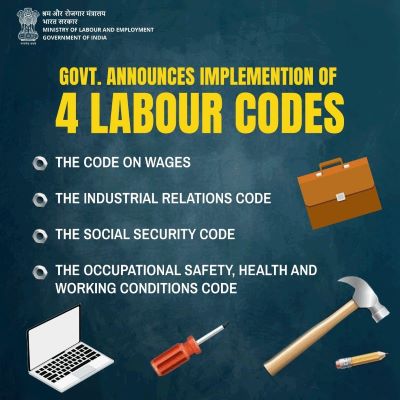
In a landmark labour reform milestone, the Government of India has notified the nationwide implementation of the four consolidated Labour Codes — the Code on Wages (2019), Industrial Relations Code (2020), Code on Social Security (2020), and the Occupational Safety, Health & Working Conditions (OSHWC) Code (2020) — bringing into effect the most sweeping transformation of India’s labour ecosystem in independent India.
- Four Labour Codes rolled out nationwide, replacing 29 archaic laws
- Historic overhaul promises better wages, stronger safety, wider social security & gender-parity at work
- Reforms align India with global standards, powering Aatmanirbhar Bharat’s future workforce
- Government announces full implementation from November 21, 2025
Effective 21 November 2025, the four Codes replace 29 fragmented Central labour laws, many dating back to the 1930s–1950s, ushering in a unified, progressive and future-ready framework designed to strengthen worker welfare, simplify employer compliance and align India with global labour standards.
The reform is rooted in three core objectives:
• Protect every worker with fair wages, safety and social security
• Simplify and modernise compliance for industries
• Support employment, productivity and economic resilience for Aatmanirbhar Bharat
Why the Reform Was Needed
For decades, India’s labour landscape was governed by overlapping, often outdated regulations that struggled to match a fast-evolving economy, new-age employment models and rising workforce aspirations. While other major economies consolidated their labour systems, India continued to operate within a complex web of 29 laws, increasing ambiguity and compliance burden.
Read Also:
Delhi Union of Journalists slams Centre’s Labour Codes as ‘Assault on Press Freedom’
The Labour Codes finally close this gap — shifting India from a colonial-era framework to a modern, flexible, worker-centric, industry-friendly labour architecture.
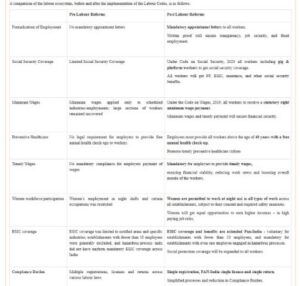
BEFORE & AFTER: HOW THE LABOUR CODES TRANSFORM THE WORKPLACE
KEY BENEFITS ACROSS SECTORS
- Fixed-Term Employees
- Equal benefits to permanent staff
- Gratuity eligibility after 1 year
- Encourages direct hiring, reduces contractual exploitation
- Gig & Platform Economy
- First-ever legal definitions for gig work, platform work, aggregators
- Aggregators to contribute to workers’ social security
- Aadhaar-linked universal account for portable benefits
- Contract Workers
- Health, safety, social security ensured by principal employer
- Free annual health check-up
- Women in the Workforce
- Gender discrimination banned
- Equal pay for equal work
- Women allowed in night shifts, mining, hazardous jobs
- Mandatory grievance committee representation
- Youth Workers
- Appointment letters for all
- Guaranteed wages during leave
- Floor wages ensure dignified living
- MSMEs
- Social security for all workers
- Double overtime wages
- Basic amenities (canteens, water, rest areas) mandated
- Beedi & Cigar Workers
- Minimum wage guaranteed
- Working hours capped
- Bonus eligibility after 30 days of work
- Plantation Workers
- Brought fully under OSHWC & Social Security Codes
- Mandatory chemical handling safety
- ESI coverage for workers and families
- Audio-Visual & Digital Media
- Journalists, dubbing artists, stunt workers formally recognised
- Appointment letters, timely wages, double overtime
- Mine Workers
- Commuting accidents recognised as employment-related (with conditions)
- Standardised national safety norms
- Free annual health check-up
- Hazardous Industry Workers
- Mandatory safety committees
- Uniform national safety standards
- Women allowed in all roles with safeguards
- Textile Workers
- Equal wages, PDS portability for all migrant workers
- Claims allowed for dues up to 3 years
- Double overtime pay
- IT & ITES
- Salary release mandatory by 7th of every month
- Equal pay, night-shift access for women
- Faster dispute resolution
- Dock Workers
- Legal recognition for all dock workers
- Mandatory insurance, PF, appointment letters
- Free annual health check-ups
- Export Sector Workers
- Gratuity, PF and social security for fixed-term workers
- Leave entitlement after 180 days
- Mandatory safety, CCTV monitoring for women during night shifts
ADDITIONAL REFORMS SHAPING THE FUTURE OF WORK
- National Floor Wage to prevent underpayment
- Gender-neutral employment including protections for transgender workers
- Inspector-cum-Facilitator for guidance-oriented oversight
- Faster dispute resolution via two-member Industrial Tribunals
- National OSH Board for unified safety standards
- Simplified compliance through single registration, licence, return
- Higher applicability limits to support MSME growth
A Decade of Transformation
India’s social security coverage has expanded from 19% in 2015 to over 64% in 2025.
The Labour Codes take this progress forward — ensuring safety, dignity and protection for every worker while fuelling job creation, industry competitiveness and economic growth.
With the Codes now in force, India stands at the threshold of a pro-worker, pro-women, pro-youth, pro-employment labour governance era.
These reforms mark a historic shift — shaping a workforce that is secure, empowered and ready for the future.