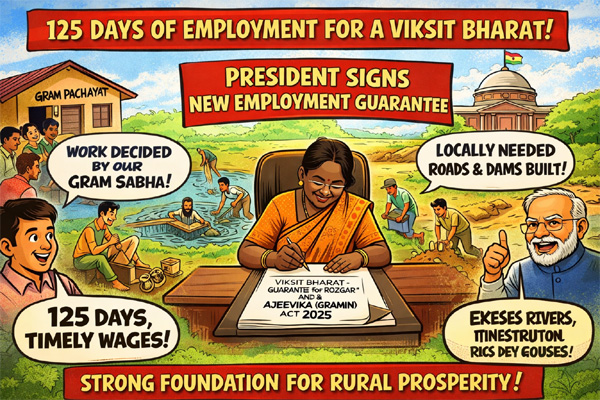
- President’s assent ushers in a new statutory era, replacing MGNREGA with a future-ready rural livelihoods framework
- Guaranteed employment rises to 125 days, strengthening income security and predictability for rural households
- Gram Sabha and Panchayats take centre stage with planning powers and bottom-up development
- Jobs aligned with durable assets—water security, infrastructure, livelihoods and climate resilience
- Beneficiaries welcome timely wages, local decision-making and assured work under Viksit Bharat @2047
NE NEWS SERVICE
NEW DELHI, DEC 21
In a landmark reform of India’s rural employment architecture, the President of India has given assent to the Viksit Bharat—Guarantee for Rozgar and Ajeevika Mission (Gramin) (VB–G RAM G) Act, 2025, formally replacing the Mahatma Gandhi National Rural Employment Guarantee Act (MGNREGA), 2005. Aligned with the national vision of Viksit Bharat @2047, the new law enhances the statutory employment guarantee from 100 to 125 days per rural household per financial year, signalling a decisive shift from welfare-centric intervention to integrated rural development.
What Has Changed: Major Modifications at a Glance
Higher Statutory Employment Guarantee
The Act mandates not less than 125 days of wage employment annually for rural households whose adult members seek unskilled manual work. This expansion strengthens livelihood security, stabilises incomes and improves predictability of work—especially critical during lean agricultural seasons.
Balanced Support for Agriculture and Labour
To ensure availability of farm labour during peak sowing and harvesting, States may notify an aggregated pause of up to 60 days in a year, without diluting the full 125-day entitlement. The calibrated provision supports agricultural productivity while safeguarding workers’ rights.
Time-Bound Wage Payments with Compensation
Wages must be paid weekly or within 15 days of work completion. Any delay attracts compensation, reinforcing wage security and accountability at the implementation level.
From Jobs to Assets: Work with Outcomes
Employment under the Act is directly linked to the creation of durable, productive and climate-resilient rural assets across four priority themes:
- Water security
- Core rural infrastructure
- Livelihood-related infrastructure
- Works mitigating extreme weather events
All assets are mapped to a Viksit Bharat National Rural Infrastructure Stack, enabling convergence, avoiding duplication and ensuring saturation-based development tailored to local needs.
Decentralised Planning, National Convergence
Planning authority rests firmly with Gram Sabhas and Panchayats through Viksit Gram Panchayat Plans (VGPPs). These locally approved plans are digitally integrated with national platforms such as PM Gati Shakti, ensuring whole-of-government coordination without centralising decision-making.
Reformed and Predictable Funding
Implemented as a Centrally Sponsored Scheme, the Act provides rule-based, normative allocations with cost-sharing of 60:40 (Centre:States), 90:10 for NE and Himalayan States, and 100% central funding for UTs without legislatures—ensuring fiscal discipline while preserving the right to demand work.
Stronger Administrative Capacity & Transparency
The administrative expenditure ceiling rises from 6% to 9%, enabling better staffing, training and field support. Technology—biometrics, geo-tagging and real-time dashboards—enhances transparency, while social audits by Gram Sabhas ensure community oversight.
Restored Unemployment Allowance
If employment is not provided within the stipulated time, unemployment allowance becomes payable after 15 days, reinstating a meaningful statutory safeguard.
What It Means on the Ground: Beneficiaries React
Across villages, beneficiaries have welcomed the expanded guarantee and local empowerment.
“Earlier, 100 days were over quickly. With 125 days, we can plan household expenses better and avoid distress migration,” said Sureshbhai, a daily-wage worker from Gujarat.
“Work decided by our Gram Sabha means the assets we build—ponds, roads, check dams—are what our village actually needs,” noted Sunita Devi, a self-help group member from Bihar.
“Timely wages and compensation for delays give us confidence that our labour will be respected,” added Raghunath, a farm worker from Odisha.
A Strategic Shift for Rural Bharat
By embedding the right to demand employment, strengthening Panchayati Raj institutions, ensuring timely payments, and aligning jobs with productive asset creation, the VB–G RAM G Act, 2025 repositions rural employment as a strategic engine of empowerment and resilience. The reform integrates accountability, technology-enabled inclusion and convergence-driven planning—laying a durable foundation for prosperous, self-reliant villages in step with Viksit Bharat @2047.