- Good Governance Day launch aligns clean energy push with Vajpayee’s legacy and Viksit Gujarat @2047 vision
- Policy targets 100 GW renewable capacity by 2030, battery storage at the core of grid stability
- Major reforms in timelines, wind repowering, transmission access to boost investor confidence
- Emerging technologies—from agrivoltaics to ocean energy—position Gujarat as a global clean-energy hub
NE BUSINESS BUREAU
GANDHINAGAR, DEC 25
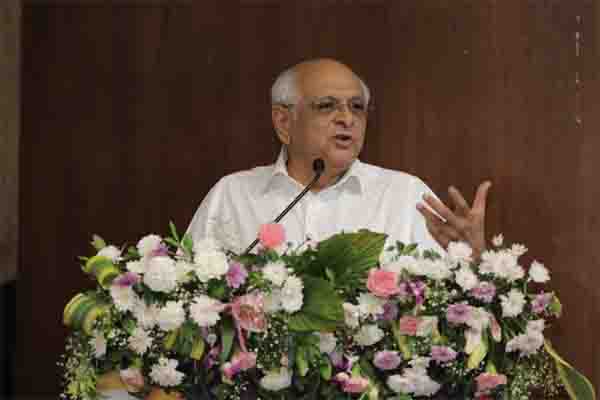
Reinforcing Gujarat’s long-standing leadership in clean and sustainable energy, Chief Minister BhupendrabhaiPatel on Wednesday launched the Gujarat Integrated Renewable Energy Policy-2025, setting the stage for the state’s next phase of green growth. The state-level launch in Gandhinagar coincided with Good Governance Day, observed nationwide on December 25 to mark the birth anniversary of former Prime Minister Atal Bihari Vajpayee, lending symbolic weight to the policy’s governance-driven approach.
The new policy reflects Gujarat’s sharpened focus on building a resilient, future-ready and investor-friendly energy ecosystem, with renewable energy, battery storage and emerging technologies at its core. Framed under the guidance of the Chief Minister and led by Energy Minister Rushikesh Patel and Minister of State Kaushik Vekariya, the policy directly addresses climate change imperatives while accelerating the transition to sustainable energy systems.
Ambition Aligned with National Climate Goals
Closely aligned with India’s Panchamrit commitments, Nationally Determined Contributions (NDCs) and the roadmap of Viksit Gujarat @2047, the RE Policy-2025 aims to position Gujarat as a globally competitive clean-energy hub. The state has set an ambitious target of surpassing 100 GW of renewable energy capacity by 2030, contributing significantly to India’s national goal of achieving 500 GW of non-fossil fuel capacity within the same timeframe.
Battery Storage Takes Centre Stage
A defining pillar of the policy is the large-scale promotion of Battery Energy Storage Systems (BESS) to enable seamless renewable energy integration and ensure grid stability. Grid-connected and co-located BESS projects alongside solar, wind and hybrid plants have been actively encouraged.
Strategic deployment of BESS for transmission support, grid ancillary services, distribution utilities and end consumers has been envisaged. Project locations will be identified by GEDA, in coordination with GETCO, SLDC and DISCOMs, ensuring a coordinated and data-driven rollout.
Reforms to Speed Up Projects and Ease Execution
To address implementation bottlenecks, the policy introduces significant relaxations in commissioning timelines, particularly for captive and third-party sale projects. Evacuation infrastructure timelines have been rationalised based on voltage levels rather than project capacity, with additional commissioning time granted to ease execution challenges.
In line with the National Repowering Policy, the RE Policy-2025 creates a supportive framework for wind repowering and refurbishment, allowing existing wind turbine generators to be upgraded without mandatory dismantling. Timelines for such projects have been extended up to 24 months, reducing downtime and costs.
Key incentives include extension of existing Power Purchase Agreements (PPAs) during the repowering phase, waiver of transmission charges on unutilised capacity, priority access to enhanced renewable connectivity and relaxation of micro-siting norms.
Technology Diversity and Investor Confidence
The policy also promotes on-demand renewable connectivity through the Akshay-Urja-Setu portal and supports new transmission projects in renewable-rich regions. Provisions enabling ownership transfer of projects approved under earlier policies, along with timeline extensions for ongoing projects, aim to ensure continuity and sustained investor confidence.
Significantly, Gujarat is expanding its clean-energy canvas by promoting emerging and innovative renewable technologies, including ocean energy, geothermal energy, concentrated solar thermal (CST), building-integrated photovoltaics (BIPV), rail and road-integrated PV, agrivoltaics and vertical-axis wind turbines. These technologies will be supported initially through pilot projects to diversify the state’s renewable portfolio.
The policy further strengthens rooftop and distributed renewable energy, encourages private sector participation and startups, and integrates employment generation and skill development initiatives within the green energy ecosystem.
Collectively, the Gujarat Integrated Renewable Energy Policy-2025 positions the state as a stable, innovation-driven and future-ready clean-energy powerhouse, reinforcing its role as a frontrunner in India’s green transition.