R ARIVANANTHAM
CHENNAI, JAN 6
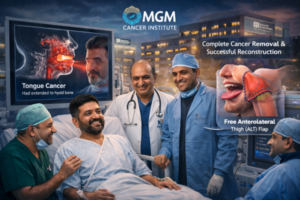
In a remarkable feat of advanced oncology and surgical precision, doctors at MGM Cancer Institute, Chennai, have successfully saved a 41-year-old man diagnosed with advanced, aggressive tongue cancer, a case previously considered inoperable by multiple hospitals due to the tumour’s extensive spread.
The patient, a chronic smoker, was diagnosed with squamous cell carcinoma of the tongue, with the tumour measuring approximately 5 × 3 cm and showing deep vertical extension. The cancer had involved the entire anterior tongue, spread to the floor of the mouth, and extended up to the hyoid bone, a critical structure in the upper neck that supports tongue movement and swallowing.
🔹 Tumour with deep vertical spread engulfed entire anterior tongue, floor of mouth and reached the hyoid bone
🔹 Case earlier deemed inoperable successfully tackled with precision multimodality cancer care
🔹 Neoadjuvant chemotherapy followed by complex composite resection and free flap reconstruction
🔹 Patient now disease-free, regains function and returns to normal life
A Tumour Once Considered Untreatable
The patient presented with a persistent ulcer and abnormal growth on the tongue, prompting detailed evaluation. A biopsy confirmed oral cancer, and a whole-body PET scan revealed extensive infiltration into deep tissues—making surgical removal extremely challenging.
“This was a highly advanced case, especially concerning given the patient’s young age,” said Dr. M.A. Raja, Director and Senior Consultant – Medical Oncology, MGM Cancer Institute.
“The tumour had deeply infiltrated vital structures, and several centres had labelled it inoperable.”
Strategic Chemotherapy Opens the Door to Surgery
After detailed deliberation, MGM’s multidisciplinary tumour board adopted an aggressive but carefully planned strategy—neoadjuvant chemotherapy to shrink the tumour and improve operability.
“Following two cycles of chemotherapy, repeat PET scans showed a good partial response,” Dr. Raja said. “This response allowed us to reassess the patient and proceed confidently with surgery.”
Complex Composite Resection and Advanced Reconstruction, a Multi-disciplinary Team Work
The patient then underwent a single, extensive composite resection surgery, led by MGM’s surgical oncology and reconstructive teams. The procedure included:
- Anterior total glossectomy (complete removal of the front portion of the tongue)
- Resection of the entire floor of the mouth
- Segmental mandibulectomy (removal of the affected portion of the jaw bone)
- Removal of the hyoid bone
Explaining the complexity, Dr. Manikandan Venkatasubramaniyan, Senior Consultant – Surgical Oncology, MGM Cancer Institute said,
“To restore form and function after such a massive resection, we performed free flap reconstruction using a Free Anterolateral Thigh (ALT) flap, transplanting healthy tissue from the patient’s left thigh to rebuild the tongue and oral cavity.”
Replying to a query, Dr Manikandan said the advanced reconstruction will make the patient to speak that can be understandable to others but his taste buds couldn’t be restored. Unbearable pain in tongue was the symptom for cancer, he added.
Precision Care, Complete Recovery
Post-surgery, the patient received adjuvant radiation therapy to eliminate any remaining microscopic cancer cells, ensuring comprehensive disease control. He has since made an excellent recovery and is currently disease-free, having returned to his routine life.
Teamwork That Redefined Possibility
“This case highlights the power of multimodality cancer care,” said Dr. Sivaram Ganesamoni, HOD and Senior Consultant – Surgical Oncology.
“What initially appeared to be an impossible clinical scenario was transformed into a success through coordinated expertise and clinical excellence.”
The multidisciplinary team included Dr. M.A. Raja, Dr. Sivaram Ganesamoni, Dr. Manikandan Venkatasubramaniyan, and Dr. A. Siva Kumar, Plastic Surgeon.
A Message of Hope
The successful outcome underscores MGM Cancer Institute’s leadership in managing advanced head and neck cancers, offering renewed hope to patients once told that treatment was not possible.
Experts stress that early evaluation of persistent oral ulcers, especially among smokers, can be life-saving—and that even advanced cancers can be conquered with the right expertise, technology and teamwork.